
China and Russia Deepen Economic Alignment — A New Eurasian Axis Expands
China and Russia are building an economic partnership that extends far beyond temporary political convenience. While Western sanctions initially accelerated this cooperation, the relationship now reflects deeper structural incentives that could reshape Eurasian power dynamics for decades. Trade volumes, energy flows, and financial coordination between Beijing and Moscow have reached levels that suggest this alignment represents more than a tactical response to external pressure.
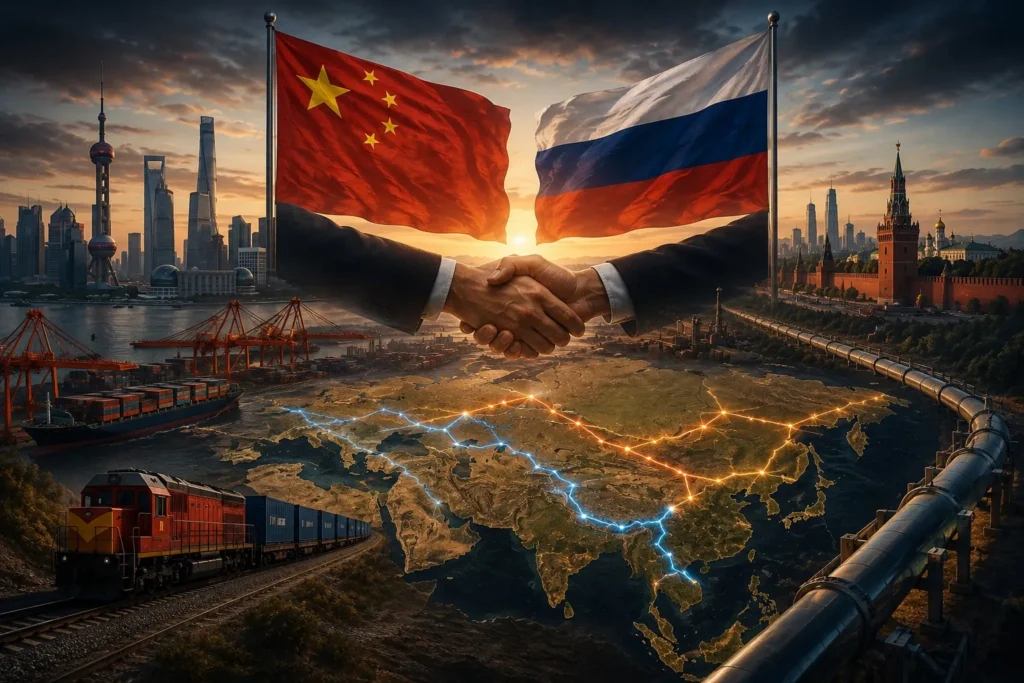
Bilateral Trade Reaches Record Levels Despite International Tensions
Economic ties between China and Russia continue expanding even as both countries face heightened scrutiny from Western allies. Bilateral trade exceeded $190 billion in 2022, representing a 30% increase from the previous year. This growth occurred despite—or perhaps because of—international sanctions and diplomatic isolation that pushed both economies toward greater interdependence.
China has become Russia’s largest trading partner, absorbing agricultural products, minerals, and manufactured goods that previously flowed to European markets. Russian imports of Chinese technology, machinery, and consumer goods have similarly increased as Western alternatives became unavailable or politically unacceptable.
Supply Chain Integration Accelerates Across Key Sectors
Manufacturing and technology cooperation has deepened significantly over the past two years. Chinese companies are filling gaps left by Western firms that exited Russian markets, while Russian suppliers provide raw materials for Chinese industrial production. This complementary relationship creates mutual dependencies that extend beyond simple trade flows.
The partnership particularly benefits Russia’s resource-rich economy and China’s manufacturing base, creating what amounts to a natural economic symbiosis between the two largest non-Western economies.
Energy Partnerships Form the Backbone of Strategic Cooperation
Resource exports continue anchoring the China-Russia economic relationship, with energy flows reaching unprecedented levels. The Power of Siberia pipeline delivers increasing volumes of natural gas to Chinese markets, while Russian oil exports to China have surged as European demand evaporated following the Ukraine conflict.
China now purchases roughly 20% of Russia’s total oil production, making it an essential outlet for Russian energy exports. This arrangement provides China with reliable energy supplies at competitive prices while giving Russia a stable customer base insulated from Western sanctions.
Long-Term Energy Contracts Cement Strategic Ties
Multi-decade energy agreements signed between the two countries create lasting economic bonds that transcend short-term political fluctuations. These contracts, valued in hundreds of billions of dollars, establish price mechanisms and delivery schedules that lock both economies into sustained cooperation.
The infrastructure required to support these energy flows—pipelines, processing facilities, and transportation networks—represents billions in sunk costs that make the partnership increasingly difficult to unwind.
Alternative Economic Systems Reduce Western Dependencies
Both countries actively develop economic mechanisms that operate independently of Western-dominated institutions. This includes everything from technology standards to academic exchanges, creating parallel systems that reduce reliance on external validation or participation.
Russia and China coordinate on developing alternative supply chains for critical technologies, semiconductors, and advanced manufacturing equipment. While these efforts remain incomplete, they represent significant progress toward economic autonomy from Western suppliers and oversight.
Infrastructure Investment Strengthens Continental Connectivity
Transportation and logistics links between the two countries are expanding rapidly through both state investment and private sector development. New rail connections, upgraded border crossings, and improved port facilities in Russia’s Far East all support increased economic integration.
The Belt and Road Initiative includes multiple projects that enhance Russia-China connectivity, from high-speed rail links to Arctic shipping routes. These infrastructure investments create permanent economic linkages that survive political changes and external pressure.
Arctic Routes Open New Trade Corridors
Russia’s Northern Sea Route increasingly serves Chinese commercial interests as Arctic ice recedes and shipping technology advances. This pathway reduces transit times for Chinese goods reaching European markets while generating transit fees for Russian authorities.
Joint development of Arctic infrastructure represents a long-term strategic investment that could reshape global shipping patterns over the coming decades.
Financial Systems Coordinate to Bypass International Restrictions
Efforts to develop alternative payment mechanisms continue expanding as both countries seek to reduce exposure to Western financial systems. The Chinese yuan now accounts for a growing share of bilateral trade settlement, while Russian banks increase their use of Chinese payment platforms.
Central bank cooperation between the People’s Bank of China and the Bank of Russia facilitates currency swaps and direct settlement mechanisms that bypass traditional correspondent banking relationships. These arrangements provide both countries with greater financial sovereignty while reducing transaction costs.
Shared Strategic Pressures Reinforce Economic Cooperation
Geopolitical competition with Western powers creates powerful incentives for sustained China-Russia cooperation that extend beyond immediate economic benefits. Both countries face similar challenges from U.S. alliance systems, technology restrictions, and diplomatic isolation efforts.
This shared strategic position makes economic cooperation a tool of broader geopolitical strategy rather than merely commercial opportunity. The partnership helps both countries demonstrate that Western economic pressure cannot force policy changes or strategic realignment.
Many analysts underestimate how durable this partnership could become. Shared strategic interests often outlast short-term disagreements, and the structural forces driving China-Russia cooperation appear stronger than the tactical considerations that historically limited their relationship.
Regional Economic Integration Creates a Eurasian Power Center
Long-term coordination between China and Russia increasingly resembles the foundation of a distinct economic bloc that could rival Western-led institutions. Combined GDP, population, and natural resources give this partnership significant global influence when the two countries coordinate their policies.
The China-Russia economic alignment attracts other countries seeking alternatives to Western-dominated trade and financial systems. Kazakhstan, Belarus, and other regional powers find themselves drawn into this expanding economic sphere through geography, necessity, or strategic calculation.
This emerging Eurasian axis represents a fundamental shift in global economic architecture. Rather than a temporary alliance of convenience, China and Russia appear to be building economic institutions and relationships designed to persist regardless of changing political circumstances or external pressure.