Global Trade Corridors Are Being Redrawn — Geography Returns to Power Politics

The global trade map is shifting beneath our feet. As supply chains buckle under geopolitical pressure and nations scramble to secure alternative routes, the world’s economic arteries are being fundamentally redesigned. What once flowed according to pure market efficiency now follows the logic of strategic security, marking a decisive return of geography to the center of power politics.

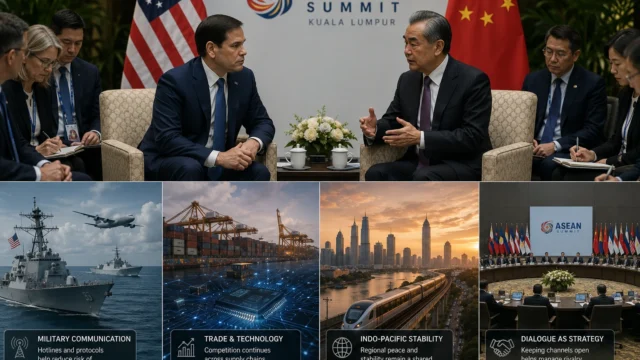
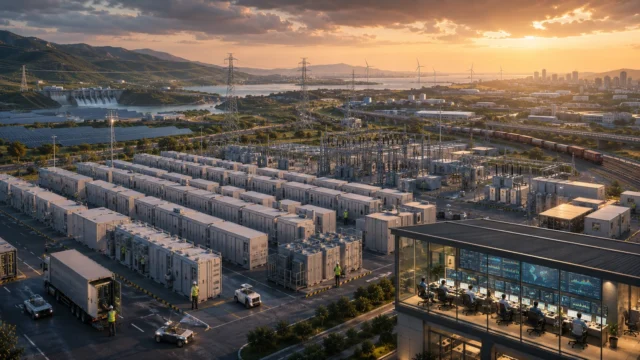
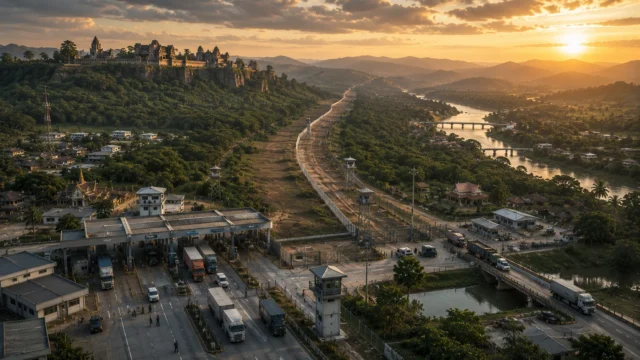
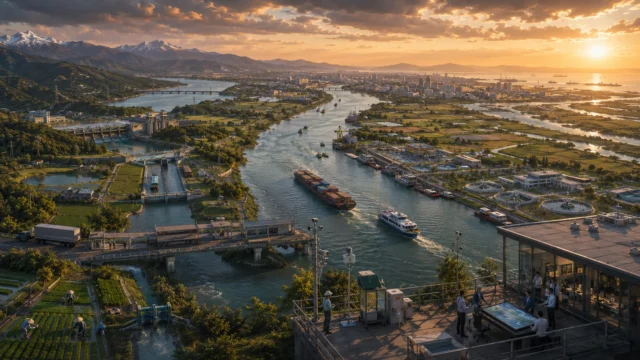
Global trade corridors, shipping routes, rail networks, and energy infrastructure illustrating the growing geopolitical importance of geography and strategic connectivity.
Trade routes, logistics hubs, and energy corridors are becoming increasingly strategic as nations reshape supply chains and adapt to a changing geopolitical landscape.

Logistics Networks Transform Into Strategic Assets

Trade routes have shed their purely commercial character. The Suez Canal’s 2021 blockage by the Ever Given revealed how a single chokepoint could paralyze global commerce, but recent developments go deeper than operational risk. Countries now view ports, shipping lanes, and rail connections as instruments of national power rather than neutral infrastructure.

China’s grip on the South China Sea shipping lanes, which carry $3.4 trillion in annual trade, exemplifies this shift. Beijing’s island-building campaign and naval expansion transform these waters into a controlled corridor where economic flows serve geopolitical ends. Similarly, Russia’s manipulation of energy pipelines through Ukraine demonstrated how infrastructure becomes weaponized when tensions rise.

Control Points Define Economic Influence

Strategic chokepoints increasingly determine who holds leverage in international commerce. The Strait of Hormuz, Suez Canal, and Malacca Strait handle roughly 60% of global maritime trade, making their control a source of outsized influence. Nations positioned along these routes find their geographic advantages translating directly into diplomatic and economic power.

New Pathways Emerge to Reduce Strategic Dependencies

Alternative corridors are rapidly taking shape as countries seek routes that bypass potential adversaries. India’s International North-South Transport Corridor aims to connect Mumbai to Moscow via Iran, cutting transit time and reducing reliance on traditional routes through the Suez Canal. The 7,200-kilometer pathway could slash shipping costs by 30% while offering strategic independence from maritime chokepoints.

The Middle Corridor through Central Asia has gained particular momentum since 2022. This route links China to Europe via Kazakhstan, Azerbaijan, Georgia, and Turkey, avoiding both Russian territory and the contested South China Sea. Container traffic through this corridor increased by 62% in 2023, reflecting urgent demand for politically neutral pathways.

Arctic Routes Open New Possibilities

Climate change unlocks previously inaccessible northern passages. Russia’s Northern Sea Route, now navigable for longer periods each year, offers a 6,000-nautical-mile shortcut between Asia and Europe. Moscow has invested heavily in icebreakers and Arctic infrastructure, positioning itself to control this emerging corridor. The route handled 34 million tons of cargo in 2023, up from virtually nothing a decade earlier.

Infrastructure Spending Accelerates to Support New Trade Patterns

Massive investment flows toward ports, railways, and energy networks that enable alternative trade routes. The European Union’s Global Gateway initiative pledges €300 billion through 2027 to build infrastructure connecting Europe with partner regions. This directly competes with China’s Belt and Road Initiative, creating parallel networks designed to serve different strategic purposes.

India’s commitment to the Chabahar Port in Iran exemplifies this infrastructure competition. New Delhi has allocated $500 million to develop the facility as its gateway to Central Asia, bypassing Pakistani territory. The port began handling significant cargo volumes in 2023, providing India with the regional connectivity it long sought.

Rail networks receive particular attention as countries seek alternatives to vulnerable sea routes. The Trans-Caspian International Transport Route, connecting China to Europe via Central Asia and the Caucasus, has seen infrastructure upgrades worth billions of dollars. Kazakhstan alone invested $2.7 billion in rail improvements in 2023 to accommodate growing east-west cargo flows.

Strategic Resilience Outweighs Pure Economic Efficiency

The calculus driving trade route selection has fundamentally changed. Where businesses once optimized purely for cost and speed, they now factor in supply chain security and geopolitical stability. This shift prioritizes resilience over efficiency, even when it means higher costs or longer transit times.

Japan’s diversification away from Chinese supply chains illustrates this new thinking. Tokyo has allocated $653 billion since 2020 to help Japanese companies relocate production to Southeast Asia and establish alternative supply networks. The economic efficiency gains from Chinese manufacturing no longer justify the strategic vulnerability of excessive dependence.

Trade corridors are increasingly about geopolitical resilience rather than simple economic efficiency. Companies now evaluate routes based on political risk assessments alongside traditional metrics like cost and delivery time. This represents a structural shift in how global commerce operates, with security considerations permanently altering economic decision-making.

Geographic Proximity Drives New Trade Partnerships

Regional trade arrangements are expanding as countries prioritize nearby partners over distant but efficient suppliers. The African Continental Free Trade Area, which began operations in 2021, aims to boost intra-African trade from its current 15% share to 25% by 2030. This reflects a broader trend toward trade regionalization driven by both security concerns and transportation costs.

Mexico’s emergence as a manufacturing hub for the U.S. market demonstrates nearshoring in action. Mexican exports to the United States reached $475 billion in 2023, making it America’s largest trading partner. Geographic proximity provides both cost advantages and strategic security that distant suppliers cannot match.

The ASEAN economic community has similarly strengthened internal trade links. Intra-ASEAN trade reached $718 billion in 2023, representing 22% of the bloc’s total trade. This regional focus reduces dependence on external supply chains while building economic ties that reinforce diplomatic cooperation.

Businesses and Governments Pursue Supply Chain Flexibility

Supply chain diversification has become a strategic imperative rather than a business optimization. Companies are deliberately building redundancy into their logistics networks, accepting higher costs in exchange for reduced vulnerability to disruption. This marks a reversal of decades-long trends toward lean, just-in-time supply chains.

The semiconductor industry leads this transformation. After experiencing severe shortages during the pandemic, major chip companies are establishing production facilities across multiple continents. Taiwan Semiconductor Manufacturing Company is building fabs in Arizona and Japan, while Samsung expands in Texas and South Korea simultaneously.

Governments actively support this diversification through subsidies and policy incentives. The U.S. CHIPS Act provides $52 billion to bring semiconductor manufacturing home, while the European Union’s Chips Act offers similar support for local production. These initiatives explicitly prioritize strategic autonomy over market efficiency.

Physical Geography Reclaims Its Role in Economic Strategy

The digital age promised to make geography irrelevant, but current trends suggest the opposite. Physical routes, natural barriers, and geographic chokepoints once again shape economic influence and national power. In my view, future economic influence will depend not only on production capacity but also on control over strategic connectivity routes.

This geographic renaissance reflects deeper changes in international relations. As great power competition intensifies, countries recognize that economic interdependence can become a vulnerability rather than an asset. Nations with favorable geographic positions—whether controlling key straits, offering overland alternatives, or providing secure harbors—find their advantages magnified in this new environment.

The redrawing of global trade corridors represents more than logistical adjustment; it signals a fundamental realignment of economic power. Geography’s return to strategic prominence means that location, routes, and physical infrastructure will determine which nations prosper in an increasingly fragmented global economy.