
BRICS Faces a Critical Test — Expansion Brings Both Power and Complexity
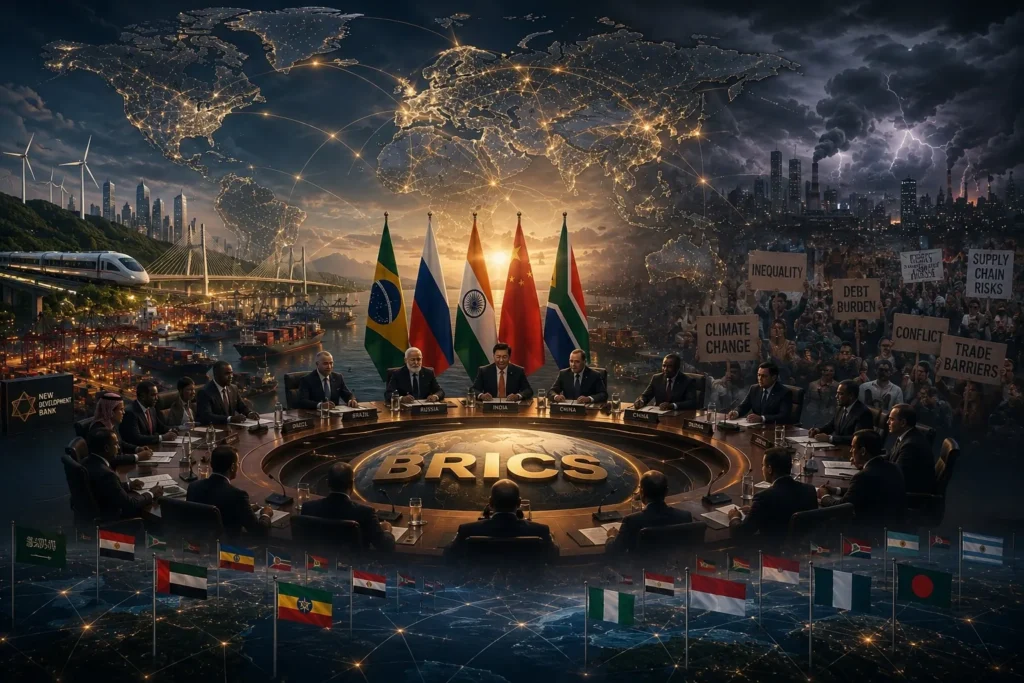
The BRICS bloc stands at a crossroads as it welcomes new members and contemplates further expansion. What began as an economic cooperation framework among Brazil, Russia, India, China, and South Africa has evolved into a geopolitical force attracting nations seeking alternatives to Western-dominated institutions. Yet as BRICS faces a critical test, expansion brings both power and complexity that could determine whether this alliance becomes a lasting pillar of multipolarity or fractures under the weight of competing national interests.
The January 2024 admission of Egypt, Ethiopia, Iran, Saudi Arabia, and the UAE marked the bloc’s most significant expansion since South Africa joined in 2010. This growth reflects BRICS’ increasing appeal, but also introduces new layers of strategic complexity that test the organization’s ability to maintain coherent direction.
BRICS Attracts Growing Interest from Emerging Powers
The bloc’s expansion momentum shows no signs of slowing. Over 40 countries have expressed interest in joining or strengthening ties with BRICS, according to Russian officials. Nations from Southeast Asia, Africa, and Latin America view membership as an opportunity to diversify their diplomatic and economic partnerships beyond traditional Western frameworks.
This appeal stems partly from BRICS’ emphasis on sovereignty and non-interference, principles that resonate with countries seeking to avoid conditional aid or political pressure often associated with Western institutions. The bloc’s focus on South-South cooperation and alternative financial mechanisms, including plans for a common currency for trade settlements, offers practical benefits for emerging economies.
New Members Bring Strategic Assets
The latest additions strengthen BRICS’ global footprint significantly. Saudi Arabia and the UAE contribute energy resources and financial capital, while Egypt provides geographic connectivity between Africa and the Middle East. Ethiopia represents Africa’s second-largest population, and Iran brings energy reserves alongside strategic positioning in the Middle East. These additions expand BRICS’ collective GDP and enhance its representation across key regions.
Diverse National Priorities Create Internal Tensions
The enlarged BRICS faces the challenge of reconciling increasingly diverse strategic objectives. While all members share a desire to reshape global governance structures, their specific priorities often diverge in practice.
China’s Belt and Road Initiative sometimes competes with Indian infrastructure projects in the same regions. Russia’s confrontational stance toward the West contrasts with Brazil’s preference for pragmatic engagement. Saudi Arabia’s security concerns about Iran now exist within the same institutional framework, creating potential friction points that could complicate consensus-building.
These differences became apparent during recent discussions about BRICS payment systems and trade mechanisms. While members agree on reducing dollar dependence in principle, they disagree on implementation details, including which national currencies should play larger roles in intra-BRICS trade.
Economic Integration Faces Structural Obstacles
BRICS members operate under fundamentally different economic models, complicating efforts to deepen integration. China’s state-directed capitalism contrasts sharply with India’s mixed economy and Brazil’s market-oriented approach. These structural differences affect everything from trade negotiations to financial coordination.
The New Development Bank, BRICS’ flagship financial institution, illustrates these challenges. While the bank has approved over $30 billion in projects since 2015, it struggles to match the scale and speed of Chinese bilateral lending or established multilateral institutions. Members disagree on lending priorities, with some favoring infrastructure development while others emphasize social programs or environmental projects.
Trade Patterns Remain Asymmetric
Despite efforts to boost intra-BRICS commerce, trade patterns remain heavily skewed toward China. Beijing accounts for roughly 70% of total BRICS GDP and dominates trade flows within the bloc. This asymmetry creates concerns about Chinese economic dominance that mirror broader global discussions about Beijing’s growing influence.
BRICS Gains Momentum in Global Governance
The bloc’s expanded membership enhances its voice in international forums. BRICS countries now represent over 40% of global population and roughly 35% of world GDP when measured by purchasing power parity. This scale gives the group significant leverage in discussions about international monetary systems, climate policy, and global trade rules.
Recent BRICS statements on Ukraine, Middle East conflicts, and global economic governance demonstrate the bloc’s ambition to offer alternative perspectives on major international issues. While these positions don’t always achieve unanimous support from all members, they signal BRICS’ intent to challenge Western policy dominance in multilateral settings.
The group’s advocacy for UN Security Council reform and increased representation for developing nations in international financial institutions reflects this broader agenda of reshaping global governance structures.
Multipolar Trends Support BRICS Expansion
The shifting global order creates favorable conditions for BRICS growth. Many middle powers increasingly prefer hedging strategies over exclusive alignment with any single great power. This trend benefits organizations like BRICS that offer platforms for cooperation without demanding exclusive loyalty.
Recent geopolitical developments, including Western sanctions on Russia and growing US-China competition, accelerate these multipolar dynamics. Countries seek options that reduce their vulnerability to economic pressure from any single bloc, making BRICS membership more attractive as a form of strategic insurance.
China and India Shape the Bloc’s Direction
Leadership dynamics within BRICS increasingly center on the China-India relationship. As the bloc’s two largest economies, their cooperation or competition significantly influences BRICS effectiveness. Recent border tensions and strategic rivalry complicate their collaboration, yet both recognize that BRICS offers a valuable platform for advancing shared interests in global governance reform.
Russia, despite its diplomatic isolation from the West, maintains significant influence within BRICS due to its energy resources and permanent Security Council seat. Brazil and South Africa provide regional leadership and democratic legitimacy, while new members bring additional resources and geographic representation.
Internal Cohesion Will Determine BRICS Future
The bloc’s long-term success depends on resolving the fundamental tension between expansion and coherence. BRICS faces a critical test in demonstrating that diverse developing nations can sustain effective cooperation without the institutional frameworks and shared values that bind traditional alliances.
In my view, BRICS’ biggest challenge is not growth—it is cohesion. The bloc’s future influence will depend on whether members can align strategic interests over the long term. Success requires developing institutional mechanisms that manage disagreements while maintaining forward momentum on shared priorities. The coming years will reveal whether BRICS can evolve from an aspirational grouping into an effective platform for reshaping global governance, or whether internal contradictions will limit its impact despite impressive membership growth.