
Export Controls Escalate the AI Race — Technology Restrictions Reshape Competition
The global race for artificial intelligence supremacy has entered a new phase where state policy, not market forces, increasingly determines who gets access to cutting-edge technology. Export controls on semiconductors, AI software, and related technologies are fundamentally altering how nations compete in the digital age, transforming innovation from a market-driven process into a geopolitical competition shaped by state intervention. These restrictions carry strategic consequences that extend far beyond immediate trade impacts, reshaping the entire landscape of technological development.
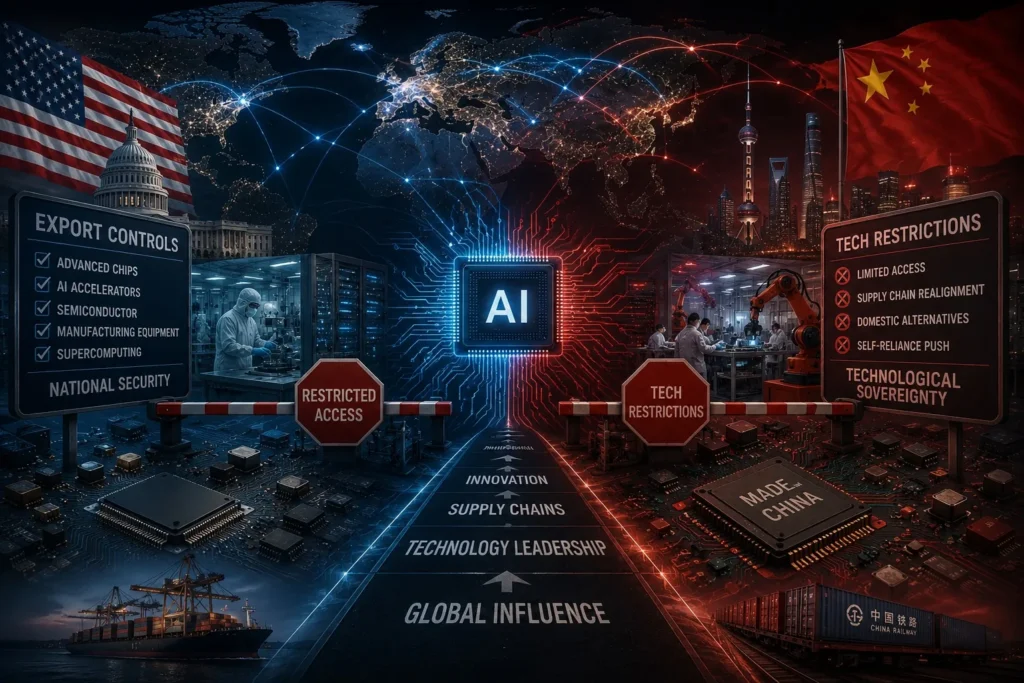
Advanced Technology Export Restrictions Tighten Worldwide
Governments across major economies are implementing increasingly sophisticated export control regimes targeting AI-related technologies. The United States has led this trend with sweeping restrictions on semiconductor exports to China, particularly focusing on chips capable of training large AI models. These measures, announced in October 2022 and expanded multiple times since, target not just finished products but also the manufacturing equipment and technical expertise needed to produce advanced semiconductors.
The European Union and allied nations have followed suit, coordinating their own export restrictions to prevent circumvention of U.S. controls. Japan and the Netherlands agreed in 2023 to restrict exports of chipmaking equipment, creating a multilateral framework that effectively limits China’s access to the most advanced semiconductor production tools. These coordinated efforts represent a significant shift from previous trade policies that generally favored open technology flows between developed economies.
Restrictions Target Both Hardware and Software Components
Export controls now extend beyond physical components to include AI software, algorithms, and technical data. The U.S. Commerce Department has expanded its Entity List to include dozens of Chinese AI companies, effectively cutting them off from American technology suppliers. Software restrictions cover everything from chip design tools to AI development frameworks, creating barriers that are often more difficult to circumvent than hardware limitations.
Semiconductor Access Becomes Central to Strategic Competition
Advanced semiconductors have emerged as the primary battleground in technological competition, with access to cutting-edge chips determining a nation’s AI capabilities. The most sophisticated AI models require specialized processors that only a handful of companies can manufacture, making semiconductor access a critical chokepoint in AI development.
TSMC, Samsung, and Intel control the production of the most advanced chips, giving the governments that influence these companies significant leverage over global AI development. The concentration of advanced chip production in Taiwan and South Korea adds another layer of geopolitical complexity, as these locations become strategically vital for maintaining technological competitiveness.
China’s efforts to develop domestic semiconductor capabilities have accelerated in response to these restrictions, but the technical complexity and capital requirements of advanced chip production present substantial challenges. Building a competitive semiconductor industry requires not just manufacturing facilities but entire ecosystems of suppliers, skilled workers, and supporting technologies that take decades to develop.
Domestic Innovation Programs Receive Increased Investment
Export controls are driving unprecedented government investment in domestic technology development. The U.S. CHIPS and Science Act allocated $52 billion for semiconductor manufacturing and research, while China has committed over $100 billion to its domestic chip industry through various state-backed funds. These investments represent a fundamental shift toward state-directed technology development.
Research institutions and universities are receiving increased funding to develop AI technologies independently of international supply chains. National laboratories and defense contractors are playing larger roles in AI research, moving development away from purely commercial applications toward strategic national priorities.
Public-Private Partnerships Reshape Innovation Models
Government agencies are forming new partnerships with technology companies to accelerate domestic capabilities while reducing dependence on foreign suppliers. These collaborations often involve sharing research costs, providing guaranteed markets for emerging technologies, and coordinating development priorities between public and private sectors.
Global Technology Supply Chains Fragment Along Geopolitical Lines
The integrated global technology ecosystem that defined the past three decades is splitting into separate, competing networks. Companies are restructuring their supply chains to comply with export restrictions, often creating parallel production systems for different markets.
Technology companies now face complex decisions about which markets to prioritize when regulatory requirements conflict. Some firms are choosing to exit certain markets entirely rather than navigate competing regulatory frameworks, while others are developing separate product lines for different geopolitical blocs.
This fragmentation extends to research and development, with international collaborations becoming more difficult as governments restrict information sharing in sensitive technology areas. Academic partnerships, conference participation, and joint research projects all face new scrutiny and limitations.
International Trade Tensions Intensify Over Technology Access
Export controls are generating new forms of international disputes as affected nations challenge restrictions through various channels. China has filed complaints with the World Trade Organization regarding semiconductor export controls, while also implementing its own retaliatory measures on critical minerals and other strategic materials.
Legal challenges are emerging in domestic courts as companies affected by export restrictions seek relief from regulations they argue exceed government authority or violate international trade agreements. These cases are creating new precedents for how technology trade disputes are resolved in an era of strategic competition.
The traditional mechanisms for resolving trade disputes are proving inadequate for addressing technology restrictions justified on national security grounds, leading to a more confrontational approach to international economic relations.
AI Development Paths Diverge Based on Technology Access
Restrictions on technology access are creating different development trajectories for AI systems in different regions. Countries with limited access to advanced semiconductors are focusing on more efficient algorithms and specialized applications that require less computational power.
Innovation patterns are shifting as developers work within the constraints imposed by available technology. This is leading to diverse approaches to AI development, with some regions emphasizing efficiency and others focusing on scale and raw computational power.
The long-term implications of these divergent development paths remain uncertain. Export controls may slow competitors in the short term, but they also encourage long-term self-reliance that creates strategic consequences that are difficult to predict.
Technology Policy Emerges as Primary Tool of Strategic Competition
Export controls represent the transformation of technology policy into a central instrument of geopolitical strategy. Governments are using access to advanced technology as leverage in broader strategic competitions, moving beyond traditional diplomatic and economic tools.
This shift requires new institutional capabilities within government agencies, as technology policy decisions now carry significant strategic implications. Trade agencies, national security organizations, and technology regulators must coordinate more closely as their decisions increasingly overlap.
The precedent being set by current export controls is likely to influence how future technologies are governed, potentially creating a world where technological development is permanently shaped by geopolitical considerations rather than purely market forces.