
The Global Order Enters a New Phase — Strategic Competition Replaces Stability
The decades-long era of relative international stability is ending. What once resembled a predictable system anchored by clear power centers now displays the characteristics of sustained strategic competition across multiple domains. From AI development races to critical mineral supply chains, from military buildups in the South China Sea to the reconfiguration of global trade routes, seemingly disparate developments reflect a fundamental shift toward multipolarity where competition, not cooperation, defines the baseline state of international relations.
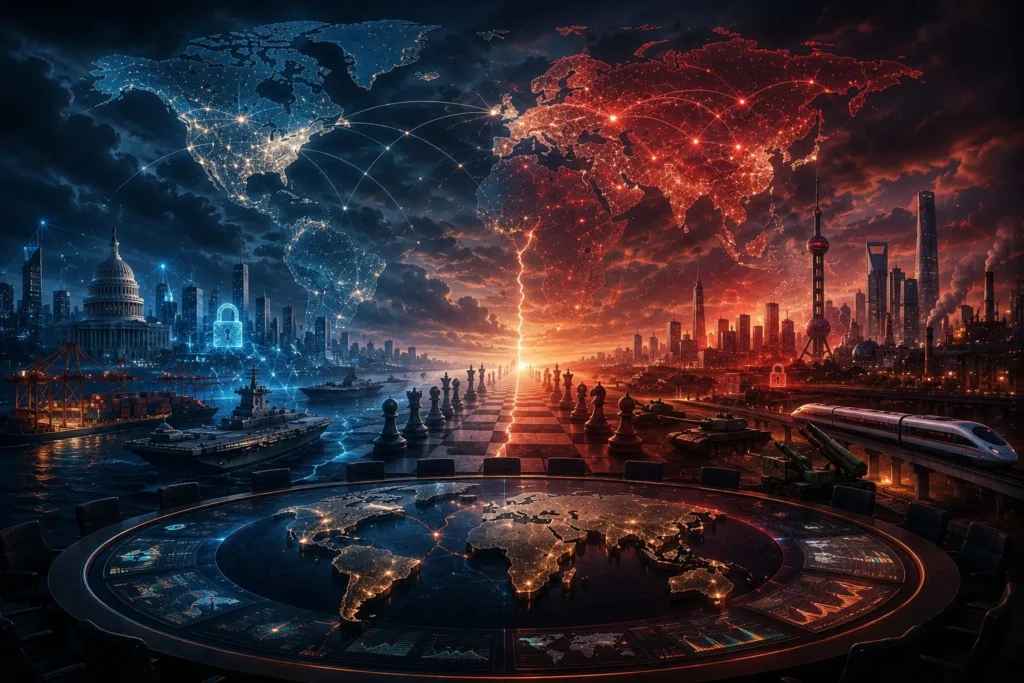
Major Powers Expand Influence Across Multiple Theaters
The clearest evidence of this transformation lies in how major and middle powers simultaneously pursue influence operations across distant regions. China’s Belt and Road Initiative now spans over 140 countries while also investing heavily in Latin American infrastructure and African ports. Russia maintains military presence from Syria to the Central African Republic while expanding economic partnerships across Asia and Africa.
The United States responds through initiatives like the Indo-Pacific Economic Framework and renewed engagement with African partners through programs like Prosper Africa. European powers pursue their own strategic autonomy through critical raw materials partnerships with Latin American and African nations. India leverages its position through the Quad partnership while simultaneously maintaining energy relationships with Russia and expanding trade with Iran.
Middle Powers Assert Independent Strategic Priorities
Turkey exemplifies this trend by maintaining NATO membership while purchasing Russian S-400 systems and mediating between Ukraine and Russia. Saudi Arabia balances security partnerships with Washington against economic cooperation with Beijing and energy coordination with Moscow. Brazil pursues deeper ties with China while maintaining traditional Western partnerships.
These patterns reveal how power projection has become simultaneously more distributed and more competitive, with multiple actors pursuing overlapping spheres of influence rather than accepting defined zones of control.
Economic Resilience Overtakes Pure Efficiency
Countries across the spectrum now prioritize supply chain security over cost optimization. The semiconductor shortage of 2021-2022 accelerated this shift, but the pattern extends far beyond chips. Critical mineral supply chains, pharmaceutical production, and food security have all become matters of national strategy rather than market optimization.
The United States allocated $52 billion through the CHIPS and Science Act to rebuild domestic semiconductor manufacturing. China announced its 14th Five-Year Plan emphasizing self-reliance in key technologies. The European Union launched the Critical Raw Materials Act to reduce dependence on single suppliers for lithium, rare earths, and other strategic materials.
Japan diversified its energy suppliers following the 2022 energy crisis, while Germany accelerated plans to reduce industrial dependence on Russian gas. These decisions reflect a fundamental recalculation: short-term efficiency gains cannot justify long-term strategic vulnerabilities.
Technology and Critical Resources Shape Power Competition
Control over artificial intelligence development, quantum computing capabilities, and critical mineral extraction increasingly determines geopolitical influence. The race for AI supremacy between the United States and China involves not just technological development but also alliance-building around AI governance standards and export controls on advanced semiconductors.
Lithium extraction rights in Latin America, rare earth processing capabilities, and advanced battery manufacturing have become sources of competitive advantage. Countries with abundant critical minerals—from Indonesia’s nickel to the Democratic Republic of Congo’s cobalt—find themselves courted by multiple major powers offering infrastructure investments and technology transfers.
Strategic Sectors Become Geopolitical Tools
Energy infrastructure projects now carry explicit strategic calculations. The Nord Stream pipeline destruction eliminated a key element of Russian leverage over European energy security. China’s investments in global port infrastructure through companies like COSCO create potential dual-use capabilities. Advanced manufacturing capabilities in sectors like electric vehicle batteries determine both economic competitiveness and strategic autonomy.
Alliance Structures Become More Fluid and Purpose-Built
Traditional bloc alignments are giving way to flexible partnership arrangements focused on specific challenges rather than comprehensive alignment. The AUKUS partnership between Australia, the United Kingdom, and the United States targets advanced military technology sharing. The Quad brings together democracies focused on Indo-Pacific security without requiring broader policy coordination.
Meanwhile, China and Russia deepen their “no limits” partnership while both maintain separate relationships with Iran, North Korea, and other partners. The Shanghai Cooperation Organization provides a forum for Eurasian cooperation without demanding exclusive alignment.
Even NATO members pursue independent policies on key issues. France maintains strategic autonomy concepts while remaining committed to collective defense. Turkey pursues relationships that conflict with broader alliance priorities while remaining strategically valuable to NATO.
Power Distribution Accelerates Across More Actors
The concentration of global power in a small number of capitals continues to erode. Regional powers like Indonesia, Nigeria, and Mexico wield increasing influence in their respective regions while maintaining strategic flexibility globally. Middle powers form coalitions around specific issues without accepting permanent hierarchies.
Economic power follows similar patterns. China’s economy rivals the United States in purchasing power terms while the European Union maintains the world’s largest single market. India’s economy continues rapid growth while Southeast Asian nations collectively represent a major economic bloc.
Military capabilities spread beyond traditional powers as countries develop asymmetric capabilities, cyber warfare capacities, and advanced missile systems. Iran’s drone technology, Ukraine’s defensive innovations, and Israel’s precision strike capabilities demonstrate how military advantages no longer correlate directly with overall power rankings.
Existing Institutions Struggle With Changing Power Realities
International institutions designed for a different era face mounting pressure to adapt or risk irrelevance. The UN Security Council’s permanent membership reflects 1945 power distributions rather than contemporary realities. The World Trade Organization operates with rules designed for an era of assumed shared commitment to open markets.
The International Monetary Fund and World Bank compete with new institutions like the Asian Infrastructure Investment Bank and BRICS expansion initiatives. Regional organizations like the African Union, ASEAN, and the Organization of American States play larger roles in addressing local challenges while global institutions deadlock.
Climate change coordination reveals both the necessity and difficulty of institutional adaptation. The Paris Agreement framework enables progress despite great power competition, but implementation remains constrained by competing national priorities and mistrust between major powers.
A More Competitive International System Takes Shape
The emerging international order resembles a return to great power competition rather than evolution toward deeper cooperation. Multiple centers of power pursue competing visions of global governance while maintaining enough interdependence to prevent complete fragmentation.
This system rewards strategic flexibility over rigid alignment, competitive advantage over cooperative optimization, and resilience over efficiency. Many seemingly separate developments—AI competition, resource security concerns, military expansion, and trade route diversification—represent connected symptoms of the same fundamental transition.
The defining challenge of the next decade involves managing a world where power remains distributed across multiple actors, competition operates as the default state between major powers, and stability requires active management rather than institutional momentum. Success in this environment demands understanding that strategic competition has replaced stability as the organizing principle of international relations.