
Undersea Cables Become Strategic Targets — The Hidden Infrastructure Powering the World
When Russian naval activity near critical undersea cable routes increased in 2023, governments worldwide began paying attention to infrastructure most people never think about. These fiber-optic cables, stretching across ocean floors like a vast nervous system, carry more than emails and video calls. They support financial transactions worth trillions of dollars, enable cloud services that power modern business, and facilitate military communications that nations depend on for security.
The modern economy relies on infrastructure that remains largely invisible to the public. Yet as digital dependence grows and geopolitical tensions rise, undersea cables become strategic targets that could reshape how power operates in an interconnected world.
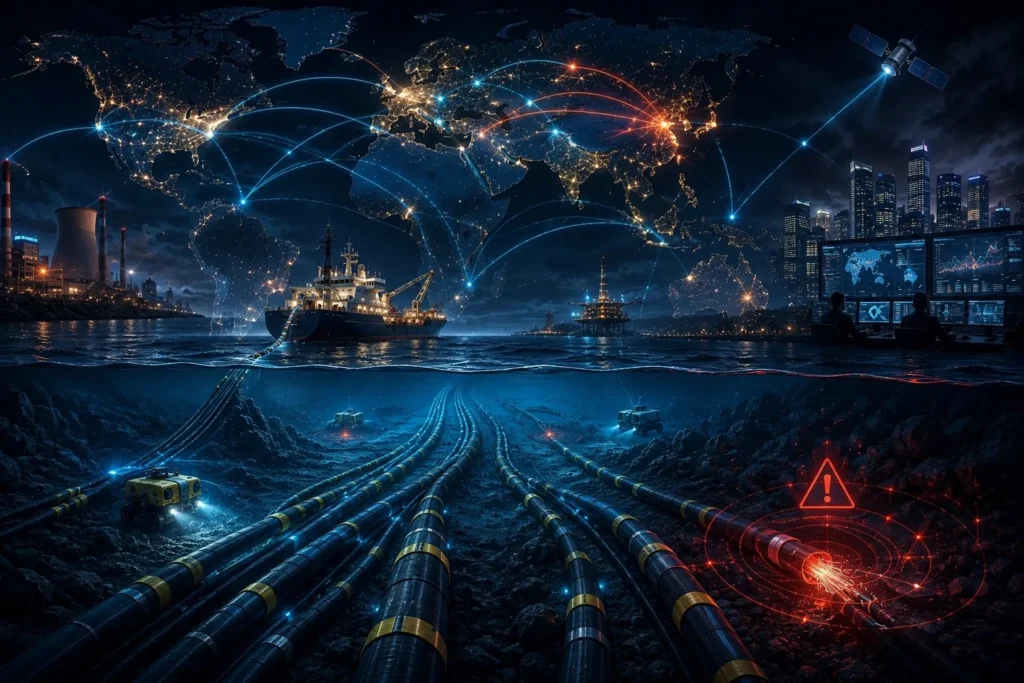
The Ocean Floor Carries Nearly All Global Internet Traffic
More than 95% of international internet traffic travels through submarine cable networks spanning over 400 routes worldwide. Unlike satellites, which handle less than 5% of global data transmission, these physical cables offer the speed and capacity that modern digital commerce requires.
A single cable can carry terabits of data per second, connecting financial markets in New York to trading floors in London within milliseconds. When the SEA-ME-WE 3 cable experienced cuts in 2008, internet speeds dropped by up to 60% across parts of the Middle East and South Asia, demonstrating how regional economies depend on these connections.
The Infrastructure Behind Digital Globalization
Each cable represents a significant investment, often costing $300 million to $500 million per route. Private companies like Google, Meta, and Amazon now fund many new installations, shifting control away from traditional telecommunications firms. This corporate involvement adds complexity to what was once primarily a matter of national infrastructure policy.
The cables themselves are surprisingly thin—about the width of a garden hose—yet they carry the data that enables everything from international banking to supply chain coordination. Their placement requires careful navigation around shipping routes, fishing areas, and existing infrastructure, making each new cable a complex logistical undertaking.
Intelligence Agencies Focus on Cable Vulnerability
Countries are implementing new monitoring systems and security protocols around cable infrastructure. The United States established the Committee for the Assessment of Foreign Participation in the United States Telecommunications Services Sector in 2020, specifically to evaluate risks to submarine cable systems.
European nations have similarly increased oversight. The UK’s National Cyber Security Centre now provides guidance on cable security, while Nordic countries coordinate monitoring after suspected interference near their territorial waters. These efforts reflect growing recognition that cable networks represent critical vulnerabilities that adversaries might exploit.
Equipment Failures and Accidents Create Broader Risks
Ship anchors cause roughly 60% of cable disruptions, usually by accident rather than hostile intent. When the Ever Given blocked the Suez Canal in 2021, backup traffic routed through alternative cables, but the incident highlighted how physical chokepoints can cascade into digital disruption.
Submarine earthquakes present another risk factor. The 2006 Hengchun earthquake off Taiwan severed multiple cables simultaneously, cutting internet connectivity across much of Asia for weeks. Financial markets, shipping coordination, and government communications all experienced significant delays as data rerouted through congested alternative paths.
Natural Disasters Expose System Dependencies
These disruptions reveal how seemingly redundant networks can fail together under stress. Cable routes often follow similar paths due to geographical constraints, meaning single events can affect multiple connections. The concentration of cables near major landing points creates additional vulnerability, as damage at these facilities can impact several networks simultaneously.
Recovery operations require specialized ships and equipment available from only a few companies worldwide. Repair times typically range from days to weeks, depending on water depth and weather conditions, leaving affected regions dependent on satellite backup systems with limited capacity.
Military Planners View Cables as Strategic Assets
Defense establishments now treat communication infrastructure as essential to national security planning. Russia’s development of specialized submarines capable of operating near cable routes has prompted NATO countries to enhance underwater surveillance capabilities.
China’s involvement in cable projects through state-linked companies raises similar concerns for Western policymakers. The firm that controls cable infrastructure can potentially monitor data flows, creating intelligence gathering opportunities that traditional espionage methods cannot match.
New Doctrines Emerge Around Information Warfare
Military thinking increasingly incorporates cable networks into conflict scenarios. Severing an opponent’s international communications could impair their financial system, disrupt government coordination, and isolate their economy from global markets—all without conventional weapons.
This recognition has led to new investment in cable protection capabilities. Several navies have acquired underwater drones designed to patrol cable routes, while some countries are developing rapid repair capabilities to restore connections quickly after disruption.
Companies and Governments Pursue Network Redundancy
Tech giants are investing heavily in alternative routes and backup systems. Google’s Curie cable connects California directly to Chile, bypassing traditional routes through Panama. Amazon’s planned cross-Pacific cables will provide dedicated capacity for its cloud services, reducing dependence on shared infrastructure.
Government initiatives follow similar logic. The EU’s Digital Compass strategy includes provisions for diverse cable routes that avoid potential chokepoints. Australia and Japan have partnered on new Pacific connections that offer alternatives to cables transiting through areas of Chinese influence.
Private Investment Reshapes Global Connectivity
Corporate cable investments now exceed traditional telecommunications spending, fundamentally changing how global communications develop. These private networks prioritize the specific needs of cloud computing and content delivery over general internet access, creating a two-tier system of international connectivity.
Smaller nations often find themselves dependent on routes chosen by major technology companies rather than their own strategic preferences. This dynamic concentrates decision-making power among a few large corporations while potentially leaving some regions with limited connectivity options.
Technology Competition Extends to Ocean Infrastructure
Communication infrastructure increasingly influences broader geopolitical competition between major powers. Control over cable networks provides both economic advantages and potential leverage over other nations’ digital access.
The physical nature of cable networks means that geography still matters in an age of digital globalization. Countries with favorable positions along major routes—such as Egypt with the Suez Canal or Singapore with Asian traffic—gain strategic value that pure technological capability cannot replicate.
In many ways, undersea cables represent one of the most underestimated geopolitical assets in the contemporary world. While public discussion focuses on satellites and cyber attacks, the majority of critical data transmission continues to rely on physical infrastructure beneath the ocean surface. As digital dependence deepens across all sectors of society, these networks will likely assume an even more central role in national security calculations.
Hidden Networks Shape Surface Politics
What happens beneath the ocean increasingly affects what happens above it. Cable disruptions can trigger financial volatility, complicate military operations, and isolate entire regions from global communication networks. Yet this infrastructure remains largely outside public awareness, managed by a combination of private companies and government agencies with varying levels of coordination.
The strategic implications extend beyond immediate connectivity concerns. Nations that control cable manufacturing, installation capabilities, and repair facilities hold significant leverage over global communications architecture. This technological dependence creates new forms of vulnerability that traditional security planning has not fully addressed.
As international tensions continue to rise, the invisible networks carrying the world’s data face growing pressure from both deliberate interference and systemic fragility. The question is not whether these systems will face future disruption, but whether governments and companies can develop adequate protection and redundancy before critical failures occur.