
Population Decline Becomes a Strategic Challenge — Demographics Reshape Global Power
Japan’s workforce shrank by 600,000 people in 2023 alone. South Korea’s fertility rate hit a record low of 0.78 births per woman. Germany recorded more deaths than births for the eighth consecutive year. These numbers represent more than statistical trends—they signal a fundamental shift in how nations compete for influence and maintain their position in the global order.
Demographics change slowly, which makes them easy to ignore in the daily churn of political analysis. Yet population trends influence nearly every aspect of national power, from economic growth and labor markets to military capacity and social stability. Unlike economic downturns that can reverse within a few years, demographic decline creates challenges that persist for decades and resist quick policy fixes.
Rising Healthcare and Pension Costs Strain National Budgets
Countries with aging populations face mounting financial pressure as healthcare expenses climb and pension obligations expand. Japan allocates roughly 40% of its national budget to social security, up from 20% in the 1990s. Italy spends nearly 16% of GDP on pensions alone—among the highest rates globally.
These costs create a fiscal squeeze that limits government flexibility. Resources that might otherwise fund infrastructure, defense, or research and development instead flow toward eldercare and retirement benefits. Germany projects that its statutory pension contributions will need to rise from 18.6% of wages today to over 22% by 2040 to maintain current benefit levels.
Competing Budget Priorities Emerge
The financial strain forces difficult tradeoffs. South Korea increased its defense spending by 4.6% in 2024, yet analysts question whether such increases can be sustained as the country’s over-65 population is expected to double by 2050. Similar tensions appear across developed economies, where aging demographics push governments to choose between maintaining social benefits and investing in future competitiveness.
Shrinking Workforces Undermine Economic Potential
Declining working-age populations create structural headwinds for economic growth. China’s working-age population peaked in 2012 and has since contracted by roughly 50 million people. This demographic shift coincides with slower GDP growth rates, though multiple factors contribute to China’s economic deceleration.
Labor shortages appear across sectors and skill levels. Germany reported over 2 million job vacancies in 2023, with particularly acute gaps in healthcare, engineering, and skilled trades. Japan’s construction industry faces worker shortages that delay infrastructure projects and drive up costs.
Innovation and Productivity Face New Pressures
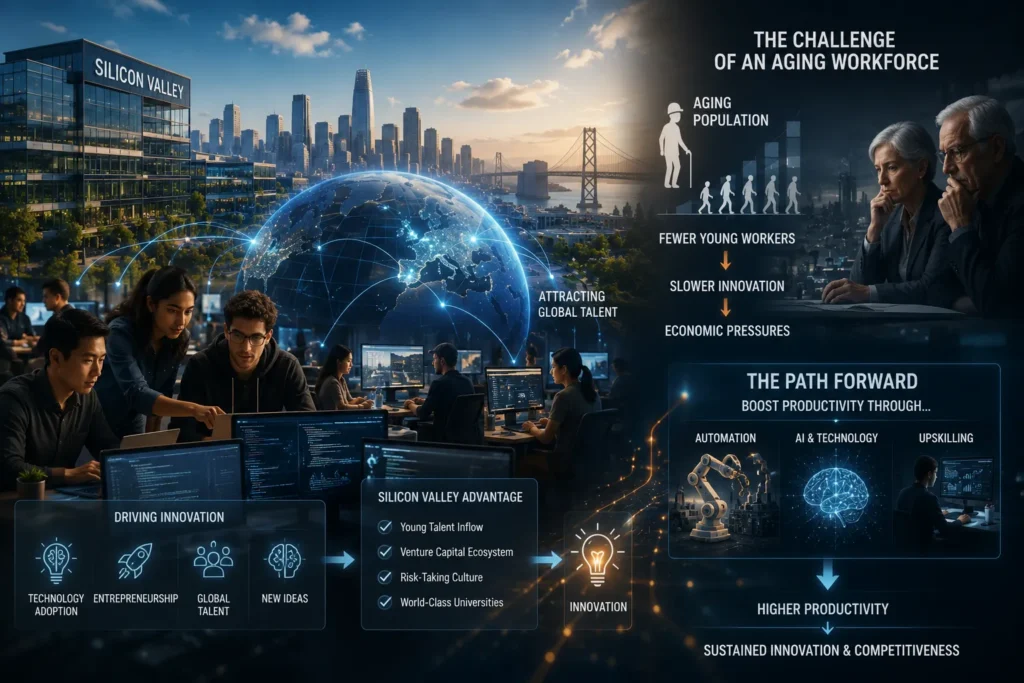
Younger workers often drive technological adoption and entrepreneurial activity. Countries with aging workforces may struggle to maintain their innovative edge unless they significantly boost productivity through automation or other means. Silicon Valley’s dominance partly reflects America’s ability to attract young talent from around the world, compensating for domestic demographic trends.
Migration Policy Becomes a Tool of National Strategy
Governments increasingly view immigration as essential for maintaining economic vitality and demographic balance. Canada targets 1.45 million new permanent residents between 2024 and 2026, explicitly citing workforce needs and demographic goals. Australia’s migration program similarly prioritizes skilled workers in sectors facing shortages.
This strategic approach to migration creates new forms of international competition. Countries vie for the same pool of educated, working-age migrants. Germany streamlined its skilled worker visa process in 2023, while the UK launched a “high potential individual” visa targeting graduates from top universities worldwide.
Brain Drain Accelerates Regional Disparities
Migration flows often favor wealthy nations with established immigrant communities and strong economies. Eastern European countries lose population to Western Europe, while parts of Africa and Asia see their most educated citizens depart for better opportunities elsewhere. These patterns can accelerate regional power shifts over time.
Military Recruitment Confronts Demographic Reality
Armed forces recruitment becomes more challenging as the pool of military-age citizens shrinks. The U.S. Army missed its recruitment targets in 2023, citing multiple factors including a competitive job market and declining interest among eligible youth. European NATO members face similar pressures as their populations age.
South Korea reduced mandatory military service from 24 to 18 months partly due to demographic pressures, while also increasing defense automation and exploring greater integration of women in combat roles. These adaptations reflect broader adjustments militaries must make as traditional recruitment pools contract.
Innovation and Growth Face Demographic Headwinds
Economic competitiveness depends heavily on maintaining a dynamic, skilled workforce. Countries with declining and aging populations may find it harder to sustain the human capital necessary for technological leadership and economic growth. Research suggests that regions with younger populations often demonstrate higher rates of entrepreneurship and business formation.
The semiconductor industry illustrates these challenges. Taiwan, South Korea, and Japan dominate chip manufacturing but all face demographic decline. Their ability to maintain technological leadership may depend on attracting foreign talent and investing heavily in automation to offset workforce constraints.
Younger Populations Create Strategic Advantages
Countries with growing, youthful populations may gain relative influence as others decline. India’s median age of 28 contrasts sharply with Japan’s 49 or Germany’s 46. This demographic dividend could support India’s economic growth for another two decades, assuming adequate job creation and skill development.
Sub-Saharan Africa’s population is projected to double by 2050, potentially creating enormous economic opportunities alongside significant challenges. Nigeria’s population may reach 400 million by mid-century, making it the world’s third-largest country. How well African nations harness this demographic potential could reshape global economic patterns.
Regional Power Balances Shift Gradually
These demographic trends don’t automatically determine geopolitical outcomes, but they create background conditions that influence national capabilities over time. A country with a shrinking population may struggle to maintain its economic size relative to nations with growing populations, even if per-capita incomes remain competitive.
Long-Term Demographic Trends Shape National Power
Population decline may become one of the most significant geopolitical challenges of the 21st century. Unlike financial crises or political upheavals, demographic shifts resist rapid correction and influence national capabilities across multiple dimensions simultaneously.
The strategic implications extend beyond economics to encompass social cohesion, cultural vitality, and international influence. Countries experiencing severe population decline may find it difficult to maintain their global presence, support extensive alliance commitments, or project power effectively.
Yet demographic destiny isn’t fixed. Nations can adapt through policy changes, technological innovation, and strategic migration programs. France reversed population decline through family-friendly policies, while immigration has helped the United States maintain relatively favorable demographic trends compared to other developed countries.
The next two decades will likely reveal which nations successfully navigate demographic transition and which struggle to maintain their position as population trends reshape the foundations of national power.