
Lithium Competition — The Resource Race Powering the Energy Transition
A quiet but consequential contest is unfolding across continents, boardrooms, and diplomatic channels. At its center is lithium — a soft, silvery metal that most people rarely think about, yet one that sits inside nearly every electric vehicle battery, grid storage system, and consumer device sold today. The lithium competition powering the energy transition is not just a story about mining. It is a story about which countries and companies will control the material foundations of the next industrial era.
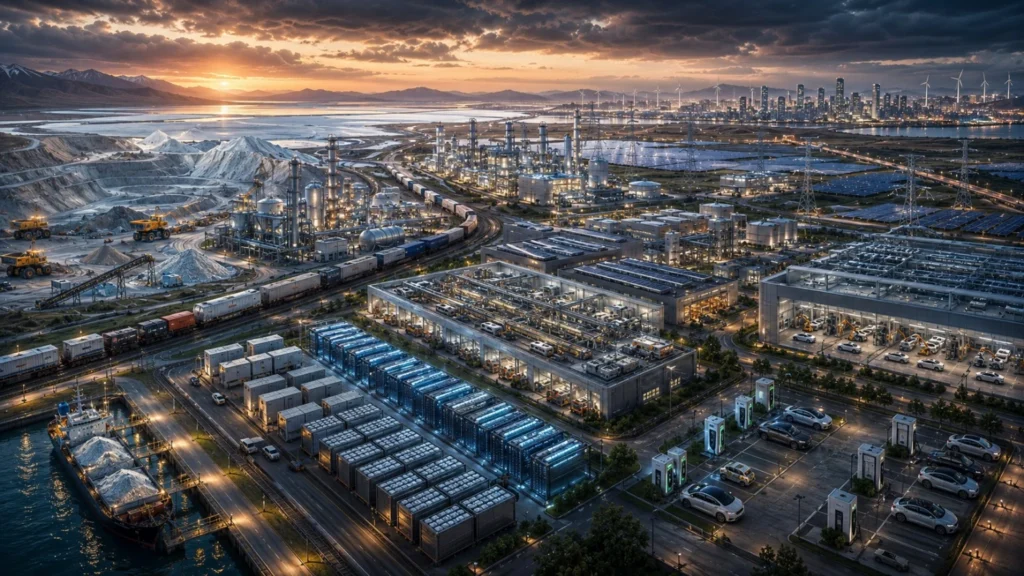
Lithium Has Become a Strategic Resource
For most of the twentieth century, oil defined the terms of strategic resource competition. Lithium is beginning to occupy a structurally similar position, not because it powers transportation directly, but because it supports an entire ecosystem — batteries, renewable energy storage, and electrification across sectors.
Why Demand Keeps Rising
Global electric vehicle sales crossed 14 million units in 2023, according to the International Energy Agency, and projections suggest that figure climbs steeply through the next decade. Each battery-electric vehicle requires roughly six to twelve kilograms of lithium carbonate equivalent. Multiply that by projected fleet expansion across Europe, China, and North America, and the supply arithmetic becomes demanding fast.
What separates lithium from other critical minerals is how many applications depend on it simultaneously. EVs, utility-scale energy storage, and consumer electronics all draw from the same supply pool. That convergence creates sustained demand pressure rather than cyclical spikes.
Battery Supply Chains Define the Energy Transition
Lithium does not move directly from a mine into a car. It passes through a refining stage to become lithium hydroxide or carbonate, then into cathode material, then into cells, then into battery packs. Each step requires capital, technical expertise, and stable supply agreements. The energy transition’s pace is partly determined by how smoothly that chain functions.
Lithium’s Role in Modern Battery Manufacturing
Lithium-ion chemistry currently dominates commercial battery production, from the gigafactories running in Nevada and Germany to the massive cell plants operating across China’s Jiangsu and Guangdong provinces. Next-generation solid-state batteries, still largely in development, are also expected to be lithium-based. This means that even if battery architecture evolves, lithium’s place at the center of energy storage technology is unlikely to shift in the near term.
The dependency is structural, not incidental.
Resource-Rich Nations Are Gaining Geopolitical Weight
The so-called Lithium Triangle — spanning Argentina, Bolivia, and Chile — holds more than half of the world’s known lithium reserves. Australia is the leading producer by volume, with hard-rock spodumene deposits that have made it a critical supplier to Asian refiners. More recently, significant deposits have been identified in the Democratic Republic of Congo, Zimbabwe, and parts of the United States.
Why These Countries Are Attracting International Attention
Countries that once sat at the margins of global commodity markets are now fielding visits from senior officials, signing framework agreements with major industrial powers, and reviewing the terms of existing mining concessions with fresh confidence. Chile updated its national lithium strategy in 2023, announcing that the state would hold majority stakes in new contracts — a policy shift that drew immediate attention from Japanese, Korean, and Chinese battery manufacturers who had established sourcing relationships there.
Bolivia, sitting atop the Salar de Uyuni, has moved more slowly due to political complexity and technical challenges around brine extraction, but it remains a long-term variable in the supply picture that investors and governments are watching carefully.
Governments Are Pushing Hard for Supply Chain Security
The United States passed the Inflation Reduction Act in 2022, which tied EV tax credits to North American battery content requirements. That was not primarily an environmental measure — it was an industrial policy instrument designed to pull lithium processing and battery manufacturing closer to home. The European Union has pursued a parallel path through its Critical Raw Materials Act, identifying lithium as one of sixteen strategic materials requiring domestic or allied supply.
These policy frameworks reflect a shared conclusion: dependence on a single supplier for a critical input is a vulnerability, not an efficiency. China currently refines roughly 60 to 70 percent of the world’s lithium, a concentration that other industrial powers regard as a structural exposure.
Bilateral agreements have followed. Australia and the EU signed a strategic partnership on critical minerals in 2022. The United States has pursued similar arrangements with Canada, Chile, and the Democratic Republic of Congo under the Minerals Security Partnership, a grouping that now includes fourteen countries and the European Commission.
Investment in Lithium Mining Is Accelerating
Rio Tinto’s acquisition of Arcadium Lithium in 2024 for approximately $6.7 billion signaled that the world’s largest mining companies are positioning for long-cycle demand. Smaller exploration firms have seen capital inflows into projects from Nevada to Serbia to Namibia. National governments are co-financing projects that would have been left to private markets a decade ago.
The scale of investment reflects a read on long-term trajectory rather than current prices. Lithium spot prices fell sharply through 2023 and 2024 after a speculative surge, but the underlying demand thesis — built on electrification commitments and battery production expansion — has not changed. The dip in prices accelerated consolidation rather than stopping investment.
Refining Capacity Is Now the Critical Bottleneck
Extraction is the visible part of the lithium story. Processing is where strategic leverage actually concentrates. Turning raw lithium ore or brine into battery-grade material requires technical infrastructure that takes years to build and is currently concentrated in a handful of locations, predominantly in China.
Countries with lithium deposits but without refining capacity face a choice: export raw material at low value, or invest heavily in building processing capability domestically. Chile, Australia, and several African producers are actively trying to move up the value chain, supported by agreements with foreign investors willing to co-fund processing facilities in exchange for supply access.
The country that mines lithium is not necessarily the country that profits most from it. That gap between extraction and value addition is where industrial policy competition is now focused.
Lithium Is Reshaping the Future of Industrial and Economic Power
The countries that secure reliable, diversified access to lithium supply chains — including refining and cell manufacturing — will carry a structural advantage into the clean energy era. That is not a forecast about distant decades. The battery gigafactories being commissioned today will operate on twenty-year timelines. The supply agreements being signed now will define competitive positions well into the 2040s.
Lithium competition, in this sense, mirrors what oil competition looked like in the mid-twentieth century: a resource race where early positioning, industrial investment, and diplomatic alignment all compound over time. The difference is that this race is running faster, across more actors, with the added urgency of climate deadlines shaping policy choices on every side.
The lithium competition powering the energy transition is already underway. The allocations being made now — in investment, in policy, in bilateral agreements — are the ones that will determine who holds the stronger hand when the clean energy economy reaches full scale.