
Middle Power Diplomacy — How Emerging Nations Are Reshaping Global Politics
The international order is experiencing a fundamental shift as countries like India, Brazil, Indonesia, and Saudi Arabia chart independent courses in global affairs. These emerging middle powers are no longer content to follow the lead of traditional superpowers, instead pursuing flexible diplomatic strategies that allow them to maximize influence while avoiding the constraints of rigid bloc alignment. This transformation in middle power diplomacy represents one of the clearest indicators that we are witnessing the emergence of a truly multipolar world.
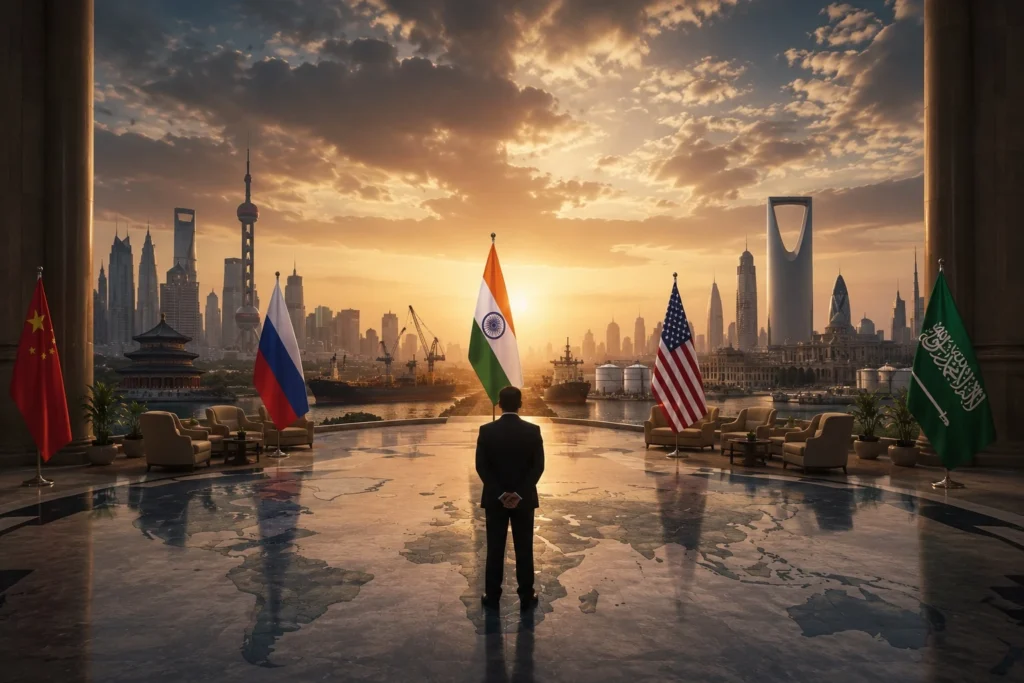
Middle Powers Assert Independent Roles in Global Affairs
Countries outside the traditional superpower hierarchy are demonstrating unprecedented diplomatic assertiveness in international relations. India’s approach to the Russia-Ukraine conflict exemplifies this trend—New Delhi has maintained trade relationships with Moscow while strengthening defense partnerships with Washington, refusing to choose sides despite pressure from both camps. Similarly, Saudi Arabia has pursued closer ties with China through energy partnerships while maintaining its security alliance with the United States.
This independence stems from changed global circumstances that give middle powers more room to maneuver. The relative decline of American hegemony, combined with China’s rise creating alternative power centers, has opened space for countries to pursue multi-alignment strategies rather than binary choices between competing blocs.
Regional Powers Drive Policy Innovation
Turkey’s diplomacy in the Black Sea region demonstrates how middle powers can shape outcomes through regional initiative. Ankara has positioned itself as a crucial mediator in grain export negotiations while simultaneously maintaining relationships with both NATO allies and Russia. This approach allows Turkey to extract concessions and enhance its strategic value to multiple parties.
Strategic Non-Alignment Delivers Diplomatic Dividends
Many emerging nations have discovered that avoiding permanent alliances creates more opportunities than rigid bloc membership. Brazil under President Lula has exemplified this approach by refusing to impose sanctions on Russia while deepening trade relationships with China and maintaining cooperation with the United States on climate initiatives.
Indonesia’s foreign policy illustrates similar principles. Jakarta has strengthened economic ties with Beijing through the Belt and Road Initiative while expanding security cooperation with Australia and maintaining neutrality in South China Sea disputes. This balanced approach has allowed Indonesia to attract investment from multiple sources without triggering geopolitical backlash.
The key advantage lies in optionality—middle powers can adapt their positions based on evolving circumstances rather than being locked into predetermined alignments that may become disadvantageous over time.
Regional Leadership Amplifies Global Influence
Influence increasingly flows from the ability to lead regional coalitions and initiatives rather than simply aligning with distant superpowers. The Association of Southeast Asian Nations (ASEAN) demonstrates how middle powers can collectively punch above their individual weight by maintaining unity on key issues while engaging major powers from a position of collective strength.
Brazil’s leadership in Latin American environmental initiatives has elevated its global profile beyond what its military or economic power alone might justify. By championing Amazon preservation and renewable energy transitions, Brazil has positioned itself as an indispensable partner for climate-focused policies worldwide.
Economic Integration Creates Political Leverage
Regional economic leadership often translates into broader diplomatic influence. India’s role in South Asian trade networks and its leadership of the G20 presidency in 2023 allowed New Delhi to set agendas on digital payments, climate finance, and supply chain resilience that reflected its priorities rather than simply responding to great power initiatives.
Economic Networks Expand Geopolitical Reach
Trade relationships, investment flows, and infrastructure projects have become primary tools for middle powers to extend their influence beyond traditional diplomatic channels. The United Arab Emirates has used its position as a global financial hub to build relationships across Africa, Asia, and Latin America that translate into diplomatic support for its regional policies.
Indonesia’s growing role in critical mineral supply chains—particularly nickel for electric vehicle batteries—has given Jakarta leverage in negotiations with both Chinese manufacturers and Western automotive companies. This economic positioning allows Indonesia to extract favorable terms while playing competing interests against each other.
Mediation Becomes a Strategic Asset
Middle powers increasingly find themselves in valuable positions as intermediaries between competing major powers. Qatar’s role in facilitating dialogue between the United States and Iran, or Turkey’s mediation efforts between Russia and Ukraine, demonstrate how countries can enhance their strategic importance by serving as neutral venues for sensitive negotiations.
These mediation roles often prove more durable than military alliances because they depend on maintaining credibility with multiple parties rather than demonstrating loyalty to one side. Countries that successfully establish themselves as trusted intermediaries can maintain relevance across different global configurations.
Multipolarity Creates Strategic Opportunities
The fragmentation of global power structures creates multiple entry points for middle powers to shape international outcomes. Rather than operating in a bipolar system where influence required alignment with either Washington or Moscow, today’s multipolar environment allows countries to build coalitions around specific issues without comprehensive alignment.
The BRICS expansion in 2023, adding Saudi Arabia, Iran, Ethiopia, Egypt, Argentina, and the UAE, illustrates how middle powers can create alternative institutional frameworks that reflect their interests rather than simply joining existing Western-dominated organizations.
In my assessment, middle powers may emerge as the primary beneficiaries of this multipolar transition. While great powers face direct confrontation and the burdens of global leadership, middle powers can exploit their flexibility, geographic advantages, and economic partnerships to expand influence without bearing the full costs of superpower competition.
Diplomatic Agility Rivals Military Strength
The traditional equation linking military capability to international influence is being rewritten as diplomatic flexibility and economic connectivity become equally important tools of statecraft. Countries like Singapore and Switzerland have demonstrated that strategic positioning, institutional expertise, and economic integration can generate influence that exceeds what their military capabilities might suggest.
This shift reflects changing global priorities where economic growth, technological innovation, and climate adaptation often matter more than traditional security concerns. Middle powers that excel in these areas can establish themselves as indispensable partners regardless of their military rankings.
The rise of middle power diplomacy signals a fundamental restructuring of international relations where influence is becoming more distributed and flexible strategies are outperforming rigid alignments. This trend will likely accelerate as global challenges require diverse coalitions and specialized expertise that no single superpower can provide alone.