
Megacities and Power — Why Urban Centers Are Becoming Global Actors
For most of modern history, power was something nations held. Borders defined it, governments exercised it, and armies defended it. That model still applies, but something has shifted underneath it. A growing share of economic output, technological development, and geopolitical influence now originates not from countries as a whole, but from specific cities within them. The question worth asking is not whether megacities matter — they clearly do — but how much independent weight they are beginning to carry on the world stage.
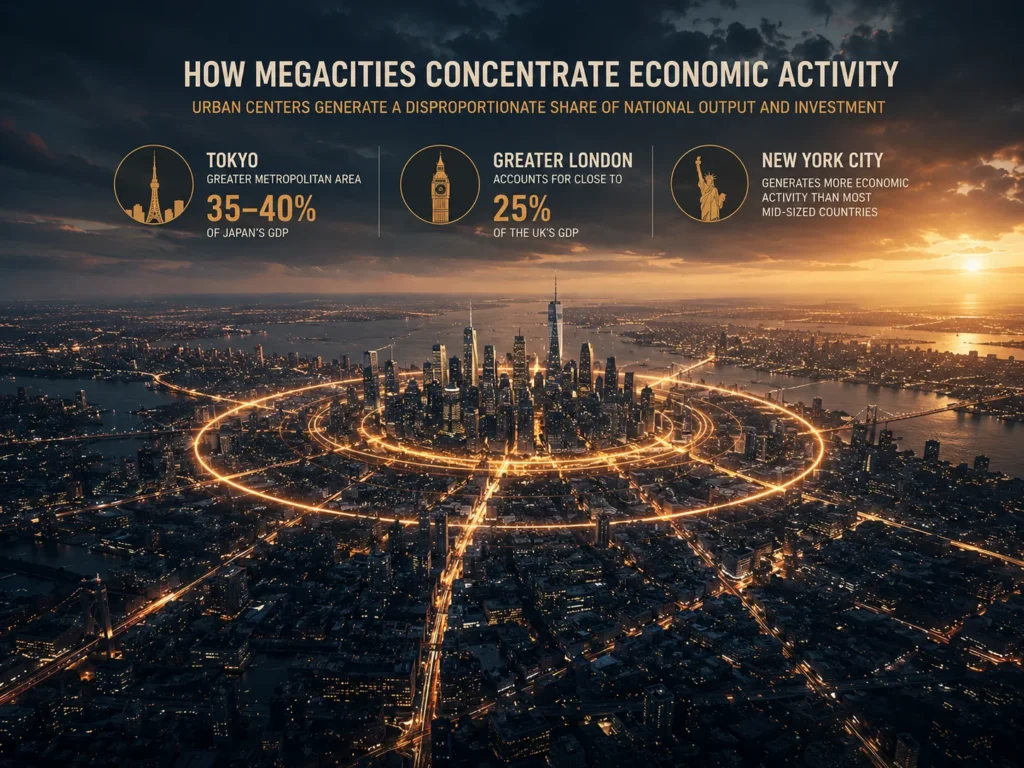
How Megacities Concentrate Economic Activity
Urban centers generate a disproportionate share of national output and investment
The numbers are difficult to argue with. Tokyo’s greater metropolitan area produces roughly 35 to 40 percent of Japan’s entire GDP. Greater London accounts for close to a quarter of the United Kingdom’s economic output despite housing about 13 percent of its population. New York City alone generates more economic activity than most mid-sized countries.
This concentration is not accidental. Cities attract capital because capital follows density — of people, of institutions, of deal flow. A manufacturing plant can theoretically be located anywhere, but a venture capital firm, an investment bank, or a multinational headquarters wants proximity to clients, talent, and competitors simultaneously. That logic compounds over time, pulling more activity toward already-large urban centers and widening the gap between cities and the rest of their national territories.
The strategic consequence is that national economic health increasingly depends on what happens inside a handful of urban cores, not across the broader country.
Population Density as an Engine of Innovation
Cities draw talent and research institutions in ways that smaller economies cannot replicate
Density does something interesting to innovation. When researchers, engineers, entrepreneurs, and investors operate within the same geography, ideas move faster and combinations happen that would not otherwise occur. Silicon Valley is the obvious example, but the pattern holds in Shenzhen’s hardware manufacturing clusters, in London’s fintech corridor, and in Singapore’s life sciences sector.
Cities attract talent partly because talent attracts talent. A software engineer choosing between a mid-sized city and a megacity is not just evaluating salary — she is evaluating access to networks, institutions, and the kinds of problems she will get to work on. Research universities and specialized hospitals anchor this further, drawing funding and people that reinforce urban concentration.
This creates a feedback loop that smaller cities and rural economies find difficult to break into, regardless of government policy intent.
Infrastructure as a Strategic Advantage
Transportation, energy, and digital networks determine how competitive a city can become
Infrastructure is often discussed as a cost or a public service. It is more usefully understood as a determinant of a city’s ceiling. Port capacity shapes trade volume. High-speed rail connections determine whether a secondary city can integrate into a megacity’s orbit. Data center density and fiber connectivity shape which cities attract technology investment.
Dubai offers a sharp illustration. Its government made deliberate, long-term infrastructure investments in aviation, logistics, and financial services infrastructure that effectively repositioned the city as a global hub — one that now competes not just with regional neighbors but with London and Singapore for certain categories of financial and commercial activity. The Jebel Ali port complex alone processes more container traffic than many major European ports.
Cities that allow infrastructure to stagnate lose competitive ground in ways that are slow to develop but difficult to reverse.
How Global Cities Build International Influence
Some cities maintain stronger international ties than entire national regions
One of the more striking features of the current period is how some cities have developed international networks that function largely independently of their national governments. London’s financial markets are deeply integrated with New York, Hong Kong, and Frankfurt in ways that have little to do with British foreign policy. Singapore’s trade and logistics relationships span Southeast Asia, South Asia, and the Gulf with a reach that exceeds what a nation of its size would normally command.
This international embeddedness gives certain cities a form of structural influence. They are nodes through which capital, goods, talent, and information flow — and removing or disrupting them carries costs that other actors, including large countries, prefer to avoid. That is not the same as sovereignty, but it is not nothing either.
The 21st century may well be remembered as much for the rise of cities as for the competition between nations. Governments remain consequential, but the cities where the most significant economic and technological decisions get made deserve their own analytical attention.
Urban Complexity and the Pressure on Governance
Housing, transport, and sustainability create challenges that existing institutions struggle to address
Scale creates problems that scale alone cannot solve. The same density that generates innovation also produces housing unaffordability, infrastructure strain, and environmental pressure. Tokyo, with one of the world’s most functional public transit systems, still grapples with aging infrastructure and demographic contraction. London has added population steadily for two decades while housing construction has lagged far behind.
These are not simply administrative inconveniences. Governance failures in major cities carry national consequences. When a megacity becomes unaffordable for mid-income workers, it begins to lose the functional diversity that made it productive. Talent retention problems follow. Eventually the city’s competitive position erodes — not dramatically, but structurally.
New governance models are being tested: metropolitan authorities with expanded fiscal powers, public-private infrastructure partnerships, and city-to-city cooperation frameworks. Whether any of these prove adequate at the pace cities are growing is genuinely uncertain.
The Intensifying Competition Between Global Cities
Cities now compete directly with each other across national borders for investment, talent, and influence
Cities are increasingly aware of each other as competitors. Singapore tracks Hong Kong’s regulatory environment closely. Dubai monitors Singapore. London watches both. This competition plays out through tax policy, residency programs, regulatory posture toward financial services and technology, and deliberate place branding.
The relocation of hedge funds and family offices from Hong Kong to Singapore after 2020 illustrated how quickly city-level conditions — shaped by political decisions — can redirect significant capital flows. This was not a national policy competition between China and Singapore so much as a city-level recalibration driven by calculations about rule of law, regulatory stability, and access to regional markets.
When Urban Power Shapes National Influence
A country’s standing increasingly reflects the success or struggle of its leading cities
The connection between urban performance and national geopolitical standing is becoming harder to ignore. China’s strategic weight in global technology and trade runs substantially through Shanghai, Shenzhen, and Beijing. The United States’ continued dominance in finance and innovation depends heavily on New York and the Bay Area maintaining their competitive positions. If either cluster were to weaken significantly — through talent exodus, regulatory overreach, or infrastructure failure — the national consequences would extend well beyond economics.
This creates an unusual political dynamic. National governments that neglect or antagonize their major cities may be undermining the very engines that sustain their broader influence. Urban success and national power are not the same thing, but in the current period they are more tightly linked than at any point in recent history. That relationship deserves more serious attention from analysts and policymakers than it typically receives.