
Grid Modernization — The Hidden Infrastructure Behind Economic Competitiveness
Most conversations about energy policy focus on generation — how much solar capacity a country has installed, or whether nuclear is making a comeback. Far less attention goes to the wires, substations, and switching systems that actually deliver electricity to homes, factories, and data centers. That gap in attention is becoming a strategic liability. Grid modernization may be the most consequential infrastructure investment of the coming decades, and the countries that recognize this early are likely to hold meaningful advantages over those that do not.
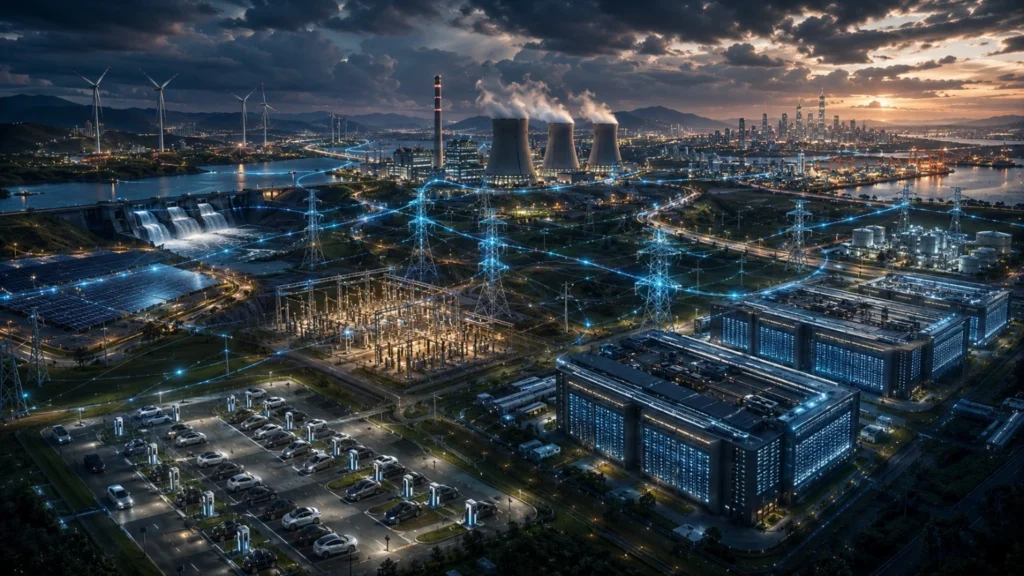
Electricity Grids Under Pressure From All Sides
Rising consumption and electrification are exposing the limits of aging infrastructure
The numbers tell a clear story. Global electricity demand is projected to grow by more than 50 percent by 2040, according to the International Energy Agency. That growth is not just about population increase — it reflects a structural shift as transportation, heating, and industrial processes migrate away from fossil fuels and onto the grid.
Electric vehicles are the most visible example. In markets where EV adoption is accelerating, utilities are already confronting demand spikes they were not designed to handle. But the pressure goes further. Data centers — the backbone of cloud computing and AI workloads — are consuming electricity at a pace that is straining regional grid capacity in parts of the United States, Europe, and Asia. Microsoft, Google, and Amazon have each flagged energy availability as a constraint on infrastructure expansion.
The core problem is straightforward: grids built for a different era of consumption are now being asked to do something fundamentally different. Upgrading them is not optional.
Why Renewable Energy Demands a Smarter Grid
Wind and solar have reshaped the energy generation mix in many countries, but they have also introduced a challenge that older grids were never designed to handle. Unlike coal or natural gas plants, which generate power on demand, wind turbines and solar panels produce electricity based on weather conditions. Output is variable, sometimes predictable, but never fully controllable.
Managing that variability requires a different kind of grid — one that can route electricity dynamically, integrate storage at scale, and respond in near real-time to fluctuations in supply and demand. Germany’s Energiewende offers a useful case study. Despite its ambitious renewable build-out, Germany has struggled with grid stability and has had to pay neighboring countries to absorb surplus electricity during periods of excess generation. The lesson is not that renewables are flawed, but that generation investment without equivalent grid investment creates structural imbalance.
Grid modernization, in this context, is not a supplement to the energy transition. It is a prerequisite for it.
Energy Security as a Strategic Infrastructure Question
The 2021 Texas grid failure, which left millions without power during a winter storm and caused an estimated $195 billion in economic damage, illustrated something that policymakers often discuss in abstract terms: electricity infrastructure is a national security asset.
Governments are increasingly treating it that way. The U.S. Infrastructure Investment and Jobs Act allocated $65 billion specifically for grid upgrades. The European Union’s REPowerEU plan, launched in response to the energy disruptions following Russia’s invasion of Ukraine, identified grid investment as central to energy independence. Japan, South Korea, and several Southeast Asian nations have each published grid resilience strategies in the past three years.
The shift in framing matters. When grid reliability is treated as a procurement issue rather than a strategic one, investment tends to be reactive and underfunded. When it is treated as infrastructure for national resilience, the political calculus changes.
How Digital Technologies Are Reshaping Grid Operations
Smart grid systems are improving efficiency, fault detection, and long-term planning
A modern grid is increasingly a digital network as much as a physical one. Smart meters, advanced sensors, AI-driven load forecasting, and automated switching systems are changing how utilities monitor and manage electricity flow. The practical effects are significant.
In the United Kingdom, National Grid ESO has used machine learning tools to improve the accuracy of short-term demand forecasts, reducing the cost of balancing supply and demand. In the United States, utilities like Duke Energy and Pacific Gas & Electric have deployed automated fault detection systems that can isolate outages in seconds rather than hours, reducing both economic disruption and safety risks.
Cybersecurity is the other side of this equation. A more digitally connected grid is also a more exposed one. The 2021 Colonial Pipeline attack — though it targeted fuel pipelines, not electricity — demonstrated how quickly infrastructure vulnerabilities can translate into economic and political consequences. Grid operators are now investing in cyber defense as a core operational function, not an afterthought.
Why Stable Power Is a Competitive Requirement for Modern Industry
Industries that defined the twentieth century economy — steel, chemicals, automotive manufacturing — needed reliable power. The industries defining the twenty-first century need something more demanding: power that is reliable, low-latency, and increasingly clean.
Semiconductor fabrication plants draw enormous and highly stable electrical loads. Even brief voltage fluctuations can damage wafers and disrupt production runs worth hundreds of millions of dollars. When TSMC and Samsung evaluate sites for new fabs, grid quality is among the top-tier criteria. The same logic applies to pharmaceutical manufacturing, advanced logistics, and large-scale AI infrastructure.
This creates a direct line between grid investment and industrial policy. A country with a fragile or outdated grid is systematically less attractive for high-value manufacturing and technology investment, regardless of what other incentives it offers.
Climate Commitments Are Accelerating Grid Investment
Meeting net-zero targets by 2050 requires an electricity system that looks very different from the one most countries have today — not just in terms of how power is generated, but in terms of how it is transmitted, stored, and distributed. The International Energy Agency estimates that global grid investment needs to reach $600 billion annually by 2030, roughly double current levels.
Several governments have begun linking climate finance directly to grid infrastructure. The U.S. Inflation Reduction Act includes transmission incentives explicitly tied to clean energy integration. Australia’s federal government committed AUD 20 billion to the Rewiring the Nation program, focused on grid upgrades needed to accommodate large-scale renewable expansion.
The strategic insight here is that grid investment serves multiple policy objectives simultaneously — decarbonization, industrial competitiveness, and energy security — which makes it unusually defensible politically when framed correctly.
Power Infrastructure and the Next Round of Economic Competition
Countries with well-modernized grids are positioning themselves for advantages that compound over time. They can attract investment in energy-intensive industries. They can integrate renewables at lower system cost. They can recover from disruptions faster. They can offer the kind of energy reliability that high-value supply chains require.
Grid modernization — the hidden infrastructure behind economic competitiveness — rarely generates the political visibility of a new highway or airport. It operates mostly in the background, noticed mainly when it fails. But the ability to distribute and manage electricity efficiently may ultimately do more to determine a country’s economic trajectory over the next two decades than many policies that receive far more attention. The strategic gap between countries that invest seriously in this infrastructure and those that do not is already opening. It is likely to widen.