
The Energy Storage Race — The Next Frontier of the Global Energy Transition
Generating clean electricity was once considered the central challenge of the energy transition. Build enough wind turbines, install enough solar panels, and the problem is largely solved. That assumption is now being tested. The energy storage race — the next frontier of the global energy transition — is exposing just how incomplete the picture was. Without the ability to store electricity reliably and at scale, even the most ambitious renewable buildouts remain structurally fragile.
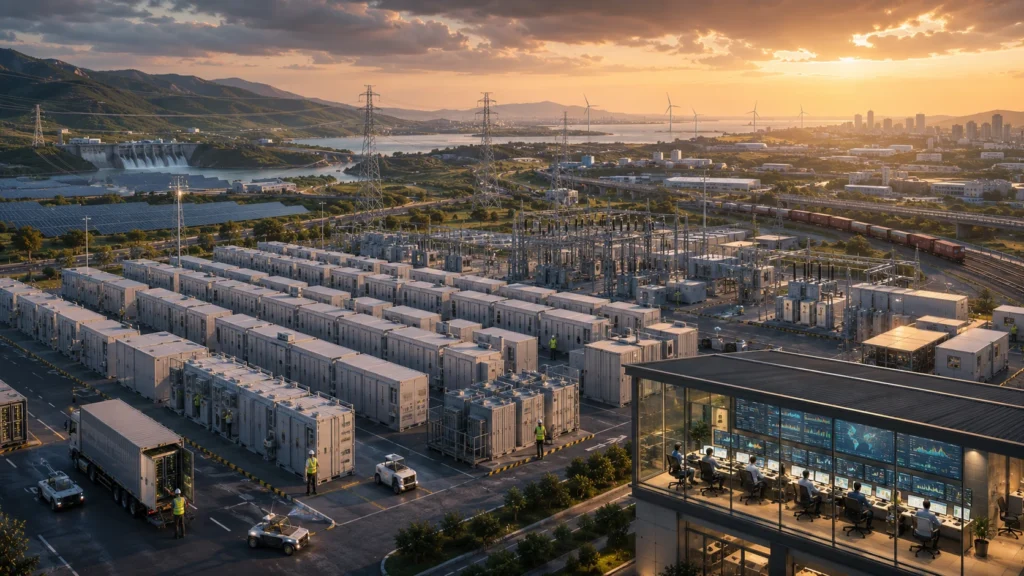
Why Renewable Energy Only Works at Scale When Paired With Storage
Wind and solar are the dominant growth stories in the global power sector. But both are intermittent by nature — the sun sets, the wind drops, and demand does not adjust to accommodate either. This basic physical constraint is what makes large-scale energy storage less of an optional add-on and more of a load-bearing requirement for any grid that intends to run predominantly on renewables.
The Gap Between Generation and Reliable Power
California offers a clear illustration. The state has invested heavily in solar capacity, but on high-demand evenings when solar output fades, the grid routinely faces stress events. Battery storage installations — including the Moss Landing facility, one of the largest in the world — have become part of the operational response. Similar dynamics are playing out in Germany, Australia, and across parts of Southeast Asia, where grid operators are discovering that generation capacity and dispatchable power are two different things.
This is the core insight: generating clean electricity is only part of the equation. Storage is what converts an intermittent resource into a dependable one.
Battery Manufacturing Is Becoming an Industrial Policy Contest
The commercial battery industry has grown fast enough that governments no longer treat it as a purely private-sector concern. Battery manufacturing is now considered strategic infrastructure, and the policy response reflects that.
How Industrial Subsidies Are Reshaping the Sector
The United States Inflation Reduction Act, passed in 2022, included substantial incentives for domestic battery production, directly targeting the supply chain dependency on Asian manufacturers. The European Union’s Battery Regulation and its Critical Raw Materials Act reflect similar ambitions — reduce external exposure, build domestic capacity, capture industrial value. South Korea, Japan, and China have each maintained long-standing support programs for their battery industries.
China currently dominates global battery manufacturing capacity. CATL alone accounts for a significant share of global lithium-ion production, and Chinese firms collectively hold a commanding position across the supply chain. The policy response in the United States and Europe is, in part, an attempt to close that gap before it becomes permanent.
Grid Stability Has Become a National Security Concern
Power grids were designed around predictable, dispatchable generation. Natural gas plants, coal plants, and hydroelectric facilities can be ramped up or down in response to demand. Renewables cannot. As their share of generation rises, grid operators face a structural challenge: how to maintain frequency, voltage, and reliability when the generation mix is no longer fully controllable.
Storage systems — primarily utility-scale batteries, but also pumped hydro and other technologies — are the primary answer. They absorb surplus power when supply exceeds demand and discharge when the reverse is true. Several countries have begun treating storage procurement as a core component of grid planning rather than a supplementary option. The UK, for instance, has integrated battery storage into its capacity market mechanisms. Texas, following the Winter Storm Uri disaster in 2021, has accelerated storage procurement as part of its grid hardening efforts.
Innovation Is Pushing Well Beyond Lithium-Ion
The battery industry is not standing still at its current technology base. Lithium-ion dominates today, but it carries limitations: cost at very large scale, fire risk, and a relatively finite discharge duration that makes it less suitable for long-duration storage applications.
Alternatives Gaining Ground in the Market
Sodium-ion batteries have attracted attention as a potential lower-cost alternative, particularly for stationary storage where energy density matters less than in electric vehicles. CATL began commercial production of sodium-ion cells in 2023. Iron-air batteries, being developed by companies like Form Energy, target multi-day storage at costs that lithium-ion cannot match for that use case. Vanadium flow batteries have found applications in grid-scale installations in China and parts of Europe, offering long cycle life and scalability.
None of these has displaced lithium-ion, but the diversification of technology options is strategically meaningful. A storage market with multiple viable chemistries is more resilient than one dependent on a single approach.
Critical Minerals Are the Hidden Constraint
Behind every battery chemistry is a materials supply chain, and that supply chain is neither simple nor evenly distributed. Lithium, nickel, cobalt, manganese, and now sodium compounds are all central to different storage technologies. Access to these materials — and the ability to process them — shapes who can manufacture at scale and at what cost.
The Democratic Republic of Congo holds a dominant share of global cobalt reserves. Chile and Australia are central to lithium supply. China controls a substantial portion of the processing capacity for multiple critical minerals, even where the raw materials originate elsewhere. This processing concentration is a strategic pressure point that has not gone unnoticed in Washington, Brussels, or Tokyo.
Diversifying both mining and processing is a medium-term goal for several governments, but it involves years of permitting, capital investment, and infrastructure development. In the near term, the mineral supply chain remains a genuine constraint on how fast storage capacity can be built.
Energy Security Now Depends on the Ability to Store, Not Just Generate
For decades, energy security was primarily about access to fuel — oil, gas, or coal. The shift to renewables does not eliminate the concept of energy security; it redefines it. A country can generate clean electricity from domestic wind and solar resources and still face grid instability if it cannot store and dispatch that power effectively.
This extends the strategic logic further than many policymakers initially recognized. Import dependency does not disappear with renewable generation — it shifts toward battery technology, critical minerals, and manufacturing capacity. Countries that cannot produce or procure storage at scale remain exposed, even if their generation assets are entirely domestic.
Storage Capacity Will Define Who Leads the Next Phase of Electrification
The energy transition is entering a stage where storage is the differentiating variable. Countries that build strong positions in battery manufacturing, grid-scale deployment, and storage technology development are positioning themselves for advantages that extend well beyond electricity supply.
In my view, the competition over energy storage could become as strategically significant as the race for semiconductor manufacturing. The parallel is not exact, but the underlying logic is similar: a technology that is foundational to industrial productivity, embedded in critical infrastructure, and dependent on complex supply chains tends to concentrate power among those who master it earliest and most completely. The countries leading this industry will influence both energy security and industrial competitiveness for decades ahead. That is not a distant scenario — the competition is already underway, and the positions being established now are likely to prove durable.