
China’s Pacific ICBM Launch Signals a New Phase of Strategic Competition
In late September 2024, China conducted its first intercontinental ballistic missile test into the open Pacific Ocean in more than four decades — a move that immediately drew scrutiny from governments, defense analysts, and military planners across the region. China’s Pacific ICBM launch signals a new phase of strategic competition, and understanding what drove this decision, and what it means for the Indo-Pacific security order, matters more than most headlines suggested at the time.
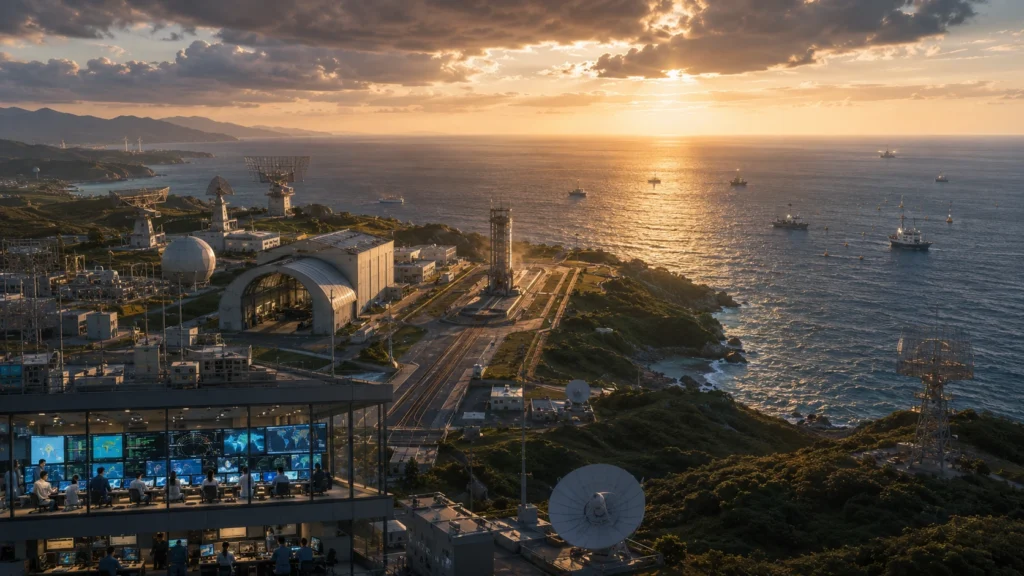
China Conducts a Rare Pacific ICBM Launch
What Made This Test Different From Routine Military Exercises
The People’s Liberation Army Rocket Force launched a Dongfeng-31AG ICBM that traveled approximately 12,000 kilometers before splashing down in international waters in the South Pacific. China notified several governments in advance — a standard diplomatic protocol — but the test itself was anything but routine.
The last time China tested an ICBM at full range into the Pacific was 1980. Conducting this kind of long-range trajectory test publicly, at this scale, after four decades, carries a different weight than a laboratory validation or a limited-range exercise. The choice to demonstrate full operational range, in open ocean, at a moment of sustained strategic tension with the United States and its allies, was clearly deliberate.
China’s Ministry of National Defense framed it as a planned, routine annual training exercise. That framing is technically accurate and strategically incomplete at the same time.
The Launch Sends a Clear Political Signal
Why Analysts Read This as Strategic Messaging, Not Just Technical Validation
Most analysts interpreted the launch not simply as a technical check on missile reliability, but as a calibrated signal. China’s nuclear modernization program has accelerated considerably over the past five years — the Pentagon’s 2023 China Military Power Report estimated that Beijing could possess more than 1,000 operational nuclear warheads by 2030, up from an estimated 500 at the time of publication. A full-range Pacific test makes that trajectory visible in concrete operational terms.
The timing reinforces this reading. Relations between Washington and Beijing over Taiwan remain tense. U.S. arms sales to Taiwan, increased American military coordination with Japan and the Philippines, and ongoing disputes in the South China Sea have all contributed to a security environment where China appears willing to communicate military readiness more explicitly than it has in the past.
This is part of a broader shift worth watching closely — from symbolic demonstrations toward more direct strategic signaling. When a nuclear-armed state chooses to demonstrate long-range capability openly, the intended audience is rarely just one country.
China’s Military Modernization Is Accelerating on Multiple Fronts
Long-Range Missiles, Nuclear Forces, and Emerging Technologies Are All Advancing Together
The ICBM test does not stand alone. It reflects a broader pattern of investment across China’s strategic forces that has been building for well over a decade.
The PLA Rocket Force has expanded its road-mobile ICBM fleet, which is harder to track and target than fixed-site systems. China has also constructed hundreds of new ICBM silos in its western interior, a development first reported by researchers at the Federation of American Scientists and later confirmed by satellite imagery analysis from the Middlebury Institute. The PLA Navy continues to expand its fleet of Jin-class ballistic missile submarines, which extend China’s second-strike capability into the open ocean.
Alongside these developments, China is investing in hypersonic glide vehicles, advanced space-based reconnaissance systems, and counter-space capabilities. The Pacific launch fits into this architecture: it tested a delivery system that ties together targeting, command, and long-range reach in a single operational demonstration.
The Indo-Pacific Security Calculus Is Shifting
Regional Governments Are Reassessing Deterrence and Strategic Stability
Governments across the Indo-Pacific moved quickly to assess the implications. Japan’s government summoned the Chinese ambassador and issued a formal protest, citing concerns about transparency and regional stability. Australia and South Korea acknowledged the test and signaled they were monitoring developments carefully.
What this kind of test does, beyond generating diplomatic friction, is force regional governments to recalibrate their assumptions. Deterrence calculations depend on estimates of capability, intent, and credibility. When a major power publicly demonstrates a capability that was previously more theoretical than visible, the strategic math for neighboring states changes — not overnight, but steadily.
For smaller regional states with existing defense partnerships with the United States, the launch reinforces the case for deepening those relationships. For countries that have tried to maintain equidistance between Washington and Beijing, the pressure to make clearer choices grows harder to avoid.
Major-Power Military Competition in the Indo-Pacific Is No Longer Slow-Moving
The Pace of Strategic Signaling Has Picked Up Considerably
The Pacific ICBM test is one data point in a pattern that includes U.S. bomber deployments to the region, American nuclear-powered submarine agreements under AUKUS, and the steady expansion of joint exercises among U.S. allies. Major-power competition in the Indo-Pacific is not approaching — it is already structuring how governments plan, spend, and align.
What makes the current moment distinct is that strategic signaling has become more frequent and more explicit on all sides. That is not automatically a sign that conflict is imminent, but it does mean the threshold for demonstrating capability — and the diplomatic costs of doing so — is being recalibrated by each actor.
China’s willingness to conduct a high-profile Pacific launch suggests Beijing believes the strategic benefits of visible deterrence demonstration outweigh the diplomatic costs. That judgment itself tells analysts something about where Chinese strategic thinking currently stands.
Allied Defense Planning Is Adapting in Response
Surveillance, Missile Defense, and Military Coordination Are All Being Strengthened
The U.S. and its regional allies were already expanding their defense cooperation before this test. The launch adds momentum to several ongoing initiatives.
Japan’s decision to develop counterstrike capabilities — a significant departure from its postwar defense posture — is partly shaped by the recognition that deterrence requires more than passive defense. Australia’s investment in long-range strike systems under AUKUS fits a similar logic. The United States, meanwhile, continues to negotiate expanded access to military facilities in the Philippines and has deepened intelligence-sharing arrangements across the region.
Missile defense is also getting renewed attention. The U.S. and Japan have agreed to develop an advanced interceptor specifically designed to address hypersonic threats, a capability gap that the Pacific test made more politically visible. None of these investments are quick fixes, but they reflect a sustained directional shift in how the alliance network is structuring itself for a longer-term competition.
China’s Pacific ICBM Launch Signals That Military Signaling Has Become a Core Tool of Geopolitical Competition
The September 2024 launch is unlikely to be the last high-profile demonstration of this kind. As China’s nuclear forces mature and U.S. alliances in the region grow denser, the incentives for visible strategic signaling — on all sides — are not diminishing.
China’s Pacific ICBM launch signals a new phase of strategic competition in the clearest possible terms: long-range deterrence is no longer a background assumption in the Indo-Pacific. It is an active, visible, and contested dimension of the regional security environment. Defense planners, alliance managers, and governments across the region will be working through the consequences of that reality for years ahead — and the decisions made now about force posture, alliance architecture, and strategic communication will shape how stable or unstable that environment becomes.