
India Rises as a Strategic Counterweight — A New Power Is Quietly Reshaping Asia
While global attention fixates on US-China tensions, a third player has been steadily building influence across Asia without fanfare or confrontation. India’s approach differs markedly from traditional great power playbooks—it’s not declaring spheres of influence or demanding allegiance from neighbors. Instead, New Delhi is positioning itself as an indispensable partner that major powers cannot afford to alienate.
This quiet ascent reflects something larger: the emergence of a multipolar world where rigid alliance structures give way to flexible partnerships. India rises as a strategic counterweight not by opposing any single nation, but by offering an alternative model of engagement that prioritizes strategic autonomy over bloc politics.
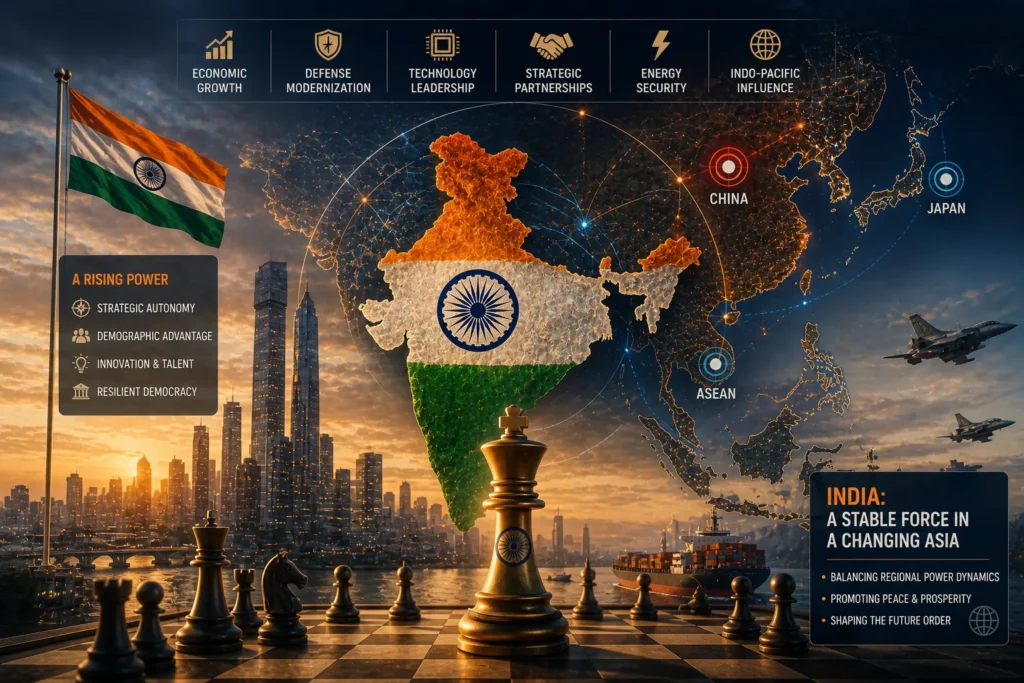
India Expands Its Strategic Footprint Through Economic Partnerships
India’s influence across Asia grows through deliberate economic engagement rather than dramatic military posturing. The country has become the world’s fifth-largest economy, with GDP crossing $3.7 trillion in 2023, creating gravitational pull that draws regional partners seeking alternatives to Chinese-dominated supply chains.
New Delhi’s approach centers on practical cooperation. The India-Middle East-Europe Economic Corridor, announced at the 2023 G20 summit, offers Gulf states and European partners a transportation route that bypasses traditional chokepoints. Similarly, India’s digital payment systems now operate in countries from Singapore to France, creating technological dependencies that translate into diplomatic leverage.
Regional Trade Integration Builds Lasting Influence
Trade relationships tell the story more clearly than diplomatic statements. India’s bilateral trade with ASEAN nations reached $131 billion in 2023, up from $81 billion just three years earlier. This economic integration creates stakeholders across the region who benefit from India’s continued rise.
The pattern extends beyond immediate neighbors. India now ranks among the top three trading partners for nations as diverse as Nepal, Bangladesh, and the Maldives, giving New Delhi significant voice in regional affairs without requiring military commitments.
India Navigates Great Power Competition Without Choosing Sides
While most nations face pressure to align with either Washington or Beijing, India maintains relationships with both superpowers plus Russia, demonstrating that strategic autonomy remains possible even in an increasingly polarized world.
This balancing act produces concrete benefits. India continues importing Russian energy despite Western sanctions, saving an estimated $2.7 billion in 2023 alone. Simultaneously, it deepens technology partnerships with the United States through initiatives like the US-India Critical and Emerging Technology partnership, launched in January 2023.
The approach frustrates policymakers in Washington and Beijing who prefer clear allegiances, but it maximizes India’s options. Prime Minister Narendra Modi can engage with Vladimir Putin in July and host President Biden in September without contradicting his country’s fundamental interests.
Defense Modernization Signals Growing Military Ambition
India’s military transformation reflects its expanding regional role. Defense spending reached $76 billion in 2023, making India the world’s fourth-largest military spender. More importantly, this investment focuses on indigenous capabilities that reduce dependence on any single supplier.
Joint military exercises demonstrate India’s growing confidence. The country now conducts regular naval exercises with the United States, Australia, and Japan through the Quad framework, while simultaneously participating in multilateral exercises with Russia and Central Asian nations. This dual-track approach keeps all major powers engaged while preventing any from gaining exclusive influence.
Indigenous Defense Production Reduces Strategic Vulnerabilities
India’s push for defense self-reliance, known as “Atmanirbhar Bharat,” has produced tangible results. Domestic defense production increased to $13.7 billion in 2022-23, up from $11 billion the previous year. Indigenous systems like the Tejas fighter aircraft and Arjun tank demonstrate technical capabilities while reducing reliance on foreign suppliers during potential crises.
India’s Indo-Pacific Strategy Reshapes Regional Security Architecture
The Indo-Pacific has become the primary theater for India’s strategic emergence. Unlike China’s assertive territorial claims or America’s military-focused presence, India offers regional partners economic opportunities combined with respect for sovereignty.
India’s approach resonates particularly well with Southeast Asian nations caught between great power competition. Countries like Vietnam and Indonesia appreciate India’s consistent support for international law in maritime disputes, while benefiting from Indian investment that comes without the debt burdens associated with Chinese Belt and Road projects.
The Quad partnership with the United States, Australia, and Japan provides institutional framework for this strategy without creating formal military alliances that might constrain India’s flexibility elsewhere.
Economic Expansion Reinforces Diplomatic Influence
India’s economic trajectory supports its geopolitical ambitions in ways that military spending alone cannot achieve. With GDP growth consistently outpacing other major economies, India offers partners a market of 1.4 billion consumers plus technological capabilities in sectors from pharmaceuticals to information technology.
The country’s demographic dividend—a median age of 28 compared to China’s 38—suggests this economic expansion will continue for decades. This creates confidence among potential partners that investments in relationships with India will pay long-term dividends.
Digital infrastructure exports demonstrate India’s soft power potential. The Unified Payments Interface, India’s digital payment system, now operates in multiple countries, while Indian firms provide digital identity systems from Estonia to Morocco. These technological exports create lasting relationships that transcend traditional diplomatic channels.
Strategic Autonomy Defines India’s Foreign Policy Architecture
India’s refusal to join formal alliance structures reflects calculated judgment rather than indecision. By maintaining what officials call “strategic autonomy,” India preserves the ability to cooperate with different partners on different issues without being constrained by alliance obligations.
This approach requires sophisticated diplomatic management. India must calibrate its relationships carefully to avoid triggering security dilemmas with any major power while maintaining credibility as a reliable partner. The strategy works because India offers genuine value—market access, technological capabilities, and regional influence—that major powers cannot easily replicate elsewhere.
Asia’s Power Balance Shifts as India Asserts Regional Leadership
The rise of India fundamentally alters Asian geopolitics by introducing a third pole of influence that operates according to different rules than either Chinese assertiveness or American alliance-building. This triangular dynamic creates opportunities for smaller nations to diversify their partnerships while forcing all major powers to compete for Indian cooperation.
In my view, India is playing one of the smartest geopolitical games right now. Rather than declaring grand strategies or making dramatic gestures, it’s building influence through practical engagement that creates mutual dependencies. The challenge will be sustaining this balance as India’s power grows and other nations demand clearer commitments.
If India manages this transition successfully, it may not just become another regional hegemon—but the architect of a new model for great power behavior that prioritizes flexibility over rigid alignment. The quiet revolution in Asian geopolitics has a distinctly Indian character: pragmatic, patient, and ultimately transformative.