
Russia Expands Its Arctic Ambitions — A New Frontier of Power Competition Emerges
The Arctic was once dismissed as a frozen wasteland at the edge of the world. Today, it stands as one of the most contested regions on Earth, where Russia’s expanding ambitions are reshaping the global balance of power. As ice melts and resources become accessible, what seemed like empty wilderness now represents trillions of dollars in untapped wealth and strategic advantage that could redefine international commerce.
This transformation is happening quietly, without the dramatic headlines that follow conflicts in other regions. But the stakes are enormous. Russia’s systematic military buildup across its Arctic territories signals a long-term strategy to dominate a region that could become as important as traditional maritime chokepoints like the Suez Canal.
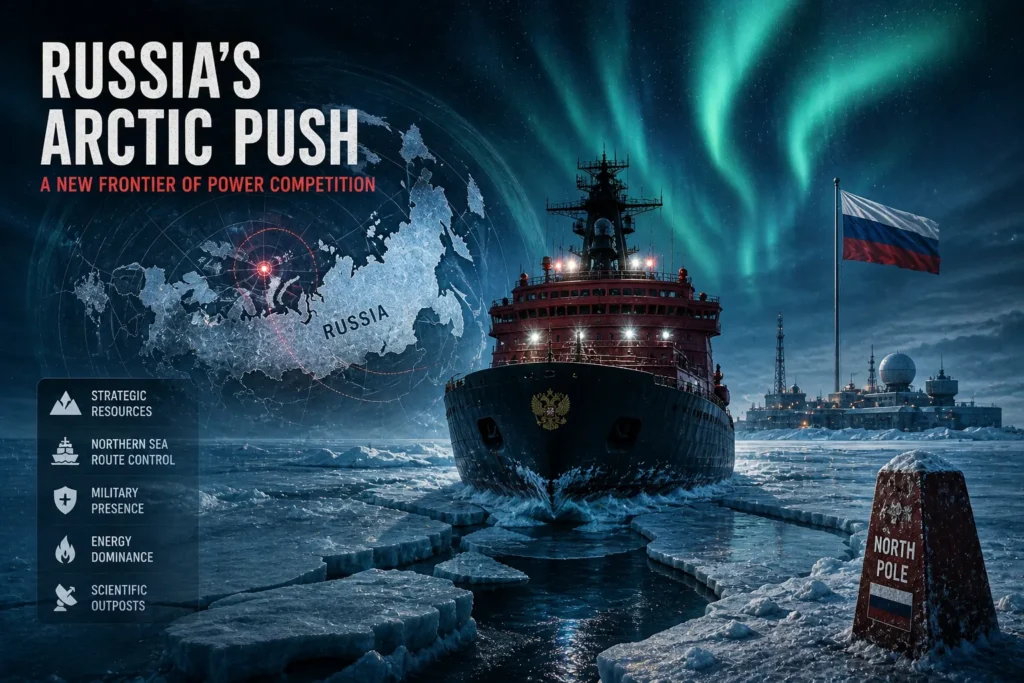
Vast Arctic Resources Fuel Global Interest
The Arctic holds approximately 13 percent of the world’s undiscovered oil reserves and 30 percent of its undiscovered natural gas, according to U.S. Geological Survey estimates. These numbers translate to roughly 90 billion barrels of oil and 1,670 trillion cubic feet of natural gas lying beneath the ice.
Russia controls the largest share of Arctic territory and has moved aggressively to stake its claims. The country submitted a revised claim to the United Nations in 2015, asserting sovereignty over 1.2 million square kilometers of Arctic seabed, including areas around the North Pole. This claim, if accepted, would grant Russia exclusive rights to extract resources from an area roughly the size of South Africa.
Beyond hydrocarbons, the Arctic contains substantial deposits of rare earth minerals essential for modern technology. Nickel, copper, zinc, and rare earth elements critical for electronics and renewable energy infrastructure lie scattered across the region. As global demand for these materials intensifies, Arctic reserves become increasingly valuable strategic assets.
Russia’s Resource Extraction Accelerates
Russian energy giant Rosneft has already begun commercial operations in Arctic waters, despite international sanctions. The company’s projects in the Kara and Barents Seas demonstrate Moscow’s commitment to Arctic development regardless of external pressure. These operations generate revenue while establishing facts on the ground that strengthen Russia’s territorial claims.
Climate Change Opens Critical Shipping Routes
Melting Arctic ice is creating new maritime pathways that could revolutionize global trade. The Northern Sea Route along Russia’s Arctic coast offers a shipping passage between Europe and Asia that is roughly 40 percent shorter than traditional routes through the Suez Canal.
In 2023, cargo volume through the Northern Sea Route reached 36.2 million tons, representing a significant increase from previous years. This growth occurs as shipping companies recognize the route’s potential to reduce transit times from 35 days via Suez to just 20 days through Arctic waters.
The economic implications are staggering. Shorter shipping routes translate to lower fuel costs, reduced labor expenses, and faster delivery times. For countries seeking alternatives to congested or politically sensitive traditional routes, Arctic passages offer strategic independence from potential disruptions in the Middle East or other volatile regions.
The Northeast and Northwest Passages Gain Viability
While Russia controls the Northern Sea Route, other Arctic passages are becoming navigable. The Northwest Passage through Canadian Arctic waters and various routes north of Alaska present alternative options for commercial shipping. However, Russia’s route currently offers the most developed infrastructure and longest season of navigable waters.
Russia Builds Military Infrastructure Across the Arctic
Moscow has systematically expanded its Arctic military presence since 2014, constructing new bases, airfields, and radar installations across its northern territories. The Russian military has reopened Soviet-era installations and built entirely new facilities, creating a comprehensive defensive network along its Arctic frontier.
The Nagurskoye airbase on Franz Josef Land, one of the world’s northernmost military installations, exemplifies Russia’s Arctic strategy. This facility can accommodate modern fighter aircraft and serves as a staging point for operations across the Arctic Ocean. Russia has also established the Trefoil military base on Alexandra Land, designed to house 150 personnel year-round in harsh Arctic conditions.
Russian military exercises in the Arctic have increased in frequency and scale. The country regularly conducts training operations involving submarines, surface vessels, and aircraft specifically adapted for Arctic warfare. These exercises demonstrate operational capabilities while sending clear signals about Russia’s commitment to defending its Arctic interests.
Nuclear-Powered Icebreakers Lead Arctic Operations
Russia operates the world’s only nuclear-powered icebreaker fleet, giving it unmatched year-round Arctic access. The country currently maintains four nuclear icebreakers in service, with three more under construction. These vessels enable military and commercial operations in conditions that would halt other nations’ activities.
This icebreaker advantage extends beyond military applications. Russian nuclear icebreakers escort commercial vessels through Arctic routes, generating revenue while demonstrating Moscow’s control over northern shipping lanes.
Competing Powers Respond to Russian Arctic Expansion
The United States has recognized the strategic challenge posed by Russia’s Arctic buildup. The U.S. Navy published its Arctic Strategy in 2021, emphasizing the need for increased American presence in polar regions. However, American Arctic capabilities lag significantly behind Russia’s decades of focused development.
China, despite lacking Arctic territory, has declared itself a “near-Arctic state” and invested heavily in Arctic research and development projects. Chinese companies have partnered with Russian firms on Arctic energy projects, while Beijing’s Belt and Road Initiative includes an Arctic component dubbed the “Polar Silk Road.”
European nations with Arctic territories—Norway, Denmark, and Iceland—find themselves caught between cooperation with traditional NATO allies and the practical reality of Russian dominance in the region. Norway has increased defense spending and enhanced cooperation with U.S. forces, while Denmark has strengthened its presence in Greenland.
NATO Adapts to Arctic Competition
The military alliance has gradually shifted attention northward, conducting Arctic exercises and establishing cold-weather training programs. However, NATO’s Arctic response remains limited compared to Russia’s comprehensive regional strategy. Geographic realities favor Russia, which shares the longest Arctic coastline and has spent decades developing polar expertise.
Environmental Transformation Accelerates Strategic Competition
Arctic sea ice is disappearing at a rate of 13 percent per decade, fundamentally altering the region’s accessibility. What once required specialized icebreakers now allows conventional vessels to operate for extended periods. This environmental change transforms economic calculations for resource extraction and shipping operations.
The Arctic is warming twice as fast as the global average, a phenomenon known as Arctic amplification. This rapid change creates new opportunities while eliminating traditional barriers that previously limited human activity in the region.
Permafrost thaw exposes previously frozen mineral deposits while simultaneously creating infrastructure challenges for Arctic development. Russian projects must adapt to changing ground conditions, but the country’s extensive Arctic experience provides advantages over newcomers to the region.
Control Over Arctic Routes Could Reshape Global Commerce
Dominance in Arctic navigation represents more than shipping efficiency—it offers strategic leverage over global trade flows. Countries controlling Arctic routes could influence commerce between major economic centers, potentially disrupting established trade patterns during geopolitical disputes.
Russia’s position along the most viable Arctic shipping route grants Moscow significant influence over this emerging transportation corridor. The country can set transit fees, impose regulatory requirements, and determine access conditions for foreign vessels. This control mechanism could become as strategically important as traditional maritime chokepoints.
The Arctic represents one of the most overlooked geopolitical hotspots today. Because it lacks immediate conflict, it doesn’t attract the same attention as other regions. But this quiet competition makes it particularly dangerous—tensions are building without clear rules or established international norms governing Arctic activities.
The Arctic Becomes Central to Global Power Competition
What was once Earth’s most remote frontier now stands at the center of 21st-century geopolitical competition. Russia’s systematic Arctic expansion reflects a long-term strategy to control resources and routes that could define global commerce for decades to come.
The transformation is irreversible. Climate change continues opening Arctic territories, while technological advances make resource extraction and shipping operations increasingly viable. Countries that establish dominant positions now will shape Arctic governance and benefit from its strategic advantages.
Russia’s head start in Arctic development provides substantial advantages, but other powers are beginning to respond. The Arctic is transitioning from a remote, underutilized region into a strategic hub where control over routes and resources could redefine global trade patterns, particularly between Europe and Asia. What we are witnessing represents the early stage of a long-term strategic contest that will influence international relations far beyond the polar region itself.