
Latin America Repositions Itself — A Quiet Shift Away from Traditional Influence
Across Latin America, a fundamental recalibration is underway. From Mexico City to Buenos Aires, governments are quietly diversifying their international partnerships, moving beyond decades of dependency on traditional Western allies. This isn’t the dramatic pivot that captures headlines, but rather a calculated repositioning that reflects both economic necessity and newfound leverage in an increasingly multipolar world.
In my view, Latin America is entering a phase of quiet transformation. The region’s abundant resources and strategic geography have never been more valuable, creating opportunities for countries to pursue multiple relationships simultaneously rather than relying on a single dominant partner.
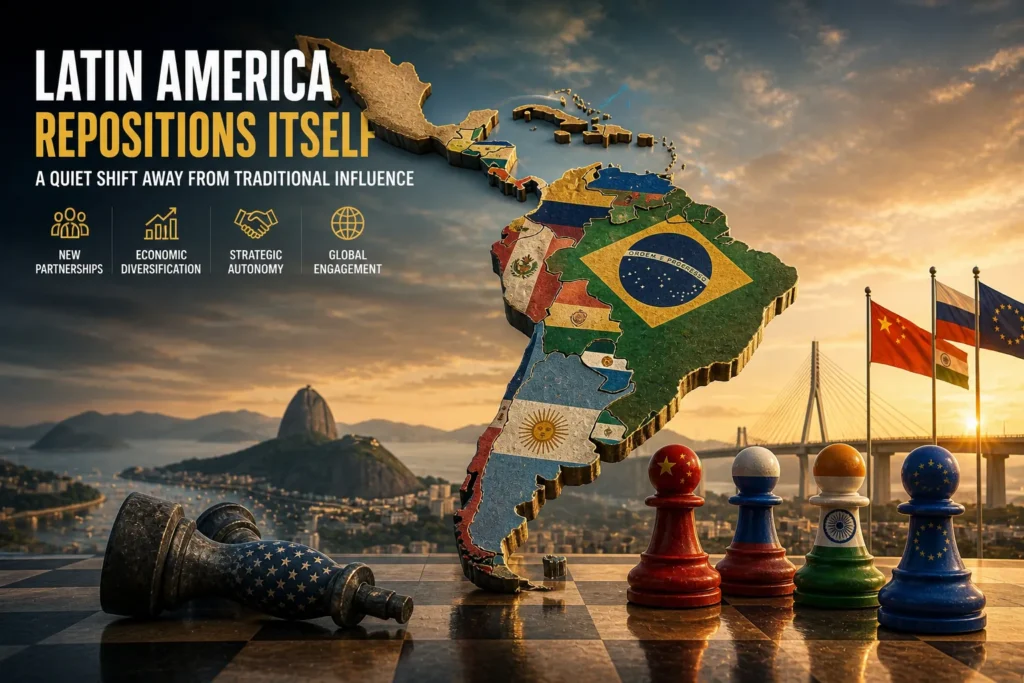
Latin America Expands Beyond Traditional Western Partnerships
The days when Latin American foreign policy could be predicted by proximity to Washington are fading. Countries across the region now maintain active diplomatic and economic relationships with powers spanning three continents, from Beijing to Moscow to New Delhi.
Brazil exemplifies this shift most clearly. Under both Jair Bolsonaro and Luiz Inácio Lula da Silva, the country has maintained its BRICS membership while simultaneously strengthening ties with European partners and preserving its relationship with the United States. This pragmatic approach allows Brazil to access Chinese infrastructure investment, European technology, and American markets without committing exclusively to any single bloc.
Mexico’s approach has been similarly calculated. Despite its deep integration with North American markets through the USMCA, Mexico has expanded trade relationships with Asian partners and maintained diplomatic independence on global issues where its interests diverge from Washington’s preferences.
Strategic Autonomy Replaces Automatic Alignment
The concept of automatic alignment with traditional partners has given way to issue-by-issue decision making. Countries now evaluate each international commitment based on domestic priorities rather than historical relationships or ideological compatibility.
China’s Economic Footprint Reshapes Regional Calculations
China’s presence in Latin America has moved far beyond trade statistics to become a fundamental factor in regional strategic planning. Beijing is now the top trading partner for Brazil, Chile, Peru, and Uruguay, while Chinese companies have invested over $130 billion in the region since 2005.
The Belt and Road Initiative has found fertile ground in Latin America, with 21 countries now participating in various infrastructure and connectivity projects. Ecuador’s Coca Codo Sinclair hydroelectric dam, built with Chinese financing and expertise, generates nearly half the country’s electricity. Similar projects across the region have created economic relationships that extend far beyond traditional commodity exports.
This economic integration carries political implications. When the United States pressed allies to exclude Huawei from 5G networks, several Latin American countries declined to follow suit, citing economic pragmatism over security concerns that seemed distant from their immediate priorities.
Infrastructure Investment Creates Long-term Dependencies
Chinese infrastructure projects often come with decades-long repayment schedules and operational agreements that embed Beijing’s influence deep into recipient countries’ economic planning. While this provides immediate development benefits, it also creates new forms of external influence that replace rather than eliminate dependency relationships.
Economic Pressures Accelerate Strategic Diversification
High inflation rates, mounting debt burdens, and currency volatility have pushed Latin American governments to seek multiple sources of investment, trade, and financial support. Traditional lenders and partners simply cannot meet the region’s development needs alone.
Argentina’s recent decision to join the BRICS coalition reflects this reality. Facing a debt crisis and limited access to international capital markets, Buenos Aires views BRICS membership as a potential pathway to alternative financing and trade arrangements denominated in currencies other than the dollar.
Colombia’s approach illustrates how economic necessity drives diplomatic creativity. While maintaining strong security cooperation with the United States, Colombia has simultaneously expanded agricultural exports to China and pursued infrastructure partnerships with European firms, spreading both risk and opportunity across multiple relationships.
Regional Integration Gains New Momentum
Latin American countries are rediscovering the benefits of stronger intra-regional cooperation as global supply chains prove vulnerable to disruption and external pressure. The Pacific Alliance, comprising Mexico, Colombia, Peru, and Chile, has eliminated tariffs on 95% of goods traded among member countries and created integrated stock markets.
The recent revival of UNASUR talks, despite previous political divisions, reflects growing recognition that regional cooperation provides leverage in negotiations with external powers. When countries can present unified positions on trade, environmental policy, or infrastructure development, they command greater attention and better terms from global partners.
Brazil and Argentina’s discussions about creating a common currency for bilateral trade represent the most ambitious regional integration initiative in decades. While implementation faces significant obstacles, the mere consideration of such mechanisms demonstrates how far regional thinking has evolved beyond traditional approaches.
Resource Wealth Attracts Intensified Global Competition
Latin America’s lithium deposits, essential for electric vehicle batteries, have become a focal point of international competition. The “lithium triangle” spanning Argentina, Bolivia, and Chile contains over half the world’s known reserves, giving these countries unprecedented leverage in negotiations with automotive and technology companies worldwide.
Agricultural resources carry similar strategic weight. As global food security concerns intensify, Brazil’s position as a major grain exporter provides significant diplomatic influence. The country has used this leverage to resist pressure on environmental policies while securing favorable trade agreements with multiple partners.
Energy resources continue to drive international interest, but with new dynamics. Guyana’s recent oil discoveries have attracted investment from American, Chinese, and European companies simultaneously, allowing Georgetown to avoid exclusive relationships that might limit its options.
Political Changes Reshape Foreign Policy Priorities
Electoral cycles across Latin America have brought leaders with different international orientations, but the underlying trend toward diversification persists regardless of ideological differences. Conservative and progressive governments alike recognize the benefits of maintaining multiple partnerships.
Chile’s Gabriel Boric has maintained the country’s diverse international relationships despite campaign rhetoric suggesting a more leftward orientation. Similarly, Ecuador’s Guillermo Lasso pursued pragmatic engagement with China while strengthening ties with the United States, demonstrating how domestic political changes need not dictate dramatic foreign policy reversals.
This consistency across political transitions reflects the institutionalization of diversified foreign policy approaches. Professional diplomatic corps and established business relationships create continuity that survives electoral changes.
A New Regional Identity Takes Shape
Latin America is positioning itself with greater confidence and autonomy on the global stage. The region’s response to the conflict in Ukraine illustrated this independence, with most countries declining to fully align with either Western sanctions or Russian positions, instead advocating for diplomatic solutions while maintaining relationships with all parties.
The key question is whether this shift will lead to greater stability or simply expose the region to new forms of external influence. The outcome depends on how effectively countries manage this growing attention from global powers while building genuine regional cooperation that strengthens their collective bargaining position.
This transformation may not dominate international headlines, but it represents a fundamental shift in how Latin America engages with the world. The region is no longer content to be anyone’s backyard.