
Global Trade Is Fragmenting — The End of a Unified Economic System?
The decades-long march toward interconnected global markets is hitting a wall. Companies that once optimized supply chains purely for cost are now redesigning them for security. Nations that embraced open trade are building barriers to protect strategic industries. The question isn’t whether global trade is fragmenting—it’s how far this shift will go and what replaces the system that defined the post-Cold War era.
Supply Chains Are Being Rebuilt Around Risk, Not Cost
Multinational corporations are quietly dismantling supply networks that took decades to perfect. Apple has accelerated production shifts from China to India and Vietnam. Intel announced a $20 billion semiconductor facility in Ohio, breaking from its traditional reliance on Asian manufacturing. These moves signal a fundamental recalculation: efficiency matters less than avoiding disruption.
The pandemic exposed how quickly global supply chains could snap. When Chinese factories shut down in early 2020, automakers in Detroit faced parts shortages within weeks. Pharmaceutical companies discovered that 80% of active ingredients for essential drugs came from China and India. These vulnerabilities forced executives to rethink the wisdom of concentrating production in single regions, no matter how cost-effective.
Companies Are Paying More for Strategic Independence
This restructuring comes with a price tag. McKinsey estimates that reshoring manufacturing could increase costs by 15-25% across major industries. Yet companies are accepting these expenses as insurance against geopolitical shocks. The logic is simple: losing market access entirely costs more than paying higher production expenses.
Strategic Partnerships Are Replacing Open Markets
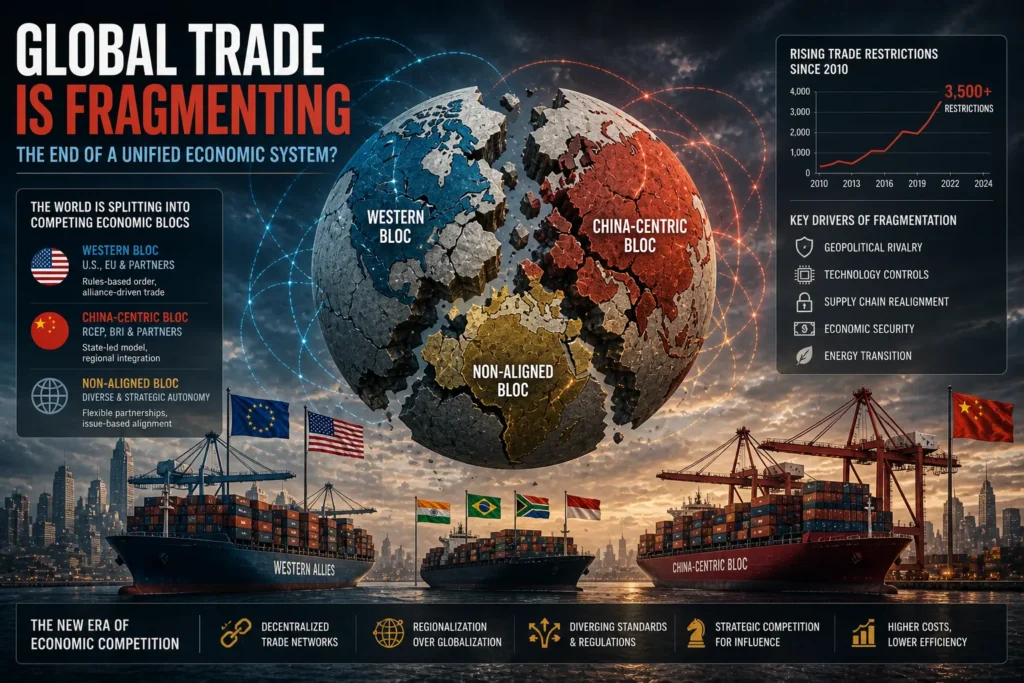
Countries are forming tighter economic clusters based on shared security interests rather than pure trade advantages. The U.S.-Mexico-Canada Agreement strengthened North American integration while creating barriers for outside competitors. The Indo-Pacific Economic Framework links 14 nations in a China-alternative trading system. Europe’s Critical Raw Materials Act aims to reduce dependence on Chinese rare earth supplies.
These partnerships represent a return to bloc-based trade reminiscent of the Cold War era, but with modern characteristics. Unlike the rigid ideological divisions of the past, today’s blocs allow for overlapping memberships and selective cooperation. Countries can participate in multiple frameworks while maintaining different levels of commitment.
The European Union’s approach exemplifies this strategy. Brussels maintains trade relationships with China while simultaneously reducing strategic dependencies through partnerships with trusted suppliers in Africa and Latin America. This dual approach—engagement with competitors, deeper integration with allies—is becoming the new normal.
Protectionist Policies Gain Mainstream Acceptance
Government intervention in trade has shed its stigma across the political spectrum. The Biden administration’s CHIPS Act provides $52 billion in semiconductor subsidies, explicitly designed to compete with Chinese manufacturing. France announced a €30 billion industrial policy to rebuild domestic production capacity. Even traditionally free-market Britain launched a National Security and Investment Act giving the government power to block foreign acquisitions.
This shift reflects changed political calculations. Voters who once welcomed cheap imports now worry about job security and national resilience. Politicians respond by promising to bring production home, regardless of economic efficiency arguments that dominated previous decades.
Tariffs Return as Policy Tools
Trade barriers are proliferating beyond traditional sectors. The U.S. maintains tariffs on roughly $350 billion worth of Chinese goods, with limited pushback from business groups that once opposed such measures. The EU imposed anti-dumping duties on Chinese steel, solar panels, and electric vehicles. These policies enjoy broad public support, suggesting the political consensus around free trade has permanently shifted.
Security Concerns Override Economic Efficiency
Strategic considerations now drive trade policy in ways that seemed impossible a generation ago. The Netherlands restricted exports of advanced semiconductor equipment to China, despite losing billions in revenue. Germany reconsidered energy partnerships with Russia even before the Ukraine invasion. Japan imposed export controls on high-tech materials despite close economic ties with affected countries.
This represents a fundamental reordering of priorities. Cost optimization and supply chain efficiency—the driving forces of globalization—are being displaced by national security calculations and resilience planning.
The semiconductor industry illustrates this transformation most clearly. Chips power everything from smartphones to military systems, making their production a national security priority. Countries that once relied on market forces to determine production locations now invest heavily in domestic capacity, regardless of economic rationale.
New Opportunities Emerge for Strategic Locations
Trade fragmentation creates winners alongside the losers. Mexico benefits from nearshoring as U.S. companies relocate production from Asia. Vietnam attracts electronics manufacturing seeking alternatives to China. Poland becomes a logistics hub as European companies diversify supply sources.
These shifts represent more than temporary adjustments. They’re creating new industrial centers that could persist for decades. Countries positioning themselves as reliable partners for major economies stand to capture investment flows that previously concentrated in established manufacturing hubs.
India’s rise in global manufacturing reflects this opportunity. The country attracted $24 billion in electronics production commitments in 2023, much of it from companies seeking China alternatives. This investment builds long-term industrial capacity that will shape trade patterns well beyond current geopolitical tensions.
Trade Disputes Intensify Between Major Powers
Commercial conflicts between the United States and China continue expanding beyond initial tariff battles. Technology transfer restrictions, investment screening, and export controls create a complex web of economic barriers. The European Union faces similar tensions as it balances commercial interests against security concerns about Chinese technology and investment.
These disputes reflect deeper competition for economic influence and technological leadership. Trade becomes an extension of strategic rivalry rather than a separate economic domain. This politicization makes traditional trade negotiations more difficult and future agreements less stable.
A More Divided Economic World Takes Shape
The era of “pure globalization” is coming to an end. What replaces it will not be complete breakdown—but a reconfiguration. Trade will continue, but within more defined blocs and strategic boundaries.
This new system may prove less efficient but more stable in terms of security. Whether that trade-off is worth it remains to be seen. What’s certain is that the unified global economic system that emerged after the Cold War is fragmenting into something more complex and less predictable.
The challenge ahead lies in managing this transition without triggering a complete retreat into economic nationalism. Countries must balance legitimate security concerns against the benefits that international trade still provides. The outcome will determine whether global trade fragmentation leads to a more resilient system or simply a more expensive one.