Turkey Expands Regional Influence — A Strategic Balancing Act Between East and West
Turkey’s president Recep Tayyip Erdoğan made headlines in October 2023 when he simultaneously hosted Hamas leaders in Ankara while maintaining NATO membership and pursuing EU trade partnerships. This moment captures Turkey’s broader geopolitical strategy: a calculated effort to expand regional influence without committing fully to any single power bloc. Turkey’s approach reflects the rise of “middle powers” that operate with strategic flexibility rather than strict alignment, using their geographic position as leverage while navigating increasingly complex international relationships.
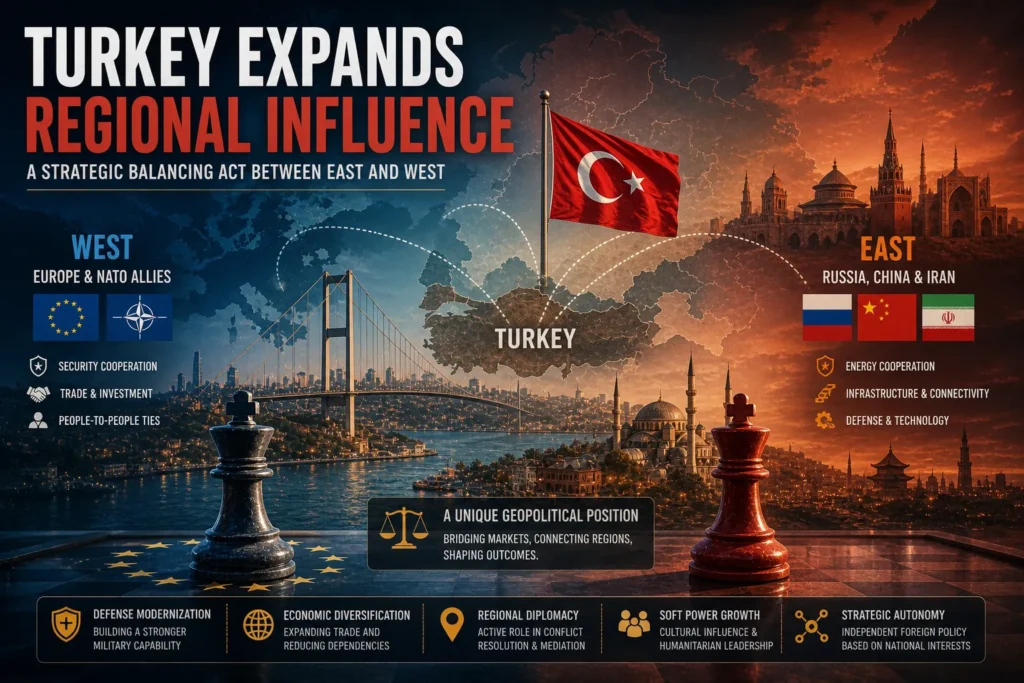
Turkey Positions Itself as a Bridge Between Competing Power Blocs
Turkey’s geographic position at the crossroads of Europe, Asia, and the Middle East has become its greatest strategic asset. The country maintains active diplomatic and economic relationships with the United States and European Union while simultaneously deepening ties with Russia, China, and Middle Eastern powers.
This multi-directional approach became particularly evident during the Ukraine conflict. While Turkey provided military drones to Ukraine and closed the Bosphorus to Russian warships, it also refused to join Western sanctions against Moscow and continued importing Russian energy. Turkey’s diplomatic efforts, including hosting grain deal negotiations between Russia and Ukraine in 2022, demonstrated its ability to maintain dialogue with opposing sides.
Strategic Partnerships Span Multiple Continents
Turkey has cultivated defense relationships that would seem contradictory under traditional alliance structures. The country purchased Russia’s S-400 missile defense system in 2019 despite being a NATO member, triggering U.S. sanctions and removal from the F-35 fighter program. Simultaneously, Turkey expanded defense cooperation with Pakistan, Qatar, and Azerbaijan while maintaining its role in NATO operations.
Economic partnerships follow similar patterns. Turkey joined China’s Belt and Road Initiative while pursuing closer trade ties with the European Union. Turkish construction companies have secured major infrastructure projects across Africa and Central Asia, extending Ankara’s influence far beyond its immediate neighborhood.
Turkey’s Military and Diplomatic Reach Extends Across Multiple Theaters
Turkey has transformed from a primarily defensive military posture to active involvement in conflicts across three continents. Since 2016, Turkish forces have conducted operations in Syria, Iraq, Libya, and provided decisive support to Azerbaijan during the 2020 Nagorno-Karabakh conflict.
The Libya intervention exemplifies Turkey’s new approach. In 2019, Turkey deployed military advisors and Syrian proxy forces to support the UN-recognized Government of National Accord in Tripoli. This intervention prevented the collapse of the Tripoli government and secured Turkish access to Eastern Mediterranean energy resources through maritime boundary agreements.
Military Technology Becomes Diplomatic Currency
Turkey’s indigenous defense industry has become a key tool of influence. Turkish drones proved highly effective in Syria, Libya, and Nagorno-Karabakh, creating international demand for Turkish military technology. Countries including Ukraine, Poland, Morocco, and several African nations have purchased Turkish drones, creating new diplomatic relationships and reducing Turkey’s dependence on Western military suppliers.
The success of Turkish military technology has also strengthened domestic political support for Erdoğan’s foreign policy approach, demonstrating tangible benefits from Turkey’s more assertive regional stance.
Energy Transit Routes Cement Turkey’s Strategic Value
Turkey controls critical energy infrastructure connecting European markets with Middle Eastern and Central Asian suppliers. The country hosts multiple pipeline projects, including the Baku-Tbilisi-Ceyhan oil pipeline and the Trans-Anatolian Natural Gas Pipeline, making it an essential energy hub.
The 2023 completion of the TurkStream pipeline from Russia, combined with Turkey’s role in the Southern Gas Corridor from Azerbaijan, gives Ankara significant leverage over European energy security. Turkey can influence gas flows to Europe while maintaining its own energy supply relationships with multiple providers.
Turkey’s energy diplomacy extends to renewable sources as well. The country has signed agreements to export renewable energy to Europe while developing domestic solar and wind capacity. This positions Turkey as a long-term energy partner rather than merely a transit route.
Regional Conflicts Create Mediation Opportunities
Turkey has positioned itself as an indispensable mediator in multiple regional disputes. Beyond the Russia-Ukraine grain deal, Turkey has facilitated prisoner exchanges, diplomatic talks, and ceasefire negotiations across different conflicts.
In Syria, Turkey controls significant territory through its military operations while maintaining diplomatic channels with both the Assad government’s backers in Moscow and Iran, and opposition supporters in Washington and European capitals. This gives Turkey unique influence over any eventual Syrian settlement.
Turkey’s relationship with Iran demonstrates this balancing act clearly. Despite supporting opposing sides in Syria and competing for influence in Iraq, both countries coordinate on Kurdish issues and maintain substantial trade relationships. Turkey has also avoided fully joining U.S. sanctions on Iran while not openly defying American pressure.
Domestic Politics Drive International Strategy
Erdoğan’s domestic political base strongly supports Turkey’s more assertive foreign policy. The ruling AKP party has framed Turkey’s regional involvement as restoring the country’s historical great power status, resonating with voters who view Turkey as unfairly constrained by Western allies.
Economic pressures at home also influence foreign policy choices. Turkey’s 2018 currency crisis and subsequent economic challenges have pushed the government to seek alternative trading partners and investment sources beyond traditional Western allies.
The approach carries significant risks. Balancing multiple sides can bring influence, but missteps could isolate Turkey from key partners if relationships deteriorate simultaneously on multiple fronts.
NATO Membership Creates Strategic Tensions and Opportunities
Turkey’s NATO membership provides security guarantees while creating friction over its relationships with Russia and Middle Eastern partners. The 2019 S-400 purchase triggered the most serious crisis in U.S.-Turkey relations since the 1974 Cyprus invasion.
However, Turkey has also used its NATO position strategically. As the alliance’s second-largest military, Turkey has blocked Swedish NATO membership over arms embargos and demanded concessions on Kurdish issues. This demonstrates how Turkey uses institutional membership to pursue bilateral objectives.
Turkey’s control of NATO’s southeastern flank gives it significant influence over alliance strategy in the Black Sea, Eastern Mediterranean, and Middle East regions. The country hosts U.S. nuclear weapons while simultaneously developing independent defense capabilities.
An Independent Multi-Vector Strategy Takes Shape
Turkey’s current approach represents a fundamental shift from Cold War-era alignment patterns. Rather than choosing between East and West, Turkey is crafting an independent path that maximizes its options while accepting higher levels of international tension.
This strategy reflects broader changes in global power distribution. As U.S. global dominance declines and multiple power centers emerge, middle powers like Turkey gain opportunities to pursue more independent policies. Turkey’s success in maintaining relationships across competing blocs may serve as a model for other countries seeking strategic autonomy in an increasingly multipolar world.
The sustainability of this approach depends on Turkey’s ability to provide value to multiple partners while avoiding actions that force others to demand exclusive loyalty. So far, Turkey’s geographic importance and military capabilities have provided sufficient leverage to maintain this delicate balance, but the strategy’s long-term viability remains an open question as global tensions continue to intensify.