
Space Becomes the Next Battlefield as Global Powers Expand Military Reach Beyond Earth
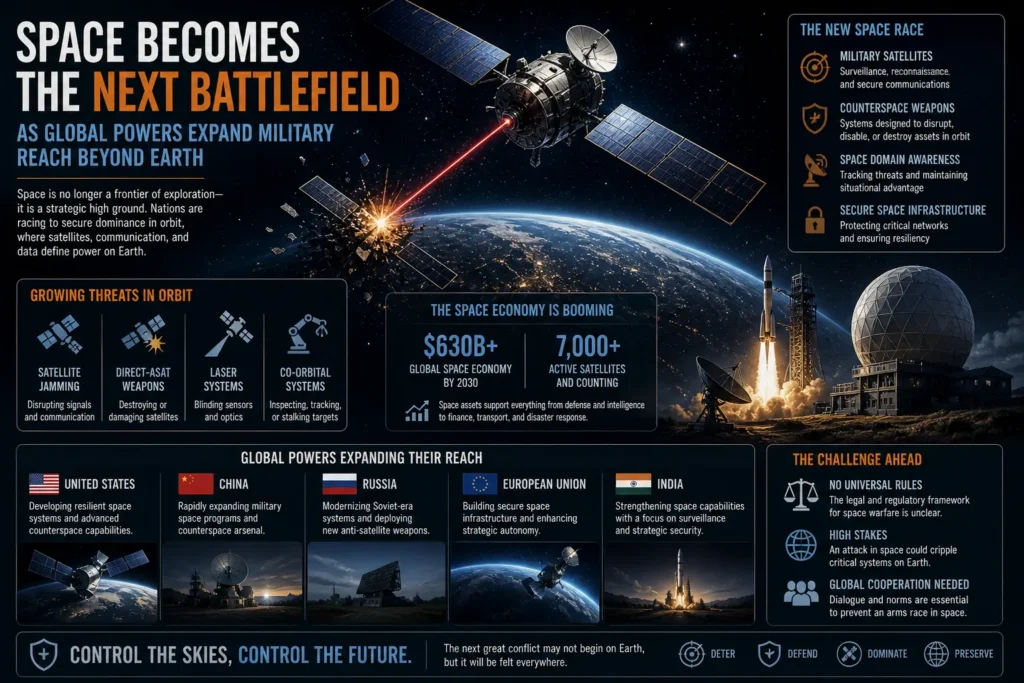
Major powers are quietly preparing for a new kind of warfare that extends far beyond traditional terrestrial boundaries. Space becomes the next battlefield as global powers expand beyond Earth, transforming what was once the domain of scientific exploration into a strategic frontier where nations compete for military advantage and economic control. The shift represents more than technological advancement—it signals a fundamental change in how countries project power and secure their national interests.
This competition affects every connected device, GPS system, and communication network on Earth. Space competition remains underestimated, yet what happens in orbit increasingly determines what happens on the ground.
Critical Space Infrastructure Reshapes National Security
Satellites now form the backbone of modern military and civilian operations. The United States operates over 3,000 active satellites, while China has rapidly expanded its constellation to more than 500 operational units as of 2024. These orbital assets enable everything from precision-guided weapons to financial transactions.
Military forces depend on satellite networks for real-time intelligence, troop coordination, and weapons guidance. The Global Positioning System, originally developed by the U.S. Department of Defense, illustrates how space infrastructure underpins both military operations and civilian services. European nations developed their own Galileo system partly to reduce dependence on American-controlled GPS.
Communication Networks Become Strategic Assets
Modern warfare relies heavily on secure satellite communications that cannot be easily intercepted or disrupted. Russia’s invasion of Ukraine demonstrated this reality when both sides targeted communication infrastructure, while SpaceX’s Starlink terminals became crucial for maintaining Ukrainian military coordination. The incident revealed how private companies now control assets that can determine battlefield outcomes.
Military Capabilities in Space Accelerate Across Nations
The Pentagon established the U.S. Space Force in 2019, recognizing space as a distinct warfare domain alongside land, sea, air, and cyber operations. Russia formed its Space Forces in 2001, while China created the Strategic Support Force in 2015 to handle space and cyber operations.
Countries are developing both defensive and offensive space capabilities. The U.S. military operates ground-based jammers that can disrupt enemy satellite signals without creating permanent damage. China and Russia have tested co-orbital interceptors—satellites designed to approach and potentially disable other spacecraft. India demonstrated its anti-satellite capabilities in 2019 by destroying one of its own satellites with a ground-launched missile.
Weapons Testing Moves Beyond Demonstration
These tests signal serious military intent rather than mere technological display. The Pentagon’s 2023 budget allocated $24.5 billion to space-related military programs, including defensive systems to protect American satellites and offensive capabilities to threaten adversary space assets. Similar spending increases are occurring across major military powers.
Private Space Companies Reshape the Strategic Landscape
Commercial space ventures have transformed from niche industries to strategic national assets. SpaceX launches more satellites annually than most countries operate in total, while companies like Planet Labs provide real-time Earth imaging that rivals government intelligence capabilities.
The commercial space economy reached $469 billion in 2021, with launch costs dropping dramatically due to reusable rocket technology. This accessibility means more nations and non-state actors can deploy space capabilities that were previously limited to superpowers.
Corporate Assets Become National Resources
Governments increasingly rely on private space companies for military and intelligence operations. The U.S. military contracts with commercial satellite operators for communications and imaging services, while Ukraine’s military depends on Starlink for battlefield connectivity. These relationships blur the line between civilian and military space infrastructure.
Strategic Orbital Positions Drive International Competition
Certain orbital locations offer significant advantages for communication, surveillance, and potential military operations. Geostationary orbit, approximately 22,000 miles above Earth, allows satellites to maintain fixed positions relative to the planet’s surface. Only limited slots exist in this valuable orbital real estate.
The International Telecommunication Union coordinates satellite positions, but the system operates on a first-come, first-served basis that favors early space powers. China has accelerated satellite deployments to claim desirable orbital positions before competitors can secure them.
Satellite Constellations Create New Strategic Dynamics
Low Earth orbit hosts growing constellations of interconnected satellites that provide global coverage for communications and surveillance. SpaceX’s Starlink network includes over 5,000 active satellites, while Amazon plans a 3,200-satellite constellation called Project Kuiper. These massive networks create new dependencies and potential vulnerabilities.
International Space Governance Struggles with Modern Realities
The 1967 Outer Space Treaty established basic principles for space activities, but it predates most current technologies and military applications. The treaty prohibits weapons of mass destruction in space but does not address conventional weapons, cyber attacks, or the military use of civilian satellites.
No international body effectively regulates the growing number of space actors or emerging military activities. The United Nations Committee on the Peaceful Uses of Outer Space operates by consensus, making rapid policy adaptation nearly impossible when major powers disagree.
Regulatory Gaps Enable Aggressive Behavior
Current international law provides little recourse when nations test anti-satellite weapons or deploy satellites with unclear purposes. China’s Shijian-17 satellite has demonstrated the ability to move close to other spacecraft and extend a robotic arm, capabilities that could serve either maintenance or hostile purposes. Existing treaties offer no clear framework for addressing such ambiguous activities.
Future Conflicts May Target Space-Based Assets
Military strategists recognize that disabling an adversary’s satellite network could cripple modern military operations without directly attacking terrestrial targets. Space assets are particularly vulnerable because they operate in predictable orbits and cannot easily maneuver to avoid threats.
A successful attack on GPS satellites would disrupt not only military navigation but also civilian infrastructure including banking systems, power grids, and transportation networks. This interconnectedness makes space infrastructure an attractive target for adversaries seeking maximum impact with minimal escalation.
Space Control Emerges as a Pillar of Global Power
Nations that control key space infrastructure will shape international affairs much like those that historically controlled sea lanes or strategic territories. The ability to provide or deny satellite services creates new forms of leverage in diplomatic and economic relationships.
Space dominance offers advantages that extend far beyond military applications. Countries with advanced space capabilities can monitor global agricultural production, track natural resources, and observe economic activity in ways that provide significant intelligence and competitive advantages. The race for space control represents a fundamental shift in how nations compete for global influence, making orbital supremacy as important as any traditional measure of national power.