
Climate Migration Increases — Environmental Pressure Reshapes Global Stability
The displacement of populations due to environmental changes has shifted from a distant forecast to an active reality reshaping borders, economies, and political calculations worldwide. Climate migration increases as droughts persist longer, floods strike more frequently, and coastal areas face permanent inundation. Yet the full scope of this challenge extends far beyond humanitarian concerns—it represents a fundamental disruption to established patterns of governance, resource allocation, and international relations that many institutions remain unprepared to handle.
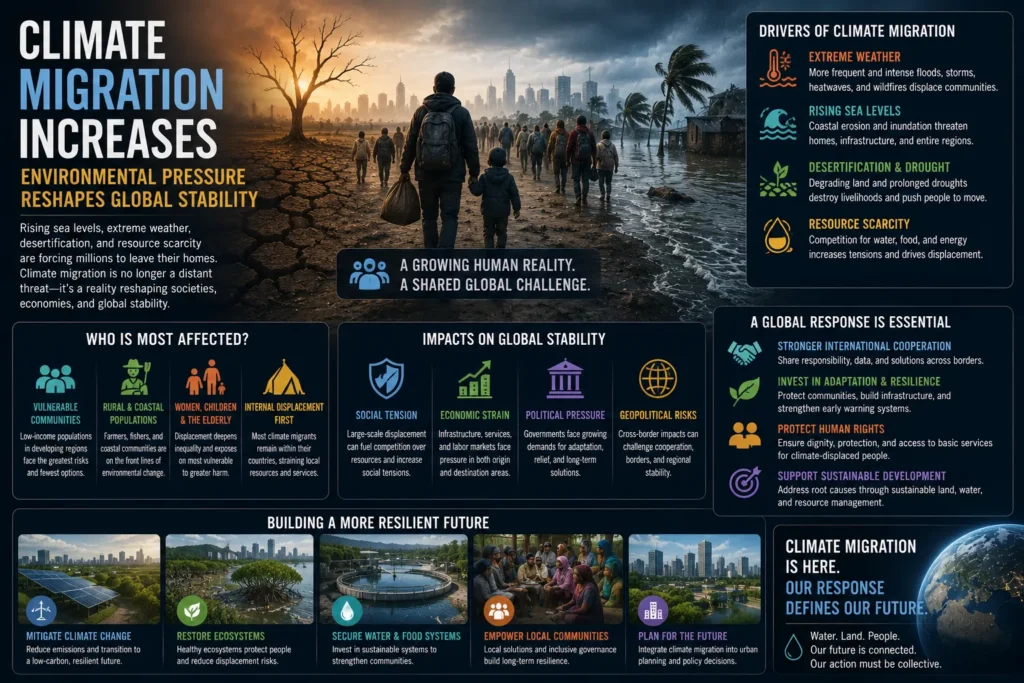
Environmental Forces Accelerate Population Displacement
Rising global temperatures and increasingly extreme weather patterns are pushing communities beyond their adaptive capacity. The Internal Displacement Monitoring Centre reported that weather-related disasters displaced 21.5 million people in 2022 alone, with prolonged droughts in East Africa and severe flooding across Pakistan accounting for millions of these movements.
These displacements follow predictable environmental triggers but create unpredictable social outcomes. When the Sahel region experiences consecutive failed harvests, rural populations move toward urban centers or cross international boundaries seeking economic opportunities. Similar patterns emerge when typhoons repeatedly devastate island communities or when aquifers run dry in agricultural regions.
The distinction between voluntary migration and forced displacement becomes murky when environmental degradation gradually erodes livelihoods over years or decades, making traditional policy frameworks inadequate for addressing these complex movements.
Coastal Communities Confront Irreversible Changes
Sea-level rise presents perhaps the most visible and irreversible driver of climate migration. Major urban centers including Miami, Bangkok, and Lagos face increasing flood frequency during high tides and storm surges. The economic implications extend beyond immediate damage—property values decline, insurance becomes unaffordable, and infrastructure requires costly adaptation measures.
Island Nations Navigate Existential Threats
Small island states like Tuvalu and the Marshall Islands confront the possibility of complete territorial loss within decades. These nations are pioneering legal frameworks for “disappearing state” scenarios, including arrangements for maintaining sovereignty without territory and securing permanent residency rights for displaced citizens in partner countries.
The Pacific Island Forum has negotiated mobility agreements with Australia and New Zealand, but these arrangements cover only a fraction of potentially displaced populations. More significantly, they establish precedents for how climate displacement might be managed through regional cooperation rather than traditional refugee frameworks.
Policy Responses Lag Behind Migration Realities
National governments and international organizations struggle to develop effective responses to climate-driven population movements. Existing refugee law requires persecution as a qualifier for protection, leaving climate migrants in legal limbo when environmental factors drive their displacement.
The European Union’s experience with Syrian refugee flows revealed institutional limits that become more problematic when applied to potentially larger climate-related movements. EU border policies prioritize containment over integration, creating bottlenecks in frontline states like Greece and Italy that lack capacity for large-scale population absorption.
Similarly, the United States has no specific visa category for climate migrants, forcing them to navigate complex asylum processes designed for different circumstances. Recent proposals for climate visas face political resistance despite growing recognition of the issue’s strategic importance.
Economic Systems Strain Under Migration Pressures
Climate migration intensifies competition for housing, employment, and public services in destination areas. When drought drives rural populations into cities like Dakar or Dhaka, informal settlements expand rapidly without corresponding increases in infrastructure capacity or formal employment opportunities.
This economic pressure creates particular challenges for developing countries that host the majority of climate migrants. Bangladesh accommodates millions of internal climate migrants in Dhaka and Chittagong, but job creation has not kept pace with population growth, leading to expanded informal economies and increased vulnerability.
Host communities often experience declining wages and reduced access to services, creating conditions for social tension. Local governments face impossible budget pressures when migration inflows exceed planned population growth by substantial margins.
Regional Cooperation Becomes Essential for Managing Displacement
Cross-border climate migration requires coordinated responses that individual nations cannot manage effectively alone. The Kampala Convention, ratified by 30 African Union members, establishes legal frameworks for protecting internally displaced persons, including those displaced by environmental factors.
Latin American countries have developed innovative approaches through the Cartagena Declaration process, extending refugee-like protection to people fleeing violence and disrupted public order—categories that increasingly overlap with climate impacts. Ecuador, for instance, has provided temporary protection to Venezuelan migrants, many of whom cite climate-related economic collapse among their reasons for leaving.
However, these regional frameworks remain untested at scale. When climate impacts affect multiple countries simultaneously—as occurs with regional droughts or hurricane seasons—the capacity for mutual support becomes constrained.
Population Shifts Generate Political Instability
Rapid demographic changes strain social cohesion and political institutions in both origin and destination areas. Syria’s prolonged drought from 2007 to 2010 contributed to rural-urban migration that intensified existing political tensions, demonstrating how environmental stressors interact with governance failures to produce broader instability.
Similar dynamics emerge when climate migrants alter electoral demographics or compete with established populations for political representation. In India, migration from climate-affected rural areas to urban centers has shifted political coalitions and policy priorities in several states.
The challenge becomes more complex when climate migration crosses ethnic or religious boundaries, as occurs when pastoralist communities move into agricultural areas during droughts, or when coastal populations relocate to highland regions with different cultural practices.
Environmental Disruption Transforms Geopolitical Calculations
Climate migration demonstrates how environmental change can evolve into economic, political, and security challenges simultaneously. What begins as crop failure or coastal flooding becomes a test of institutional capacity, international cooperation, and social resilience across multiple countries and sectors.
Traditional security frameworks focused on military threats prove inadequate for addressing these multidimensional challenges. Climate migration affects trade routes, labor markets, urban planning, and diplomatic relations in ways that require sustained policy attention rather than crisis response.
In my view, climate migration may become one of the defining geopolitical issues of the coming decades because it directly affects stability, governance, and resource distribution across borders. The countries and regions that develop effective frameworks for managing these population movements will gain significant advantages in maintaining social cohesion and economic productivity as environmental pressures intensify. Those that fail to adapt their institutions and policies risk facing cascading disruptions that extend far beyond their borders.