
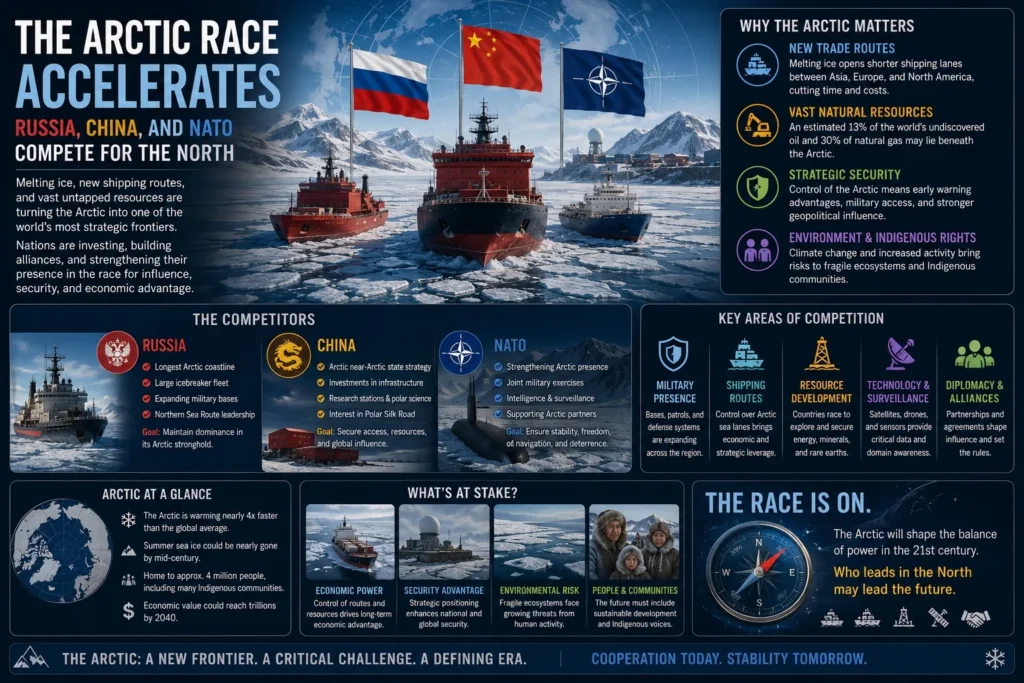
The Arctic Race Accelerates — Russia, China, and NATO Compete for the North
The Arctic has transformed from a frozen periphery into a contested frontier where major powers now compete for influence, resources, and strategic position. As climate change accelerates ice melt across the region, what was once an environmental concern has evolved into a multifaceted geopolitical competition that could reshape global power dynamics for decades to come. Russia strengthens its northern military infrastructure, China positions itself as a “near-Arctic state” despite geographic distance, and NATO members scramble to counter both challengers in a region they once considered securely Western.
This northern competition reflects more than territorial ambition—it represents a fundamental shift in how nations view Arctic access, from scientific curiosity to economic necessity and strategic imperative.
Climate Change Opens New Strategic Possibilities
Melting ice has fundamentally altered Arctic accessibility, creating opportunities that were impossible just two decades ago. Summer sea ice extent has declined by roughly 13 percent per decade since satellite monitoring began in 1979, opening previously impassable waters to shipping and resource extraction.
The Northern Sea Route along Russia’s coast now sees regular commercial traffic during summer months, cutting shipping time between Europe and Asia by up to 40 percent compared to traditional routes through the Suez Canal. Similarly, the Northwest Passage through Canadian Arctic waters has become increasingly navigable, though political and practical challenges remain significant.
Resource Access Drives Economic Interest
Beneath Arctic ice lies an estimated 13 percent of global oil reserves and 30 percent of undiscovered natural gas, according to U.S. Geological Survey assessments. Critical minerals including rare earth elements, nickel, and lithium—essential for renewable energy technology and defense applications—are also abundant across Arctic territories.
These resources were largely theoretical when locked under permanent ice. Now they represent tangible economic opportunities worth hundreds of billions of dollars, attracting investment from energy companies, mining corporations, and sovereign wealth funds.
Russia Strengthens Its Northern Defense Infrastructure
Moscow views Arctic dominance as both economic opportunity and strategic necessity. Russia controls roughly half of the Arctic coastline and has systematically expanded military capabilities across its northern territories since 2014.
The Russian military has reopened Soviet-era bases on Franz Josef Land, New Siberian Islands, and Wrangel Island while constructing new facilities at Cape Schmidt and Kotelny Island. These installations house advanced radar systems, air defense batteries, and fighter aircraft capable of projecting power across Arctic airspace.
Military Modernization Extends Russian Reach
Russia’s Northern Fleet, headquartered in Murmansk, has received significant upgrades including nuclear-powered icebreakers and submarines specifically designed for Arctic operations. The fleet now operates as a separate military district, reflecting Moscow’s strategic prioritization of northern defenses.
President Vladimir Putin has repeatedly emphasized Arctic development as a national priority, directing government agencies to increase northern investment and streamline regulatory processes for resource extraction projects. This approach treats the Arctic not as frontier territory but as core Russian strategic space requiring protection and development.
China Positions Itself as a Polar Power
Despite lacking Arctic territory, China has methodically built influence through economic investment, scientific research, and diplomatic engagement with Arctic states. Beijing’s 2018 Arctic Policy white paper declared China a “near-Arctic state” and outlined plans for a “Polar Silk Road” connecting Asian markets with European destinations through northern shipping routes.
Chinese companies have invested heavily in Arctic infrastructure projects, including a $12 billion liquefied natural gas facility in Russia’s Yamal Peninsula and proposed mining operations in Greenland. These investments provide China with practical access to Arctic resources while establishing long-term economic relationships with regional governments.
Research Stations Expand Chinese Presence
China operates research stations in Norway’s Svalbard archipelago and Iceland, conducting studies that serve both scientific and strategic purposes. Chinese icebreaker vessels regularly transit Arctic waters, gathering oceanographic data while demonstrating Beijing’s growing polar capabilities.
This research-focused approach allows China to maintain Arctic presence without triggering direct territorial disputes, while building expertise necessary for future commercial and strategic operations in the region.
NATO Members Respond to Northern Competition
Western allies have recognized the Arctic as an increasingly contested domain requiring coordinated military and diplomatic responses. The United States has revitalized its Arctic strategy, establishing new military commands and increasing exercise frequency in northern regions.
Norway, a NATO member with extensive Arctic territory, has strengthened defense cooperation with allies while modernizing its own northern military capabilities. The country hosts rotational U.S. Marine deployments and serves as a staging area for multinational Arctic exercises.
Military Exercises Signal Deterrent Intent
NATO’s Trident Juncture exercises in 2018 involved 50,000 troops training in Norwegian Arctic conditions, the largest military exercise in the region since the Cold War ended. These demonstrations signal Western determination to maintain security influence in Arctic regions while testing interoperability between allied forces in extreme weather conditions.
Canada has also increased Arctic patrol frequency and announced plans for new naval facilities in northern territories, recognizing that sovereignty requires demonstrated presence and capability.
Competition for Critical Resources Intensifies
Arctic mineral wealth has attracted attention beyond traditional energy resources. Greenland’s rare earth deposits could reduce global dependence on Chinese supplies, making the territory strategically valuable for Western technology supply chains.
The race for these resources reflects broader concerns about supply chain security and technological independence. Nations that control access to critical minerals gain significant leverage over global manufacturing and defense industries.
Mining operations in Arctic conditions require specialized technology and substantial capital investment, limiting participation to well-funded corporations and state-backed enterprises. This dynamic favors major powers with advanced technical capabilities and financial resources.
Northern Shipping Routes Challenge Global Trade Patterns
Arctic shipping routes represent more than alternative pathways—they could fundamentally alter global trade flows and economic relationships. The Northern Sea Route offers Asian exporters direct access to European markets while bypassing traditional chokepoints in the Mediterranean and Red Sea.
Container shipping through Arctic waters remains limited by ice variability and infrastructure constraints, but bulk cargo transport has increased steadily. Russian energy exports to Asian markets increasingly use northern routes, reducing dependence on pipeline networks through third countries.
This shift affects established shipping hubs and port facilities designed around current trade patterns. Maritime insurance, logistics networks, and commercial relationships may need restructuring as Arctic routes become more reliable and cost-effective.
The Arctic Emerges as a Defining Strategic Theater
What began as environmental change has created a new arena for great power competition that combines resource control, military positioning, and economic opportunity. The Arctic may become one of the defining geopolitical theaters of the next twenty years because it combines resource competition with global trade transformation in ways that traditional strategic frameworks struggle to address.
Unlike other contested regions, the Arctic offers potential benefits to multiple powers simultaneously through shipping access and resource development, but it also creates zero-sum competition for military positioning and territorial influence. This duality makes Arctic politics both cooperative and confrontational, requiring careful management to prevent escalation while allowing legitimate economic development.
The nations that successfully navigate Arctic competition will gain significant advantages in global energy markets, critical mineral supplies, and strategic positioning for future geopolitical challenges. Those that fail to adapt to Arctic realities risk finding themselves excluded from one of the century’s most significant strategic and economic transformations.