AI Supply Chains Split Into Strategic Blocs — The Era of Neutral Technology Is Ending
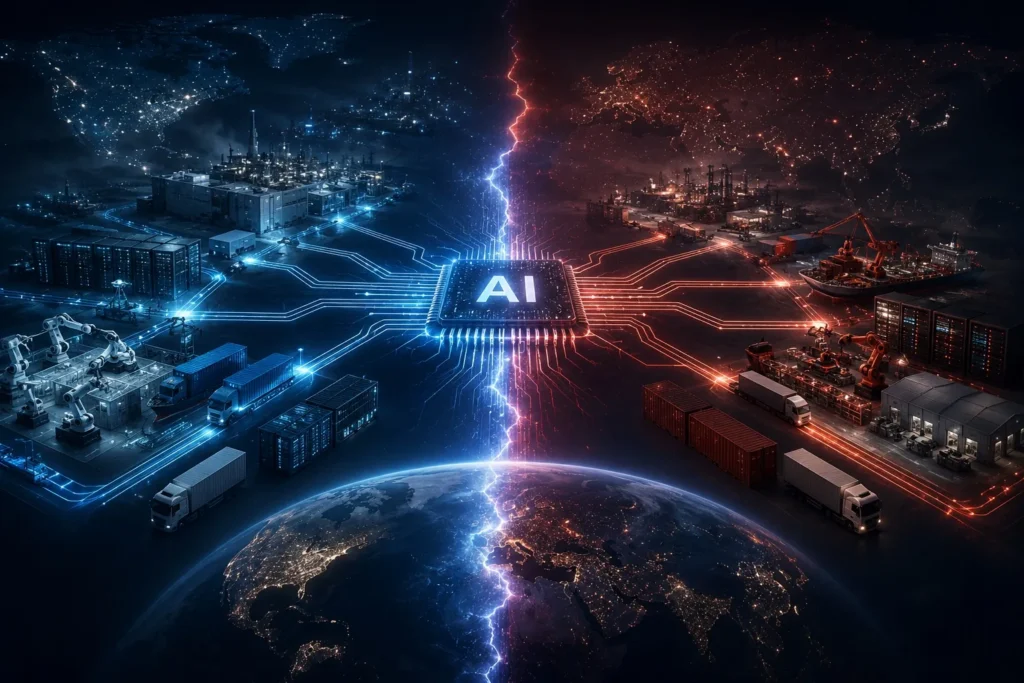
The global AI industry is undergoing a fundamental realignment that extends far beyond Silicon Valley boardrooms or Beijing research labs. As artificial intelligence transforms from a commercial technology into a cornerstone of national power, the era of neutral technology sharing is rapidly ending. Countries are restructuring their AI supply chains around trusted allies, creating competing technological blocs that may define global commerce for decades.
This shift represents more than trade policy adjustments. The AI race now encompasses semiconductors, energy infrastructure, rare earth minerals, data centers, and logistics networks—all increasingly viewed through the lens of national security rather than economic efficiency.
AI Infrastructure Transforms Into Strategic National Assets
Governments worldwide now classify AI systems alongside defense capabilities and critical infrastructure. The European Union’s AI Act, China’s algorithmic governance regulations, and the United States’ executive orders on AI development signal a coordinated move to treat artificial intelligence as sovereign technology requiring state oversight.
This reclassification carries immediate consequences for international business. Companies developing large language models, autonomous systems, or advanced machine learning platforms face export controls, investment restrictions, and mandatory security reviews. The Biden administration’s October 2022 semiconductor export controls on China exemplify this approach, targeting not just chips but the entire ecosystem supporting AI development.
National Security Priorities Override Market Efficiency
The strategic importance of AI infrastructure creates new market dynamics. Rather than optimizing for cost or performance alone, governments prioritize domestic control and allied partnerships. This shift explains why the United States invested $52 billion in domestic semiconductor manufacturing through the CHIPS Act, even though Asian production remains more cost-effective.
Technology Partnerships Align Along Geopolitical Lines
Countries increasingly select AI technology partners based on political alignment rather than purely technical capabilities. The AUKUS partnership between Australia, the United Kingdom, and the United States includes provisions for AI and quantum computing cooperation that explicitly exclude other nations, including traditional allies.
Japan’s restrictions on advanced semiconductor equipment exports to China, despite significant economic costs, demonstrate how technology policy follows diplomatic priorities. Similarly, India’s Digital India initiatives favor partnerships with democratic allies over potentially more advanced Chinese alternatives.
These partnerships extend beyond government agreements. Private companies face pressure to align their supply chains with their home country’s strategic objectives, creating technology ecosystems that mirror political alliances.
Trust Networks Replace Global Markets
The concept of trusted technology suppliers is reshaping international commerce. Rather than sourcing components from the most competitive global suppliers, companies must verify that their entire supply chain meets security standards defined by their domestic governments. This verification process naturally favors suppliers from allied nations, even when alternatives might offer better terms.
Advanced Semiconductor Production Becomes a Geopolitical Chokepoint
The concentration of advanced chip manufacturing in Taiwan, South Korea, and select facilities in other locations creates a strategic vulnerability that all major powers recognize. Taiwan Semiconductor Manufacturing Company produces over 90% of the world’s most advanced processors, making it a critical node in global AI development.
China’s substantial investments in domestic semiconductor capacity, including the $47 billion National IC Industry Investment Fund, represent attempts to reduce dependence on this concentrated supply chain. Meanwhile, the United States and European Union are building parallel domestic capabilities, accepting higher costs in exchange for strategic independence.
The technical complexity of advanced semiconductor production limits how quickly countries can achieve self-sufficiency. Building a competitive foundry requires not just capital investment but also specialized talent, equipment suppliers, and years of operational experience that cannot be easily replicated.
Manufacturing Geography Drives Strategic Planning
The physical location of chip production increasingly influences international relations. South Korea’s position as home to Samsung’s advanced fabs gives it outsized influence in global technology policy. Similarly, the Netherlands’ ASML holds unique leverage through its monopoly on extreme ultraviolet lithography machines essential for cutting-edge processors.
Data Centers Emerge as Critical Geopolitical Infrastructure
The massive computational requirements of AI systems make data center location and capacity strategic national concerns. Training large language models requires clusters of thousands of specialized processors, creating bottlenecks that governments cannot ignore.
China’s restrictions on data leaving its borders, combined with requirements that AI models undergo government approval, create practical barriers to international AI cooperation. The European Union’s data residency requirements under GDPR similarly constrain where AI systems can operate and how they process information.
Major cloud providers find themselves caught between these competing regulatory frameworks. Amazon Web Services, Microsoft Azure, and Google Cloud must maintain separate infrastructure in different regions, effectively fragmenting what was once a global computing platform.
Computing Power Concentrates in Friendly Nations
Countries are directing AI computing infrastructure toward allied nations. The United States’ recent agreements to establish cloud computing regions in allied countries reflect this strategic thinking, as does China’s Digital Silk Road initiative that extends computing infrastructure to partner nations.
Critical Resources for AI Development Follow Strategic Alliances
The mineral requirements for AI infrastructure—including lithium for batteries, rare earths for processors, and copper for data centers—are becoming strategic considerations. China’s dominance in rare earth processing gives it significant leverage over global technology supply chains, while countries like Australia and Canada leverage their mineral wealth to secure preferential technology partnerships.
Energy requirements for AI systems also drive geopolitical calculations. Training GPT-4 required an estimated 50 gigawatt-hours of electricity, equivalent to the annual consumption of thousands of households. Countries with abundant clean energy, including Nordic nations and Canada, are attracting AI infrastructure investments that strengthen their positions in global technology networks.
In my view, the future AI landscape will not be a single global ecosystem. Instead, competing technology blocs may emerge, each built around different strategic alliances.
Supply Chain Security Extends to Raw Materials
The AI race is no longer only about software or algorithms. It now includes chips, energy, minerals, logistics, and trusted geopolitical networks. This expansion means that countries must secure entire resource chains, from lithium mines to power grids, to maintain competitive AI capabilities.
International Technology Cooperation Fragments Along Strategic Lines
The collaborative model that characterized early internet development is giving way to parallel technological development within aligned blocs. Research partnerships increasingly exclude researchers from strategic competitor nations, while international conferences and academic exchanges face new restrictions.
The exclusion of leading Chinese universities from certain AI research collaborations, despite their technical contributions, illustrates how political considerations now override scientific cooperation. Similarly, restrictions on technology transfer agreements prevent the kind of cross-border innovation that previously accelerated technological progress.
This fragmentation creates inefficiencies but reflects calculated decisions by governments that view technological dependence as unacceptable strategic risk. The result is duplicated research efforts and slower overall progress in exchange for greater national control over AI development.
Technology Competition Enters a Geopolitical Era
The transformation of AI supply chains into strategic blocs represents a fundamental shift in how the global economy operates. Unlike previous technology cycles where market forces determined winners and losers, AI development now follows the logic of great power competition.
This change creates new opportunities for middle powers that can position themselves as trusted partners within competing blocs. It also means that technological advancement becomes inseparable from diplomatic relationships and security partnerships.
The era of neutral technology is ending, replaced by AI ecosystems that reflect and reinforce global power structures. Understanding these emerging blocs will be essential for businesses, policymakers, and anyone seeking to navigate the new geopolitical landscape of artificial intelligence.