
Greenland’s Mineral Wealth Attracts Global Attention — A Strategic Island Gains New Importance
Greenland strategic minerals: Greenland sits at the intersection of changing technology, rising resource demand, and shifting Arctic accessibility. What was once a remote island locked beneath ice and snow has emerged as a focal point for global powers seeking critical minerals essential to modern economies. The island’s vast mineral reserves, previously considered too difficult and expensive to extract, are drawing serious attention from governments and corporations as technological advances and climate change alter the calculus of Arctic resource development.
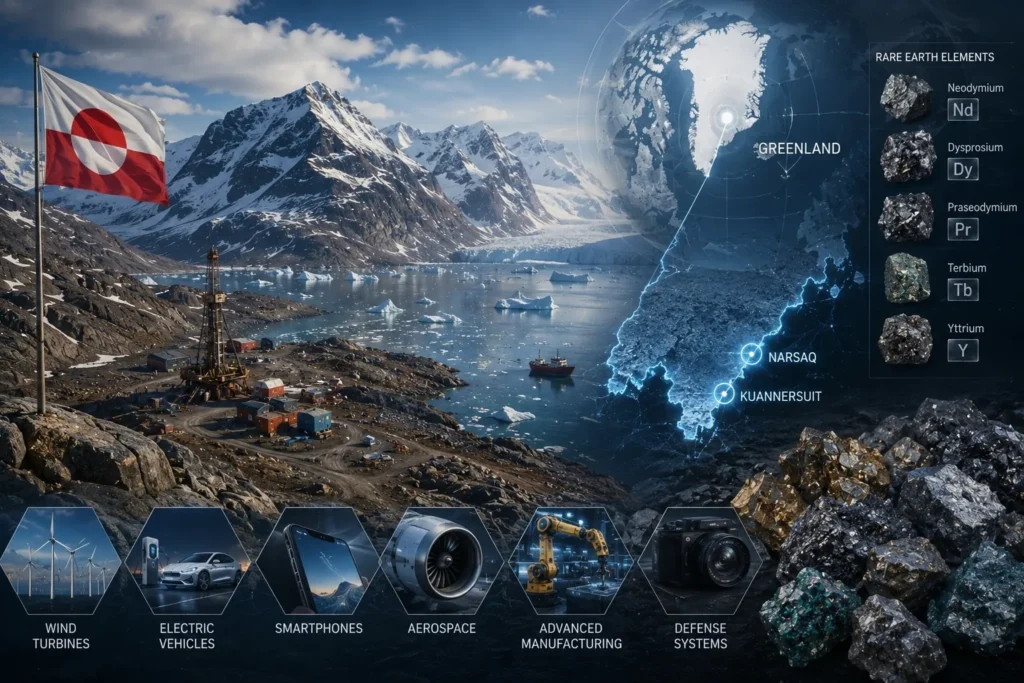
Greenland Contains Vast Untapped Mineral Deposits
The island holds some of the world’s largest unexploited reserves of rare earth elements, essential for everything from wind turbines to smartphone batteries. Geological surveys have identified substantial deposits of neodymium, dysprosium, and other rare earth metals concentrated primarily in the southern regions near Narsaq and Kuannersuit.
Beyond rare earths, Greenland contains significant uranium reserves at sites like Kuannersuit, where the Kvanefjeld project has identified one of the largest uranium deposits outside traditional mining regions. The island also holds substantial reserves of zinc, lead, gold, and iron ore, with some deposits already under active exploration by international mining companies.
Strategic Minerals Drive New Interest
The concentration of multiple strategic resources in one location makes Greenland particularly attractive to countries seeking to reduce dependence on current supply chains. China currently dominates rare earth production, controlling roughly 80% of global output, creating supply vulnerabilities that governments and industries are eager to address through alternative sources.
Rising Demand for Critical Minerals Reshapes Resource Priorities
Global consumption of rare earth elements has increased dramatically as renewable energy technologies expand and electronic devices proliferate. Wind turbine generators require substantial amounts of neodymium and dysprosium, while electric vehicle motors depend on rare earth permanent magnets for efficiency and performance.
The European Union has designated rare earth elements as critical raw materials, acknowledging their importance to economic security and technological competitiveness. Similar classifications by the United States and other major economies have elevated resource access from a commercial consideration to a strategic imperative.
Clean Energy Transition Accelerates Demand
The push toward carbon neutrality has intensified competition for minerals essential to renewable energy infrastructure. Solar panels, wind turbines, and battery storage systems all require materials that are geographically concentrated in relatively few locations, making diversification of supply sources a priority for governments planning long-term energy transitions.
Arctic Development Becomes More Feasible
Climate change has reduced sea ice coverage and extended ice-free seasons, making Arctic shipping routes more viable and resource extraction more practical. The Northern Sea Route along Russia’s Arctic coast has seen increased commercial traffic, while Greenland’s coastal waters remain accessible for longer periods each year.
Technological advances in cold-weather mining equipment and remote operations have also lowered the barriers to Arctic resource development. Modern mining techniques can operate in harsh conditions that would have been prohibitive for large-scale extraction projects just two decades ago.
Infrastructure Development Follows Resource Interest
Several international firms have begun feasibility studies for port facilities and transportation infrastructure that could support mining operations. The Australian company Greenland Minerals has advanced plans for the Kvanefjeld project, while other international investors are exploring options for rare earth extraction in the south.
Geopolitical Competition Extends to the Arctic
Major powers are repositioning their Arctic strategies as resource accessibility improves and strategic competition intensifies. The United States reopened a consulate in Greenland in 2020, marking renewed American interest in the region after a 67-year absence.
China has declared itself a “near-Arctic state” and invested in Greenland mining projects through state-backed companies, raising concerns among NATO allies about strategic resource access and potential military implications. Denmark, which maintains sovereignty over Greenland while granting the island significant autonomy, finds itself managing competing international interests.
Military and Economic Interests Converge
Greenland’s location between North America and Europe, combined with its resource wealth, makes it valuable for both economic and security purposes. The island hosts important radar installations and could serve as a strategic position for monitoring Arctic shipping routes as they become more active.
Local Decision-Making Shapes International Ambitions
Greenland’s government maintains authority over natural resources under its 2009 Self-Government Act, giving local officials significant influence over which projects proceed and under what terms. The Inatsisartut (Greenland’s parliament) has demonstrated willingness to halt projects that conflict with environmental priorities or local preferences.
In 2021, Greenland’s government imposed a moratorium on uranium mining, effectively suspending the Kvanefjeld project despite years of international investment and planning. This decision illustrates how local political dynamics can override external economic pressure and reshape international resource strategies.
Balancing Development and Environmental Concerns
Greenlandic officials face pressure to develop the economy while protecting the environment that defines the island’s identity and supports traditional livelihoods. Public opinion remains divided on large-scale mining, with some viewing it as essential for economic independence and others concerned about environmental consequences.
Harsh Conditions Complicate Extraction Projects
Despite technological advances, Arctic mining remains expensive and technically challenging. Extreme cold, limited transportation infrastructure, and seasonal accessibility continue to impose significant costs on resource development projects.
The absence of major ports, limited road networks, and dependence on seasonal shipping create logistical constraints that affect project viability. Building the infrastructure necessary for large-scale mining requires substantial upfront investment with uncertain returns, deterring some potential investors despite the strategic value of Greenland’s resources.
Strategic Importance Transforms Geographic Isolation
Greenland demonstrates how geography can suddenly become strategically important when technology and economic demand change. Resources that were once inaccessible are now attracting global interest, turning remote regions into geopolitical assets.
The island represents the future of resource geopolitics, where strategic importance extends beyond traditional metrics of population or industrial capacity to include access to materials essential for technological competition. While Greenland’s population remains small at roughly 56,000 people, its strategic relevance could grow dramatically as demand for critical minerals increases and Arctic accessibility improves.
The interplay between local governance, international competition, and resource development will likely define Greenland’s role in global affairs for decades to come, making this Arctic island an unexpected but significant factor in 21st-century strategic planning.