
Kazakhstan as Eurasian Connector — Why the Heart of Central Asia Is Becoming Strategically Important
Kazakhstan occupies one of the most underestimated positions in global geopolitics. While it rarely dominates international headlines, this Central Asian giant sits at the intersection of several transformative trends reshaping Eurasian power dynamics. From new trade corridors to energy security concerns, Kazakhstan’s strategic importance extends far beyond its massive territory, positioning it as an increasingly vital player that major powers cannot afford to ignore.
Kazakhstan Commands the Crossroads of Three Continents
Geography has handed Kazakhstan an exceptional strategic advantage. Spanning over 2.7 million square kilometers, the country forms a natural land bridge connecting Europe, Asia, and the Middle East. This positioning becomes more valuable as global trade patterns shift away from traditional maritime routes and explore overland alternatives.
The country shares borders with Russia and China—two of the world’s most influential powers—while maintaining connections to the Caspian Sea and Central Asian neighbors. This geographic reality means that virtually any major infrastructure project linking East and West must consider Kazakhstan’s role. As geopolitical tensions complicate traditional shipping lanes, Kazakhstan’s territory offers alternative pathways that bypass potential chokepoints.
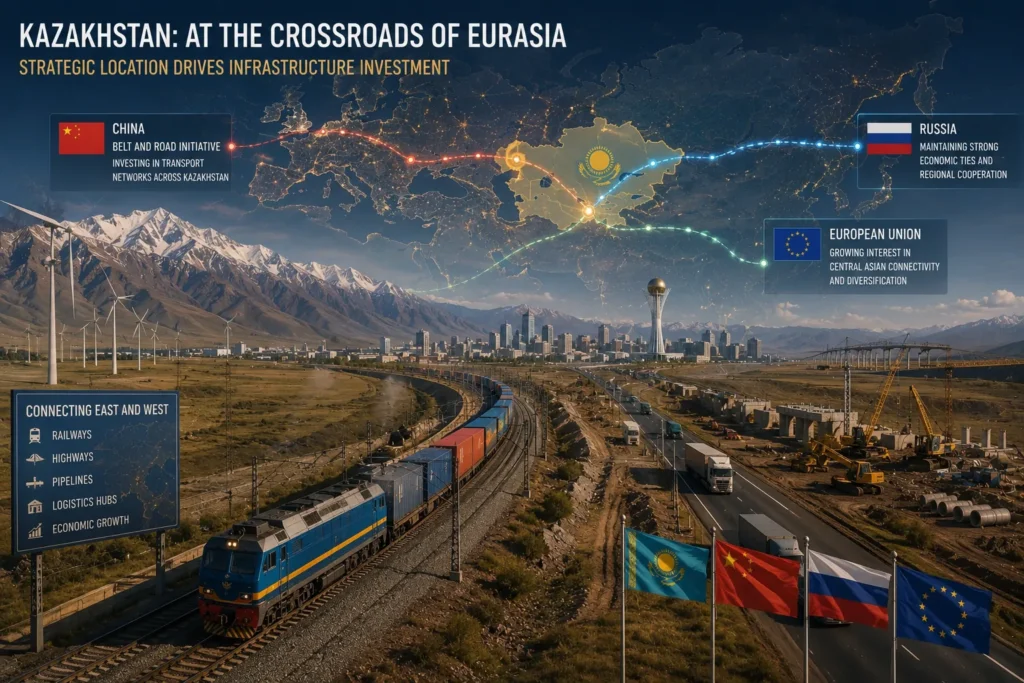
Strategic Location Drives Infrastructure Investment
Major powers recognize Kazakhstan’s geographic value through substantial infrastructure commitments. China’s Belt and Road Initiative has invested billions in Kazakhstani transportation networks, while Russia maintains significant economic ties despite evolving political dynamics. European Union interest in Central Asian connectivity has also intensified, particularly following recent geopolitical disruptions.
New Trade Corridors Elevate Kazakhstan’s Commercial Significance
The Middle Corridor—a rail route connecting China to Europe through Kazakhstan, the Caspian Sea, and Turkey—has experienced dramatic growth. Container traffic through this route increased by over 70% in recent years as companies seek alternatives to traditional shipping methods. Kazakhstan sits at the heart of this emerging trade pathway.
Railway investments are transforming the country into a logistics hub. The Khorgos-Eastern Gate special economic zone on the Chinese border processes increasing volumes of cargo, while new rail connections improve access to European markets. These developments create economic opportunities while strengthening Kazakhstan’s position in global supply chains.
Kazakhstan’s growing relevance demonstrates how geography can create geopolitical influence. As trade routes diversify and supply chains evolve, countries positioned between major economic regions gain strategic leverage. Kazakhstan is increasingly benefiting from this shift.
Digital Connectivity Complements Physical Infrastructure
Beyond physical trade routes, Kazakhstan is developing digital infrastructure to support its hub ambitions. New data centers and improved telecommunications networks aim to position the country as a regional technology center, complementing its role in physical goods transportation.
Energy Resources Amplify Regional Influence
Kazakhstan ranks among the world’s top oil producers, with daily output exceeding 1.8 million barrels. The Tengiz and Kashagan oil fields represent some of the largest reserves outside the Middle East. This energy wealth provides economic stability and political leverage in international relations.
Uranium mining adds another strategic dimension. Kazakhstan produces approximately 40% of global uranium supply, making it indispensable for nuclear energy programs worldwide. Countries pursuing nuclear power expansion—from Europe to Asia—must maintain positive relationships with Kazakhstan to secure uranium access.
Natural gas reserves, while smaller than oil holdings, still contribute to regional energy security. Kazakhstan has expanded pipeline infrastructure to diversify export routes, reducing dependence on any single transit country or destination market.
Energy Exports Enable Balanced Diplomacy
Resource wealth allows Kazakhstan to pursue independent foreign policy approaches. Revenue from energy exports provides economic foundation for diplomatic flexibility, enabling the country to engage multiple partners without excessive dependence on any single relationship.
Great Powers Compete for Kazakhstani Partnership
China views Kazakhstan as essential to Belt and Road success. Chinese investments in Kazakhstani infrastructure exceed $30 billion, while bilateral trade continues expanding. However, this relationship remains primarily economic rather than military or political.
Russia maintains historical ties through the Eurasian Economic Union and security partnerships, yet Kazakhstan has demonstrated increasing autonomy in foreign policy decisions. The relationship balances economic integration with political independence.
European engagement has intensified significantly. The EU launched its Global Gateway initiative partly to provide alternatives to Chinese infrastructure financing, with Central Asia—including Kazakhstan—as a priority region. Recent high-level visits underscore growing European interest.
The United States, while geographically distant, maintains engagement through energy partnerships and democracy promotion programs. American companies participate in major Kazakhstani energy projects, creating economic ties that support broader diplomatic relationships.
Regional Powers Also Seek Influence
Turkey has expanded connections through linguistic and cultural ties, while India pursues energy partnerships and trade opportunities. Iran engages through Caspian Sea cooperation, and Gulf states explore investment opportunities. This diverse engagement reflects Kazakhstan’s growing international profile.
Diplomatic Balance Preserves Strategic Autonomy
Kazakhstan’s multi-vector foreign policy avoids exclusive alignment with any single power bloc. This approach, formalized under former President Nazarbayev and continued under President Tokayev, prioritizes economic development over ideological alignment.
Recent examples demonstrate this balanced approach. Kazakhstan has maintained normal relations with Russia while avoiding explicit support for controversial policies. Similarly, the country engages with China economically while preserving political independence. European and American partnerships complement rather than replace existing relationships.
This diplomatic flexibility reflects practical recognition of geographic and economic realities. Kazakhstan benefits from engagement with all major powers rather than choosing sides in great power competition.
Infrastructure Development Accelerates Economic Transformation
Transportation investments are reshaping Kazakhstan’s economic landscape. The Western Europe-Western China highway corridor cuts transit times significantly, while railway modernization improves cargo capacity and reliability. These improvements attract international companies seeking efficient logistics solutions.
Urban development projects in Almaty and Nur-Sultan create regional business centers. International airports expand connectivity to global markets, while special economic zones offer favorable conditions for foreign investment. These developments support Kazakhstan’s ambitions to become a regional economic hub.
Digital infrastructure investments complement physical improvements. Improved internet connectivity and expanded telecommunications networks support modern business operations and attract technology companies to establish regional operations.
Central Asia Emerges as a Global Strategic Priority
Kazakhstan’s rise reflects broader Central Asian growing importance in international affairs. The region’s strategic location, energy resources, and economic potential attract increased attention from major powers seeking to expand influence in Eurasia.
In my view, Kazakhstan is one of the most underestimated countries in global geopolitics. It rarely dominates headlines, yet its location, resources, and diplomatic approach place it at the center of several major geopolitical trends. As Eurasian connectivity expands, Kazakhstan’s influence is likely to grow significantly.
The heart of Central Asia is becoming strategically important precisely because it offers what many regions cannot: stable governance, abundant resources, and flexible partnerships. These advantages position Kazakhstan to benefit from shifting global dynamics while maintaining the autonomy that makes it an attractive partner for diverse international actors.