
Cable Landing Stations — The Hidden Infrastructure Connecting the Digital World
When people picture the internet, they tend to imagine satellites orbiting overhead or invisible wireless signals bouncing between towers. The physical reality is far less glamorous — and far more consequential. More than 95% of international internet traffic travels through submarine fiber-optic cables laid across the ocean floor. And the points where those cables come ashore, known as cable landing stations, have quietly become some of the most strategically important facilities in the global digital economy.
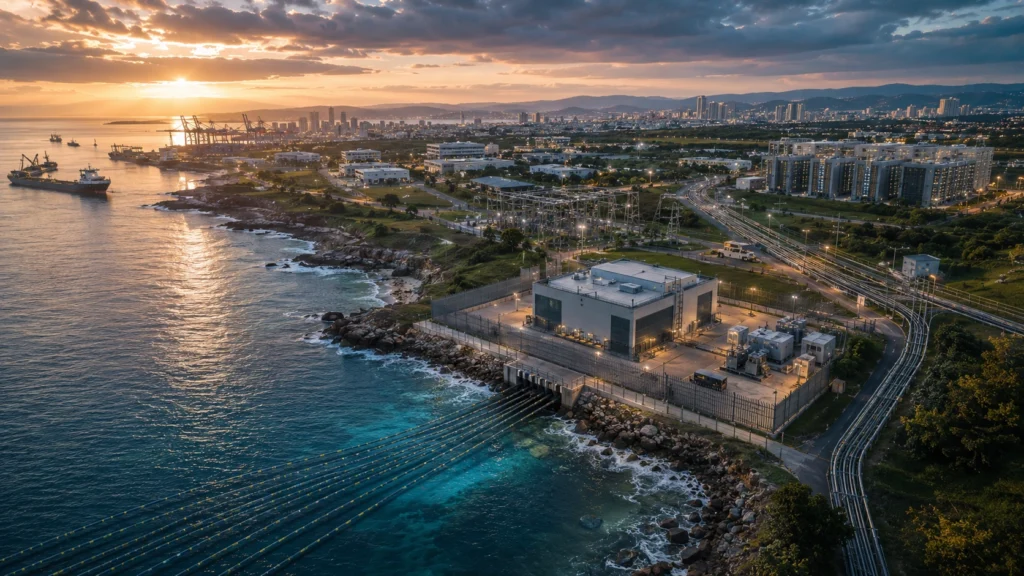
Most International Internet Traffic Moves Beneath the Ocean
Submarine fiber-optic cables carry the overwhelming majority of global digital communications
Satellites handle certain communications tasks well — GPS, broadcasting, remote sensing — but for raw data volume, nothing competes with submarine cables. A single modern cable system can carry dozens of terabits per second across thousands of miles of open ocean. The transatlantic and transpacific routes alone carry the bulk of global financial data, cloud computing traffic, and everyday internet use.
This is not a recent development. The first transatlantic telegraph cable was laid in 1858. What has changed is scale. As of 2024, there are more than 500 active or planned submarine cable systems worldwide, according to TeleGeography, with total investment in new cable infrastructure accelerating sharply over the past decade. The image of the internet as something cloud-like or wireless is a useful simplification — but it obscures the physical architecture that actually keeps it running.
Why Cable Landing Stations Are Critical Infrastructure
These onshore facilities serve as the gateway between global cable systems and domestic networks
A submarine cable on its own is just a long wire on the seabed. Its usefulness depends entirely on the facilities where it connects to land. Cable landing stations house the equipment that amplifies and manages signal transmission, convert the optical signals carried by the cable into usable data, and link the international system to domestic telecommunications networks.
They tend to be physically unremarkable — low buildings, often near a beach or coastal industrial zone, typically fenced and unmarked. But disrupting a single well-positioned station can affect internet access across an entire region. When an anchor strike damaged cables near Tonga in January 2022, the island nation lost nearly all international connectivity for five weeks. That single incident illustrated, more clearly than any policy paper, how concentrated the physical chokepoints of the internet actually are.
How Reliable Connectivity Drives Economic Growth
International data links are foundational infrastructure for modern commerce and financial markets
Access to fast, reliable international connectivity is no longer optional for economies that want to participate fully in global commerce. Cross-border data flows now underpin everything from e-commerce logistics and cloud-hosted enterprise software to real-time currency trading and international banking settlements. When connectivity degrades, the economic cost accumulates quickly.
For developing economies, this dependency is both an opportunity and a vulnerability. Countries that secure reliable submarine cable connections can attract data center investment, fintech activity, and outsourced digital services. Those that rely on a single cable system, or on systems routing through a third country, carry structural risk. Singapore and Portugal are instructive examples — both have invested deliberately in becoming cable hubs, and both now punch well above their geographic size in terms of digital trade and data center density.
Security Risks Around Submarine Infrastructure Are Growing
Governments are reassigning cable infrastructure from technical concern to national security priority
For most of their history, submarine cables were treated primarily as a telecommunications matter — regulated, but not especially securitized. That framing has shifted. In 2023 and 2024, several NATO members raised concerns about unusual activity near cable routes in the Baltic and North Sea. The severing of cables near Finland and Sweden in late 2024 — attributed by investigators to vessel anchor drag, though the circumstances remain contested — prompted renewed discussion about deliberate interference.
The United States has moved to restrict Chinese telecommunications companies from participating in certain cable projects connecting to American territory. Australia and Japan have taken similar positions on projects passing through their regions. The underlying concern is straightforward: a cable landing station with hardware or software managed by an adversarial actor represents a potential intelligence collection point, not merely a commercial facility.
Geographic Position Turns Some Countries Into Regional Digital Hubs
Nations that host major cable landing stations often gain structural advantages as connectivity nodes
Geography still matters in the digital age, perhaps more than is commonly acknowledged. Countries located on or near major oceanic cable routes have a natural advantage in attracting landing station investment. But policy choices amplify or constrain that advantage considerably.
Egypt controls the Suez Canal — one of the primary overland crossing points for cables connecting Europe to Asia. The United Kingdom’s position at the eastern edge of the Atlantic has made it a historic hub for transatlantic cable landings. In the Pacific, Guam has emerged as a critical waypoint, with its U.S. military presence adding a security dimension that purely commercial hubs cannot offer. Nations that recognize this positioning early and invest in the supporting infrastructure — reliable power, legal frameworks, skilled labor — tend to capture a disproportionate share of future landing investment.
Investment in New Submarine Cable Projects Is Accelerating
Major technology companies and governments are funding new cable systems at an unusual pace
The pipeline of new submarine cable projects is longer now than at any point since the early 2000s boom. What distinguishes the current wave is the identity of the investors. Google, Meta, Amazon, and Microsoft now fund or co-own a significant share of new cable capacity, moving beyond the traditional model in which cables were owned by consortiums of telecommunications carriers.
This shift has practical effects. Private tech company cables are often designed for proprietary traffic rather than shared carrier use, which changes how capacity is distributed and who has access to it. It also means that infrastructure decisions once made through regulatory processes are increasingly driven by corporate strategy. Governments are beginning to respond — the European Union has flagged submarine cable resilience as part of its broader critical infrastructure protection agenda, and several Indo-Pacific nations are actively courting cable investment as part of their digital economy development strategies.
Digital Connectivity Is Becoming a Dimension of Geopolitical Influence
In my view, cable landing stations will become as strategically important in the digital era as seaports were during the industrial era. The analogy is not perfect — data moves at the speed of light, not at the pace of shipping lanes — but the structural logic is similar. Nations that control key nodes in a global network gain leverage, attract economic activity, and build dependencies that others must navigate around.
Countries investing in secure, resilient digital connectivity are strengthening not only their economies but also their long-term geopolitical position. The countries that treat this infrastructure as a strategic asset — rather than a passive technical facility — are the ones most likely to shape how the next generation of digital trade, data governance, and communications architecture gets built. Cable landing stations are where that competition touches the ground.