
South-South Cooperation — Why Emerging Economies Are Building New Partnerships
For decades, the dominant model of international economic engagement ran along a familiar axis: wealthier nations in the Global North provided aid, investment, and market access to developing countries in the South. That model has not disappeared, but it is being steadily supplemented — and in some areas, displaced — by something structurally different. South-South cooperation, the growing web of economic, diplomatic, and technological ties among emerging economies, has matured into one of the clearest indicators of how global power is actually shifting. Understanding why these partnerships are expanding, and what they are producing, matters for anyone tracking where international growth and influence are headed next.
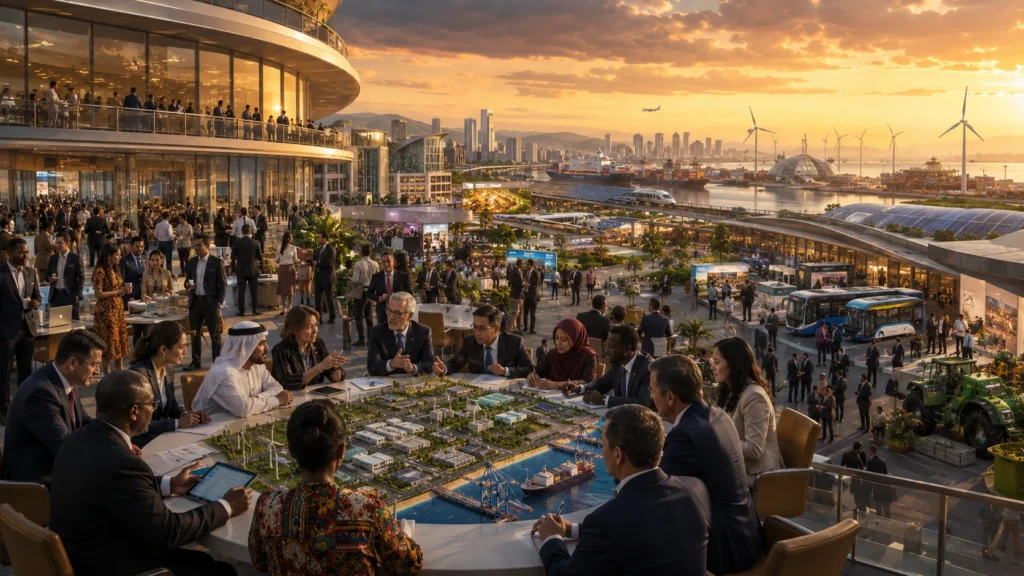
Emerging Economies Are Expanding Their Economic Ties Across Regions
A new pattern of cross-regional engagement is taking shape across Asia, Africa, Latin America, and the Middle East.
The scale of South-South engagement today is not easily captured by any single statistic, but the direction is consistent. Trade volumes between developing economies have grown substantially over the past two decades. According to UNCTAD, South-South trade now accounts for roughly 25 percent of global merchandise trade, compared to under 10 percent in the early 1990s. What was once a marginal category in global commerce has become a structural feature of it.
This is not simply trade growth. Countries across Asia, Africa, Latin America, and the Middle East are building relationships that span investment, diplomacy, joint ventures, and policy coordination. India has deepened commercial and development ties across sub-Saharan Africa. Brazil has become a significant agricultural partner for several African nations. Gulf states are channeling capital into Asian infrastructure and African energy projects. The geometry of global economic relationships is genuinely changing, not as a symbolic gesture but through accumulated practical decisions made by governments and businesses seeking alternatives to the traditional North-South axis.
Trade Diversification Is Reducing Dependence on Traditional Markets
Governments across the developing world have learned, often through difficult experience, what concentrated export dependence looks like when it goes wrong. A single major market that contracts, imposes conditions, or shifts its trade policy can send reverberations across an entire national economy. South-South trade relationships offer a way to spread that risk.
This diversification is partly defensive, but it also reflects genuine commercial opportunity. As middle-income populations grow in Asia, Africa, and Latin America, demand for goods and services is rising in markets that were considered marginal a generation ago. Indonesian manufacturers are finding buyers in East Africa. Vietnamese exporters are expanding across Southeast Asia and into South America. The commercial logic behind these relationships does not require a political narrative — it reflects where the purchasing power is actually growing.
The strategic dimension matters too. Countries that reduce their reliance on a small number of trading partners gain leverage in negotiations and greater resilience when geopolitical disruptions occur. Trade diversification, in this context, is also a form of foreign policy.
Infrastructure Investment Is Improving Cross-Regional Connectivity
Large-scale connectivity projects are reshaping transportation, logistics, and energy networks across developing regions.
China’s Belt and Road Initiative remains the most visible example, but it is far from the only driver of South-South infrastructure investment. India’s development finance has supported port and road projects across South Asia and East Africa. The African Union’s Programme for Infrastructure Development in Africa has facilitated cross-border energy and transport corridors. Brazil and Argentina have long-standing cooperation on energy and logistics infrastructure in South America.
These projects are not without controversy. Concerns about debt sustainability, local employment, and environmental standards are legitimate and have been raised by credible observers. At the same time, the infrastructure gaps in developing economies are real, and the projects addressing them are producing tangible changes in how goods and people move across regions. Port capacity in Djibouti, rail links in East Africa, and energy grids in Southeast Asia all affect the actual cost and feasibility of doing business across these regions. That has compounding effects on trade, investment, and economic integration over time.
Technology Exchange Is Accelerating Industrial and Digital Development
One underappreciated aspect of South-South cooperation is how much of it now involves knowledge and technology transfer, not just goods and capital. This is a meaningful shift from earlier phases of development cooperation, which often centered on financial assistance flowing in one direction.
Today, Indian technology firms operate across Africa and Southeast Asia. Chinese telecommunications infrastructure, including companies like Huawei and ZTE, has been deployed in dozens of developing countries, raising both connectivity levels and geopolitical questions simultaneously. Brazil has shared agricultural research through Embrapa’s international programs that have benefited smallholder farmers in Africa and Latin America. The transfer of practical technical knowledge — whether in digital infrastructure, crop science, or manufacturing processes — is quietly supporting industrial capacity in ways that external aid rarely did as effectively.
Regional Institutions Are Gaining Influence in Global Governance
New multilateral initiatives are beginning to complement, and sometimes challenge, the existing global governance architecture.
The BRICS grouping has expanded significantly, with Argentina, Egypt, Ethiopia, Iran, Saudi Arabia, and the UAE invited to join in 2024, though not all have formally acceded at the same pace. The New Development Bank, which BRICS established in 2014, has now extended membership to Bangladesh, Egypt, the UAE, and Uruguay, among others. The Shanghai Cooperation Organisation has similarly widened its membership.
These institutions are not replacing the IMF or the World Bank. But they are creating alternative venues for policy coordination, development finance, and diplomatic engagement. Their existence gives emerging economies more options — and options, in international relations, translate into influence. Countries that once had limited leverage in global negotiations now have parallel institutions to work through when existing structures do not serve their interests well.
Finance, Education, and Health Are Becoming Core Areas of South-South Collaboration
Shared development goals have pushed cooperation beyond trade and infrastructure into areas that directly affect living standards. South-South health cooperation became particularly visible during the COVID-19 pandemic, when India and China both supplied vaccines and medical equipment to developing countries at a scale that Western nations largely did not match in the early phases of the crisis. India’s Serum Institute produced the majority of COVAX-distributed doses during 2021, a fact that was significant both practically and diplomatically.
Educational exchange is another growing area. Scholarships and university partnerships between emerging economies have expanded considerably over the past decade. China now hosts more than 500,000 international students annually, many from Africa and Southeast Asia. India has positioned itself as a regional education hub, particularly for students from South Asia and parts of Africa.
These forms of cooperation build the human capital and institutional trust that underpin longer-term economic relationships. They also create durable social ties that persist beyond any single government or policy cycle.
A More Multipolar Economic Network Is Taking Shape
South-South cooperation, taken as a whole, reflects the growing confidence and capability of emerging economies to define their own terms of engagement with the global system. This is not a unified movement with a single agenda. The interests of India, Brazil, South Africa, Indonesia, and Nigeria do not align on every issue. What they share is a preference for a more distributed global order — one in which no single bloc dominates the terms of trade, finance, and development.
The future of international economic growth is, on current trends, more likely to be driven by partnerships among emerging economies than by the traditional North-South development model. That is not a prediction about geopolitical conflict — it is an observation about where populations, markets, and productive capacity are concentrated. South-South cooperation is not a reaction against the existing international order so much as an adaptation to the fact that the order has already changed. The partnerships being built now are the architecture of what comes next.