
NATO Leaders Commit to Historic Defense Spending Increase — Europe Signals a New Security Era
At the recent NATO summit, alliance members endorsed one of the most consequential shifts in collective defense policy in decades. The decision to substantially raise long-term spending targets was not framed as a crisis response. It was framed as a structural adjustment — a recognition that the security environment Europe faces today is fundamentally different from the one that shaped alliance planning for the past thirty years.
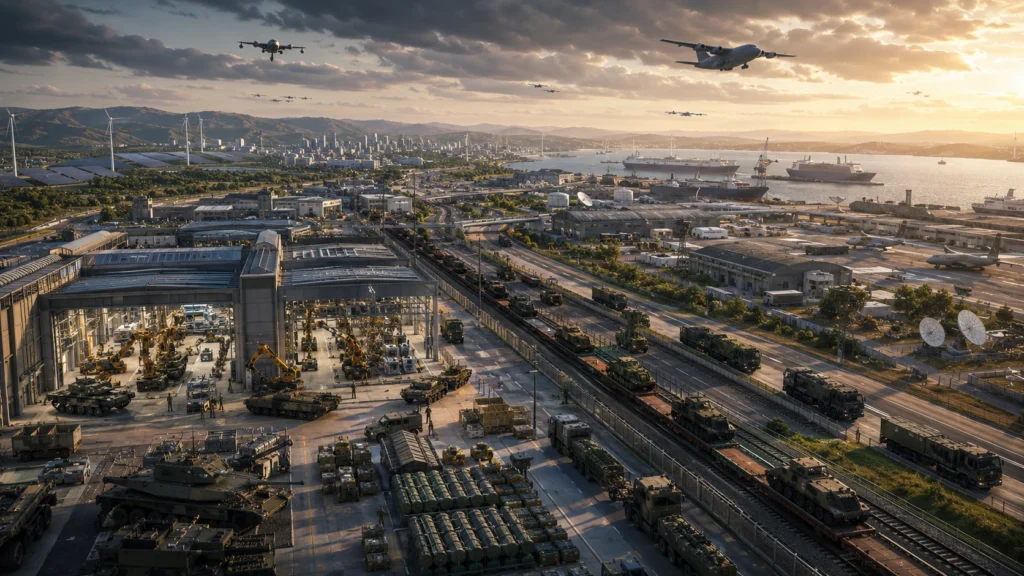
NATO Endorses a Significant Shift in Defense Investment
Alliance members locked in higher long-term spending commitments that go well beyond previous targets
The headline figure from the summit was clear: NATO member states agreed to raise defense spending targets significantly above the longstanding 2% of GDP benchmark that many countries had already struggled to meet consistently. The new guidance points toward figures closer to 3% or higher over the coming years, with specific timelines tied to national planning cycles.
What made this moment different was the framing. Previous spending debates within NATO often played out as disputes between the United States and European allies over burden-sharing. This time, European governments arrived with their own urgency. The pressure was not coming primarily from Washington — it was coming from an honest assessment of what collective deterrence now requires.
Several member states, particularly in Central and Eastern Europe, have already moved ahead of the new targets. Poland has committed to spending above 4% of GDP on defense, a figure that reflects its geographic position and the severity with which Warsaw reads the threat picture. The Baltic states have made similar moves. These are not symbolic gestures; they represent real changes in procurement timelines and force structure planning.
Military Readiness as the Organizing Principle
The summit put deterrence and collective defense capabilities at the center of alliance strategy
Spending numbers matter less than what the money is supposed to accomplish. At this summit, NATO leaders were unusually specific about priorities: logistics infrastructure, ammunition stockpiles, air defense systems, and the ability to deploy forces quickly across the continent. These were not abstract goals. They reflected lessons drawn directly from observing how the war in Ukraine has unfolded — what runs out first, what breaks down under sustained pressure, and where the gaps are.
The alliance’s eastern flank has driven much of this thinking. Forward presence, previously treated as a deterrent signal, is now being rethought as an actual warfighting requirement. That distinction has real consequences for how countries plan their contributions and how NATO coordinates rotational deployments versus permanent basing.
Europe Accelerates Its Own Strategic Reassessment
Governments across the continent are expanding defense planning as uncertainty becomes the baseline assumption
What is happening inside European governments runs parallel to the NATO-level decisions. Defense ministries that spent much of the 2000s and 2010s managing budget cuts are now rebuilding institutional capacity that atrophied over decades. That is a slower and more difficult process than announcing a new spending target. Recruiting, training, procurement pipelines, and industrial agreements all operate on timelines that don’t bend easily to political urgency.
Germany’s continued evolution of its Zeitenwende — the strategic reversal announced after Russia’s full-scale invasion of Ukraine in 2022 — is the clearest example of how national policy has shifted. Berlin has moved from deep reluctance on defense expenditure to broad political consensus that higher spending is necessary and permanent. That shift in the largest European economy carries weight beyond Germany’s own military capacity.
Defense Industries Prepare for Sustained Long-Term Demand
Higher spending commitments are reshaping procurement expectations, innovation investment, and industrial capacity
For defense contractors and industrial planners, the summit’s outcomes signal something they have been cautious about banking on: durable demand. The hesitation to scale up production capacity has historically reflected a concern that political commitment to higher spending would fade once the immediate crisis passed. The framing coming out of this summit — structural adjustment rather than temporary surge — changes that calculus.
European defense firms and their government partners are now looking at multi-year procurement contracts, production line expansions, and investment in technologies including drone systems, electronic warfare capabilities, and next-generation air defense. NATO’s push for greater interoperability also creates pressure to standardize equipment across member states, which shapes procurement decisions at the national level.
This is also where industrial policy and defense policy begin to overlap. Several European governments are treating defense investment as an economic and technological priority, not just a security one.
Alliance Unity Remains Both a Strength and a Management Challenge
NATO leaders emphasized cooperation while navigating real differences in national priorities and threat perceptions
NATO’s political cohesion remained intact at the summit, but unity within an alliance of 32 member states is always a managed outcome rather than a natural one. Countries differ in how they prioritize threats, which capabilities they want to develop, and how much their domestic political environments will sustain defense spending over time.
The United States under the current administration has pushed hard for European burden-sharing, and the summit produced commitments that gave Washington what it publicly asked for. Whether that changes the underlying dynamic of American strategic patience with European defense timelines remains an open question — one that will matter considerably if the political environment in Washington shifts again.
European Security Enters a Different Kind of Phase
The summit’s decisions reflect a continent rethinking the assumptions that shaped its security posture for a generation
Europe spent roughly three decades after the Cold War operating on the assumption that large-scale conventional conflict on the continent was a historical artifact. That assumption has been thoroughly revised. What is taking its place is not panic or remilitarization in the ideological sense — it is something more deliberate: a recalibration of what security requires in an era where strategic competition is the baseline, not the exception.
The countries most exposed to this shift are driving it the fastest. Those with more geographic distance or more complicated domestic politics are moving more slowly, but the direction is consistent across the alliance.
Higher Defense Spending Becomes a Defining Feature of European Policy
The most significant outcome of the summit may not be the specific targets agreed upon, but what those targets represent as a policy signal. Europe is no longer treating defense readiness as a variable that adjusts with the threat level. It is treating it as a permanent structural priority — one that will shape industrial planning, technology investment, and alliance strategy for the foreseeable future.
That shift, if it holds, is consequential well beyond military affairs. It changes how governments allocate resources, how they relate to their defense industries, and how they engage within the alliance. NATO leaders commit to historic defense spending increase — Europe signals a new security era not through a single announcement, but through the cumulative weight of decisions that are now difficult to reverse.