
Autonomous Weapons — How Artificial Intelligence Is Transforming Modern Warfare
The battlefield has always rewarded speed, precision, and information. Artificial intelligence is now compressing all three into systems that can act faster than any human commander can process. Autonomous weapons represent one of the fastest-growing areas of defense innovation, and while fully autonomous lethal systems remain limited in deployment, AI-assisted capabilities are already reshaping how militaries surveil, plan, and strike. The question is no longer whether this shift is happening — it is how far it will go, and who gets to set the rules.
How AI Is Reshaping Military Capability
The clearest changes are not in robots pulling triggers. They are in the layers of intelligence and decision support that now sit behind every significant military operation.
AI Integration in Surveillance, Targeting, and Battlefield Decision Support
The U.S. military’s Project Maven, launched in 2017, was an early signal of where things were heading. The program used machine learning to analyze drone footage at a scale no human analyst team could match — sorting hours of video to flag objects and patterns of interest. That same logic has since expanded across ISR (intelligence, surveillance, reconnaissance) operations globally.
China has invested heavily in AI-enabled surveillance infrastructure with direct military applications. Russia has tested autonomous ground vehicles in Syria. Israel’s use of AI-assisted targeting in Gaza operations drew significant scrutiny in 2023 and 2024, particularly around a system reportedly called “Lavender,” which allegedly used machine learning to generate targeting recommendations at speed. The details remain contested, but the operational pattern is clear: AI is increasingly doing the analytical work that precedes lethal decisions.
The Evolution of Autonomous Systems on the Ground and in the Air
Robotics and autonomy are not new to defense. What has changed is the degree of independence these systems can sustain in contested environments.
From Remote Control to Operational Independence
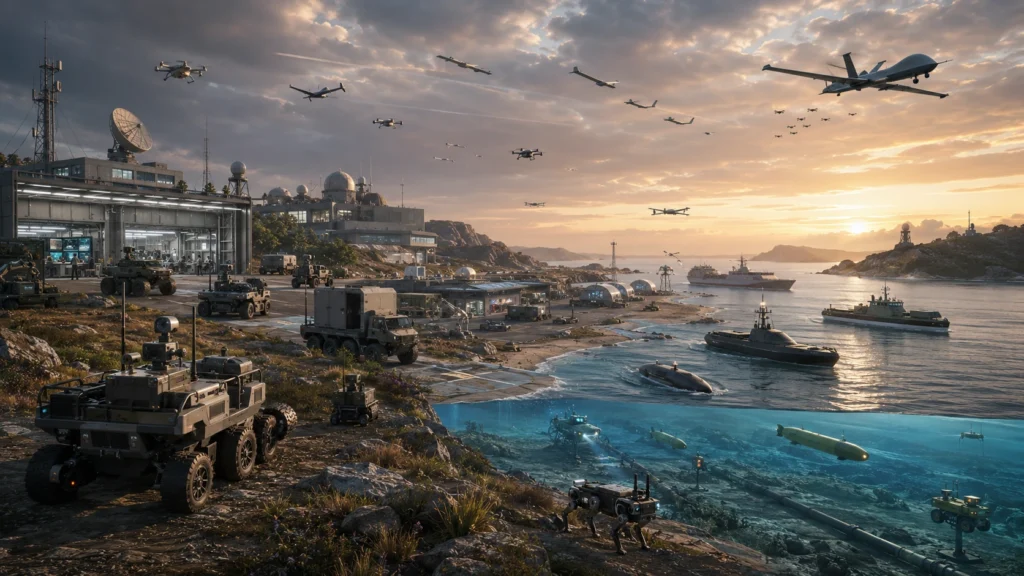
Loitering munitions — sometimes called “kamikaze drones” — are now widely used by multiple militaries. Ukraine’s war with Russia has functioned, in part, as a live testing ground for drone warfare at scale, with both sides deploying first-person-view drones, autonomous swarms, and AI-assisted targeting systems. The costs are low enough that attrition no longer carries the same strategic weight it once did when a single aircraft represented years of industrial output.
Naval and undersea autonomous systems are advancing at a similar pace. The U.S. Navy’s Ghost Fleet Overlord program has tested crewed-optional surface vessels. Autonomous underwater vehicles are being developed for mine detection, surveillance, and — in longer-range planning — potential strike roles. The common thread across platforms is a reduction in the human presence required to generate military effect.
The Arms Race Driving Defense Innovation
Military competition between major powers is accelerating the pace of AI investment in ways that traditional arms control frameworks were not built to handle.
The United States, China, and Russia have all formally identified AI as a strategic priority in their defense planning. The U.S. Department of Defense allocated over $1.8 billion specifically toward AI and autonomy in its fiscal year 2024 budget request. China’s civil-military fusion policy is designed to channel commercial AI advances directly into People’s Liberation Army systems. The competitive logic is self-reinforcing: if one side holds back, the other gains an asymmetric advantage.
Smaller states and non-state actors are not standing still either. Turkey’s Bayraktar drones have been exported across multiple conflict zones. Iran has supplied loitering munitions to proxy forces in the Middle East. The proliferation of lower-cost autonomous systems means the strategic gap between major and minor military powers is narrowing in specific, targeted ways.
Why International Rules Have Failed to Keep Up
Global discussions on lethal autonomous weapons systems (LAWS) have been underway at the United Nations Convention on Certain Conventional Weapons (CCW) since 2014. A decade later, there is still no binding treaty, no agreed definition, and no formal prohibition.
The Legal and Ethical Gaps Surrounding Autonomous Weapons
Part of the difficulty is definitional. “Autonomous” covers a spectrum — from a missile with a pre-programmed target to a system that selects and engages targets without human input in real time. States have been reluctant to lock themselves into definitions that might constrain systems they consider defensive or already deployed.
The International Committee of the Red Cross has called for new binding rules that would prohibit autonomous weapons targeting people and set strict limits on systems attacking objects. That position has not translated into state consensus. Major military powers have generally resisted hard limits, preferring voluntary principles over enforceable obligations.
The Human Control Debate: How Much Is Enough?
“Meaningful human control” has become the operative phrase in policy discussions, but meaningful is doing a lot of work in that sentence.
Rethinking What Human Oversight Actually Means in Lethal AI Systems
A human clicking an approval button after an AI has identified a target, assessed the environment, and pre-loaded the strike parameters is technically exercising control. Whether that constitutes genuine oversight over a lethal decision is a serious question. Speed is the problem: if AI systems are operating at machine tempo, inserting a human into the loop may slow the process without meaningfully changing the outcome.
Some militaries are beginning to distinguish between “in the loop,” “on the loop,” and “out of the loop” configurations — where human involvement ranges from direct authorization to passive monitoring. Where exactly to draw those lines is now a core strategic and ethical debate, not just a technical one.
Defense Industry Spending Signals Long-Term Commitment
The commercial and industrial side of this shift is not speculative. It is being funded at scale.
Lockheed Martin, Northrop Grumman, and Raytheon have all expanded AI-focused divisions in recent years. Palantir, which began as a data analytics firm, has repositioned itself as a defense AI company and secured contracts with the U.S. Army for its AI-enabled battle management platform. Anduril Industries, founded in 2017 by Palmer Luckey, has become one of the more closely watched defense startups, building autonomous surveillance towers, drones, and what it describes as an AI-driven “operating system for defense.”
The investment signals a structural shift: AI and autonomy are not add-ons to existing military platforms. They are becoming the primary design principle around which next-generation systems are built.
Warfare in the AI Era: What the Strategic Picture Actually Looks Like
The deepest challenge may not be military at all. In my view, the greatest geopolitical problem is not whether autonomous weapons will exist — they already do in various forms. The real question is whether international norms and governance can evolve quickly enough to keep pace with technological change.
History offers mixed precedent. Chemical weapons were eventually banned through sustained multilateral effort after catastrophic use in World War I. Landmines and cluster munitions generated binding conventions, though major powers declined to sign. Nuclear weapons were never prohibited, only partially constrained. Autonomous weapons fit none of these templates cleanly.
What makes the current moment distinct is the speed of diffusion. Technologies that once took decades to proliferate now spread in years. A drone swarm that costs tens of thousands of dollars can achieve effects that once required air forces. As AI-enabled systems become cheaper and more capable, the barriers to their use — by states and non-state actors alike — continue to fall. Managing that reality will require more than voluntary principles and delayed UN talks. It will require states to decide, with some urgency, what kind of warfare they are willing to sanction — and what lines, once crossed, cannot be uncrossed.