
Tensions Escalate in the Taiwan Strait as China Moves Closer to Semiconductor Self-Sufficiency
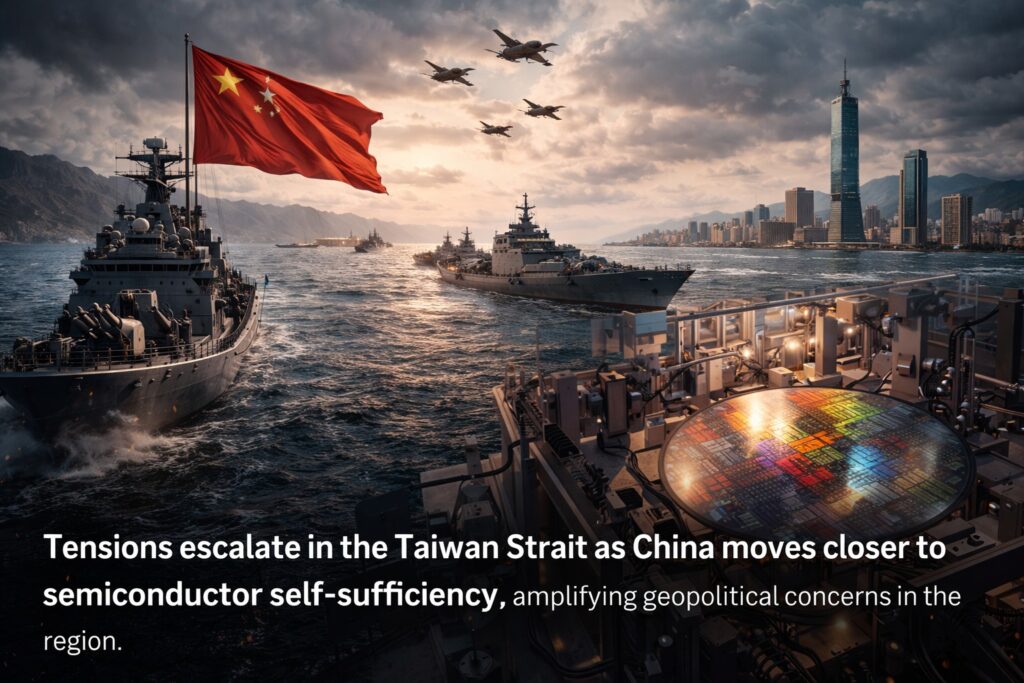
The Taiwan Strait is emerging as the world’s most dangerous geopolitical flashpoint, where military posturing meets technological competition in a volatile mix. As tensions escalate in the Taiwan Strait and China moves closer to semiconductor self-sufficiency, the strategic calculations that have maintained relative stability for decades are rapidly changing. The convergence of China’s advancing chip manufacturing capabilities with heightened military tensions creates a scenario where traditional deterrence mechanisms may no longer hold.
A Critical Flashpoint Takes Shape
The Taiwan Strait has transformed into one of the world’s most precarious military zones, where multiple factors combine to create an increasingly unstable situation. China’s military modernization program has accelerated dramatically, with regular deployment of advanced fighter jets, naval vessels, and missile systems in exercises near Taiwan. These displays of force have become more frequent and sophisticated, demonstrating capabilities that would have been unimaginable just a decade ago.
Military Build-Up Meets Alliance Strengthening
Simultaneously, the AUKUS defense partnership between Australia, the United Kingdom, and the United States has solidified into a formidable alliance structure. This trilateral arrangement focuses specifically on Indo-Pacific security concerns, with submarine technology sharing and advanced weapons development at its core. Defense analysts point to this parallel military expansion on both sides as creating conditions where miscalculation becomes increasingly likely, with each demonstration of strength prompting counter-responses that raise the overall tension baseline.
China’s Path to Chip Independence Nears Completion
Intelligence assessments and industry analysis converge on 2026 as the timeline when China achieves meaningful semiconductor self-sufficiency. This represents a fundamental shift in global technology dependencies that have shaped international relations for the past two decades. Chinese semiconductor companies, despite facing Western export restrictions, have made significant advances in manufacturing processes and design capabilities.
The implications extend far beyond technical achievements. Once China can produce advanced chips domestically, the nation eliminates a major strategic vulnerability that has long influenced its international behavior. This technological independence removes what has been perhaps the most effective lever of Western influence over Chinese policy decisions.
Technology Competition Enters Uncharted Territory
The rivalry between the United States and China has evolved beyond traditional semiconductor competition into emerging technologies that could reshape global power structures. Quantum computing development has accelerated on both sides, with potential applications that make current cybersecurity measures obsolete. The race for artificial general intelligence (AGI) has become equally intense, as both nations recognize that leadership in this field translates directly into influence over information systems and infrastructure management worldwide.
These technological frontiers matter because they determine who sets standards, controls critical systems, and shapes the digital architecture that underpins modern society. The competition has moved from economic advantages to questions of fundamental security and autonomy in the digital age.
Global Power Balance Reaches an Inflection Point
The year 2026 represents more than just China’s semiconductor independence timeline—it marks a broader shift in international power structures. The expansion of BRICS+ membership has created an alternative economic and diplomatic framework that challenges traditional Western-led institutions. This multipolarity differs fundamentally from the post-Cold War period when American influence faced few serious structural competitors.
The transition creates uncertainty about which international norms will prevail and which institutions will remain relevant. Countries increasingly navigate between competing power centers, making calculations based on immediate interests rather than long-term alliance commitments.
Economic Pressure Loses Its Effectiveness
Western nations have relied heavily on economic sanctions and technology restrictions to influence Chinese policy, particularly regarding Taiwan. The semiconductor restrictions implemented since 2020 represented the most significant economic pressure tool available to Western governments. However, as China approaches chip self-sufficiency, this leverage diminishes rapidly.
Without the threat of technology cutoffs, traditional diplomatic pressure mechanisms become less effective. Military deterrence may emerge as the primary remaining tool for preventing unwanted Chinese actions, but military deterrence carries inherently higher risks of miscalculation and escalation than economic measures.
Multiple Crisis Points Converge
The potential for Taiwan Strait escalation occurs against a backdrop of ongoing global conflicts that have already stretched Western military and diplomatic resources. The war in Ukraine continues to demand significant attention and materiel support, while Middle East conflicts require ongoing diplomatic engagement and military presence.
A third major conflict zone would test the limits of Western capacity to maintain simultaneous commitments across multiple regions. This constraint affects both the credibility of deterrence threats and the practical ability to respond effectively to rapidly developing situations. The convergence of these pressures creates windows of opportunity for aggressive actions by actors who calculate that Western responses will be limited by competing priorities.
The intersection of China’s approaching technological independence with heightened military tensions creates conditions unlike any seen since the Cold War. The traditional tools of international pressure are losing effectiveness just as the stakes in the Taiwan Strait reach their highest levels, setting the stage for decisions that could reshape the global order.