Geopolitics Is Now the Biggest Threat to the World Economy
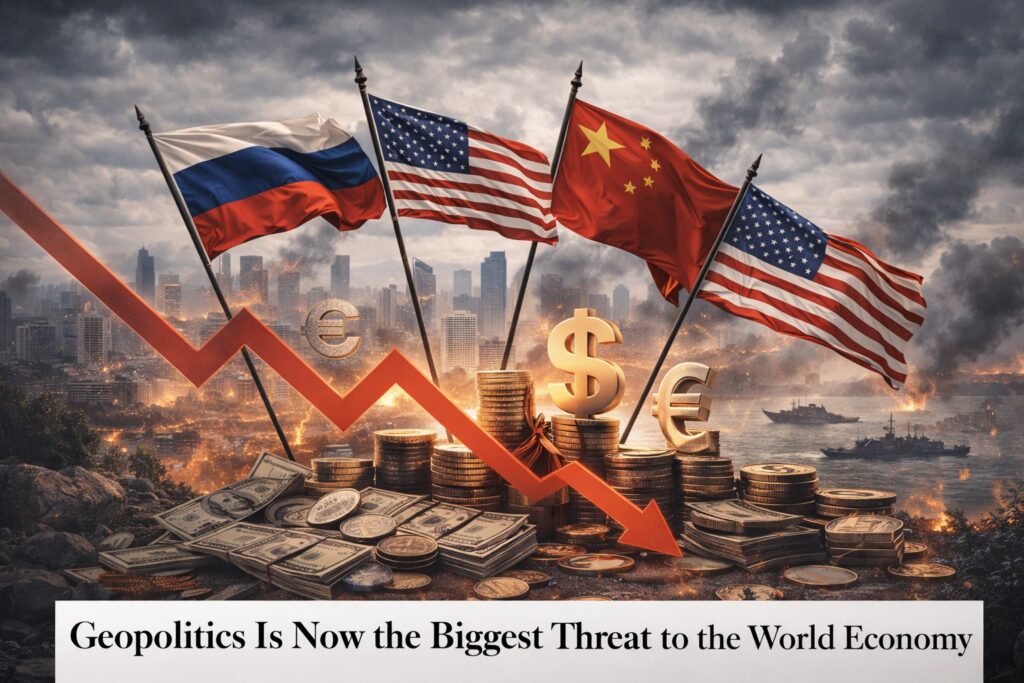
Something fundamental has shifted in corporate boardrooms across the globe. For the first time in decades, chief financial officers are ranking geopolitical instability as their primary concern—above inflation, interest rates, and even recession risks. This represents more than just a change in executive sentiment; it signals that the economic certainties businesses have relied on for strategic planning are dissolving.
The fact that global CFOs now rank geopolitics as the biggest risk signals a major shift in how the world economy operates. Traditionally, financial risks like inflation, interest rates, and currency fluctuations dominated executive concerns. Today, those factors are increasingly seen as consequences—rather than causes—of deeper geopolitical instability.
Political Tensions Eclipse Traditional Financial Risks
The data tells a stark story. Recent surveys of Fortune 500 CFOs show geopolitical concerns have jumped to the top of risk assessments, overtaking the monetary policy decisions and market volatility that previously dominated their worry lists. This isn’t just about Ukraine or Taiwan—it’s about a recognition that political decisions now drive economic outcomes more directly than market forces.
Consider how quickly sanctions, trade restrictions, and diplomatic tensions can reshape entire industries overnight. Energy markets swing based on pipeline politics. Technology companies face sudden export bans. Agricultural exports become diplomatic weapons. The traditional economic playbook, built on assumptions of stable international cooperation, no longer applies.
Executive Sentiment Reaches New Lows
Corporate leaders across sectors report feeling less confident about their ability to forecast business conditions than at any point since the 2008 financial crisis. Unlike previous downturns driven by clear economic factors, the current uncertainty stems from political calculations that remain opaque to business planners.
Manufacturing executives express particular concern about the unpredictability of trade policies. One day, certain materials flow freely across borders; the next, they’re subject to tariffs or outright bans based on shifting diplomatic relations.
Investment Decisions Face Extended Delays
Companies are responding to this uncertainty by hitting the pause button on major capital expenditures. Projects that might have received quick approval in more stable times now undergo months of additional scenario planning. The question isn’t whether an investment makes economic sense—it’s whether the political environment will allow it to succeed.
This cautious approach extends beyond obvious geopolitical hotspots. Even investments in traditionally stable regions now require extensive political risk assessments. Multinational corporations are learning that political stability can evaporate faster than market conditions change.
Capital Allocation Becomes More Conservative
The shift toward defensive positioning shows up clearly in corporate balance sheets. Cash reserves are growing as companies delay commitments that could become liabilities if political winds shift. Research and development spending, once considered recession-proof, now gets scrutinized through the lens of potential regulatory changes and international restrictions.
Supply Chain Vulnerabilities Multiply
The fragility of global supply networks has become impossible to ignore. What started as pandemic-related disruptions has evolved into a permanent state of heightened risk as geopolitical tensions reshape trade relationships. Companies that spent decades optimizing for efficiency now scramble to build redundancy and flexibility into their logistics networks.
The semiconductor shortage offered an early preview of how quickly political decisions can cascade through interconnected supply chains. Now, similar vulnerabilities exist across industries as diverse as pharmaceuticals, automotive manufacturing, and renewable energy. The era of just-in-time delivery has given way to just-in-case stockpiling.
Regional Diversification Becomes Essential
Smart companies are redesigning their supply chains to avoid single points of failure tied to political relationships. This means higher costs in the short term but potentially greater resilience when the next diplomatic crisis hits. The challenge lies in predicting which relationships will remain stable and which might deteriorate without warning.
Long-Term Planning Confronts New Realities
Strategic planning cycles that once focused primarily on market trends and competitive dynamics now must incorporate political scenario modeling. Companies invest in geopolitical advisory services, hire former diplomats, and develop contingency plans for various conflict scenarios. This represents a fundamental evolution in how businesses think about risk management.
The old model assumed political stability as a given, with economic variables as the primary sources of uncertainty. The new reality inverts that assumption. Political decisions drive economic conditions, making traditional forecasting methods less reliable. When CFOs start prioritizing geopolitics above all else, it means one thing: predictability is gone. And without predictability, long-term planning becomes significantly harder.
This shift is long overdue—but also deeply concerning. For years, globalization created the illusion that economic growth could remain insulated from political conflict. That illusion is now breaking down, forcing businesses to confront the reality that economic prosperity and political stability remain inextricably linked. The companies that adapt quickest to this new environment will likely emerge stronger, but the transition period promises to be turbulent for everyone involved.