
Japan Breaks Its Pacifist Legacy — A Historic Military Shift Signals a New Asia Power Balance
Japan has quietly dismantled one of the most defining features of its post-war identity. In December 2022, the government lifted its long-standing ban on exporting lethal weapons, ending nearly eight decades of military restraint that shaped the country’s role in global affairs. This is not merely a policy adjustment—it represents a structural pivot that signals Japan’s recognition that its pacifist model may no longer be viable in today’s security environment.
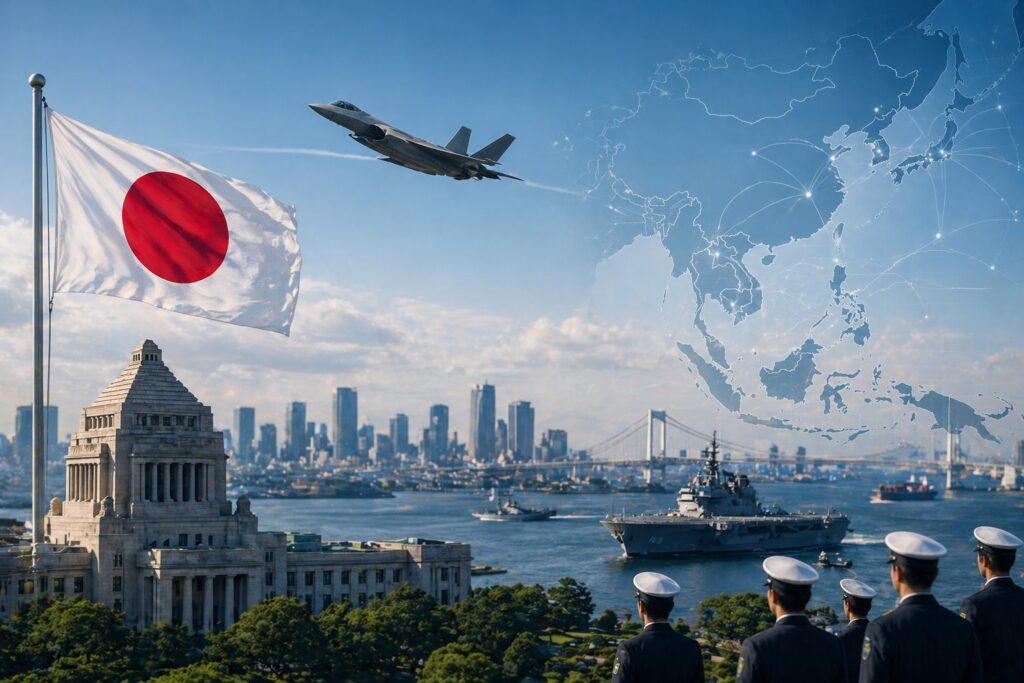
Japan Abandons Decades of Post-War Military Restraint
The decision to allow lethal weapon exports marks the most significant departure from Japan’s pacifist constitution since its adoption in 1947. Under the new policy framework approved by Prime Minister Fumio Kishida’s government, Japan can now sell military equipment including missiles and fighter jet components to countries engaged in active conflicts, reversing restrictions that had been in place since the 1960s.
The Policy Change Goes Beyond Symbolic Gestures
The shift extends far beyond weapons exports. Japan’s National Security Strategy, updated in December 2022, explicitly identifies the country as facing its “most severe and complex security environment since the end of World War II.” This language represents a fundamental reframing of how Japan views its position in the region and its military responsibilities.
The new framework allows joint development and production of defense equipment with partner nations, opening pathways for Japan to become a significant player in the global arms market. This transition reflects a calculated assessment that economic prosperity alone cannot guarantee national security in the current geopolitical climate.
China’s Military Expansion Drives Japan’s Strategic Recalculation
Japan’s military transformation directly responds to China’s growing assertiveness across the Indo-Pacific. Beijing’s military buildup around Taiwan, its territorial claims in the East China Sea, and its construction of artificial islands in the South China Sea have fundamentally altered Japan’s threat assessment.
Chinese military aircraft incursions near Japanese airspace increased by 38% between 2019 and 2023, according to Japan’s Defense Ministry. These encounters have moved from occasional diplomatic irritants to regular occurrences that Japanese officials now treat as systematic pressure campaigns designed to test Japan’s resolve and response capabilities.
The Taiwan situation adds another layer of urgency. Japanese defense planners recognize that any military conflict over Taiwan would likely involve Japanese territory, given the proximity of Japan’s southern islands to potential conflict zones. This geographic reality has pushed Japanese policymakers to conclude that passive deterrence is insufficient.
Defense Spending Reaches Historic Levels
Japan is implementing the largest military expansion in its modern history. The government committed to doubling defense spending from 1% to 2% of GDP by 2027, bringing Japan’s military budget to approximately $80 billion annually. This puts Japan among the world’s top five military spenders.
New Capabilities Target Long-Range Threats
The expanded budget prioritizes acquiring counter-strike capabilities that would allow Japan to hit missile launch sites in enemy territory—a concept that directly challenges the purely defensive posture Japan maintained for decades. The government plans to purchase Tomahawk cruise missiles from the United States and develop its own long-range strike weapons in partnership with allies.
Japan is also investing heavily in cyber warfare capabilities, space-based defense systems, and artificial intelligence applications for military use. These investments reflect an understanding that future conflicts will involve domains that traditional pacifist frameworks never contemplated.
Japan Prepares to Enter the Global Arms Market
The Philippines and Australia are among the first countries expected to receive Japanese military equipment under the new export policy. Japan’s advanced missile defense systems, radar technology, and naval platforms are particularly attractive to regional partners seeking alternatives to Chinese or American suppliers.
This emerging arms trade relationship serves multiple strategic purposes. It strengthens defense ties with key allies while providing Japan with practical experience in military cooperation that goes beyond the theoretical. It also creates economic incentives for Japanese defense companies to invest in research and development that could benefit Japan’s own military capabilities.
Military Partnerships Expand Beyond Traditional Boundaries
Japan’s defense cooperation now extends well beyond its historical alliance with the United States. The trilateral partnership with the UK and Italy to develop a next-generation fighter jet represents Japan’s first major military technology collaboration with European powers since World War II.
This partnership, known as the Global Combat Air Programme, positions Japan as an equal partner in cutting-edge military technology development rather than simply a purchaser of foreign systems. The project signals Japan’s intention to become a technological leader in defense innovation, not merely a consumer of other nations’ military products.
Regional cooperation has also intensified. Joint military exercises with South Korea, despite ongoing historical tensions, have become more frequent and sophisticated. Intelligence sharing arrangements with Australia, India, and the Philippines have expanded significantly, creating an informal network of countries concerned about Chinese expansion.
Domestic Resistance Reveals Deep Cultural Tensions
Despite government support for these changes, public opinion remains divided. Polls consistently show that while Japanese citizens support stronger defense capabilities, many remain uncomfortable with abandoning the country’s pacifist principles entirely.
Anti-war organizations, some led by survivors of World War II, continue to organize protests against the military expansion. These groups argue that Japan’s economic success stemmed partly from its commitment to peaceful development rather than military competition.
The generational divide is particularly notable. Younger Japanese, who did not experience the post-war reconstruction period, are more supportive of military normalization. Older citizens, especially those who lived through Japan’s wartime period, express greater concern about the potential consequences of military expansion.
Asia’s Strategic Architecture Undergoes Quiet Transformation
Japan’s military evolution represents one of the most significant but under-discussed geopolitical shifts occurring today. Unlike dramatic events such as invasions or trade wars, this transformation happens gradually through policy changes and budget allocations that attract limited public attention outside Japan.
Once a country like Japan moves in this direction, historical patterns suggest it rarely reverses course. The institutional momentum behind military expansion, combined with the strategic logic driving these changes, creates conditions that make retreat unlikely even if political leadership changes.
This shift challenges the post-war assumption that major powers could achieve security through economic integration and diplomatic engagement alone. Japan’s experience suggests that in a multipolar world with competing great powers, even the most committed pacifist nations may conclude that military strength remains essential for protecting their interests and values.
The implications extend far beyond Japan itself. If one of the world’s most successful pacifist nations determines that military restraint is no longer viable, this assessment will influence strategic calculations across Asia and beyond. The model of economic power without military ambition that Japan represented for decades is being reconsidered not just in Tokyo, but in capitals throughout the region.