
China Tightens Control Over Critical Minerals — A Silent Move That Could Shake Global Tech Supply Chains
China has quietly strengthened its grip on critical mineral exports through new restrictions and regulatory changes that may prove more consequential than high-profile trade disputes. Unlike tariffs or sanctions that dominate headlines, resource control operates in the background—yet its effects ripple through every smartphone, electric vehicle, and wind turbine produced globally. This measured escalation represents a fundamental shift in how economic power operates in the 21st century, where control over raw materials increasingly rivals technological innovation as a source of strategic advantage.
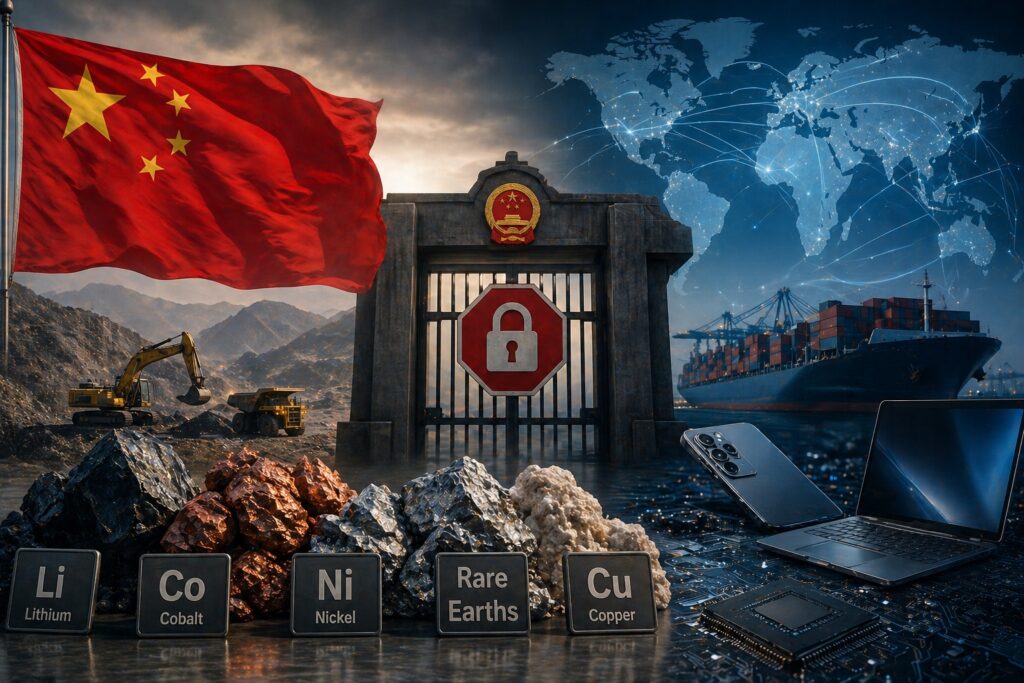
China Expands Export Controls on Strategic Minerals
Beijing has implemented a series of new export restrictions targeting rare earth elements, lithium, and other critical materials essential to modern technology. The Chinese government formalized these controls through updated regulations requiring special licenses for mineral exports and expanding the list of materials subject to oversight.
These measures build on China’s existing dominance in rare earth processing, where it controls roughly 85% of global refining capacity. The country has also secured significant positions in lithium mining operations across Africa and South America, creating multiple pressure points in the supply chain.
New Licensing Requirements Create Additional Barriers
The updated export framework introduces mandatory licensing for previously unrestricted materials and extends review periods for existing applications. Chinese officials frame these changes as necessary for national security and environmental protection, but the timing suggests broader strategic calculations.
Companies seeking to export these materials now face lengthier approval processes and heightened scrutiny of their end-use applications. This administrative approach allows Beijing to maintain plausible economic justifications while exercising greater control over global supply flows.
Technology Sectors Face Mounting Supply Vulnerabilities
The semiconductor industry stands particularly exposed to these supply restrictions. Rare earth elements are essential for chip manufacturing, and alternative sources remain limited in scale and processing capability. Major tech companies have begun reassessing their supply chain resilience as access becomes less predictable.
Electric vehicle manufacturers encounter similar challenges. Battery production requires lithium, cobalt, and rare earth elements that flow through China-controlled supply chains. Tesla, BMW, and other automakers are accelerating efforts to secure direct mining partnerships outside China, but these arrangements take years to establish and scale.
Renewable energy development also depends heavily on these materials. Wind turbines require rare earth magnets, while solar panel efficiency relies on processed minerals that China dominates. Energy transition timelines may face delays if alternative supply sources cannot match current production volumes.
Geopolitical Alignment Increasingly Shapes Market Access
Traditional market mechanisms are giving way to political considerations in mineral trade relationships. Countries seeking reliable access to critical materials find themselves navigating diplomatic relationships rather than simply competing on price and efficiency.
This shift marks a departure from decades of globalization assumptions about neutral, efficient supply chains. Resource-rich countries now evaluate potential customers based on broader strategic alignments, turning commodity markets into extensions of foreign policy.
The pattern extends beyond China’s actions. Other mineral-rich nations observe how resource control translates into geopolitical leverage and may adopt similar approaches. Australia has already implemented foreign investment restrictions on critical mineral projects, while the Democratic Republic of Congo has renegotiated mining contracts to capture greater value from cobalt exports.
Western Nations Accelerate Supply Diversification Efforts
The United States has launched multiple initiatives to reduce mineral import dependence, including the Defense Production Act funding for domestic mining projects and partnerships with allied nations. The Inflation Reduction Act includes provisions incentivizing North American mineral sourcing for clean energy projects.
European Union officials have unveiled the Critical Raw Materials Act, aiming to source at least 10% of critical minerals domestically by 2030 and diversify supply sources away from single-country dependence. The EU is negotiating strategic partnerships with Canada, Australia, and several African nations to secure alternative supply arrangements.
Japan and South Korea have formed a joint critical minerals partnership, pooling resources to invest in mining projects across Southeast Asia and Latin America. These efforts reflect recognition that individual countries lack sufficient scale to compete with China’s integrated supply chain approach.
Building Alternative Supply Chains Takes Time
The central challenge facing diversification efforts is the extended timeline required to establish new mining and processing operations. Mineral extraction projects typically require 10-15 years from discovery to production, while processing facilities take 3-5 years to construct and optimize.
China built its current dominance over several decades of patient investment and integration. Competing nations must compress this timeline while maintaining environmental and labor standards that add complexity and cost to new projects.
Green Energy Transition Costs May Rise Significantly
Limited access to critical minerals threatens to slow clean energy adoption and increase production costs across multiple sectors. Solar panel manufacturers already report supply constraints affecting production schedules, while wind turbine developers face longer lead times for rare earth components.
Electric vehicle prices may remain elevated if battery material costs increase due to supply limitations. This dynamic could delay mass EV adoption and extend the timeline for transportation sector decarbonization goals.
Energy storage projects face similar pressures. Grid-scale battery installations require substantial mineral inputs, and supply constraints may limit the pace of renewable energy integration. Countries pursuing aggressive climate targets may need to revise timelines or accept higher costs for achieving decarbonization objectives.
Raw Material Control Emerges as Strategic Power
China’s tightening grip on critical minerals highlights a fundamental shift in global competition: control over resources is now as strategic as control over technology. This represents one of the most underestimated geopolitical moves today, operating quietly but with far-reaching consequences.
Countries with mineral resources increasingly view them as strategic assets rather than simple export commodities. This mindset transforms mining operations into national security considerations and trade relationships into diplomatic dependencies.
The real challenge for other countries is time. Building alternative supply chains takes years, not months. That gap creates a window of strategic advantage that is difficult to close quickly, allowing resource-controlling nations to extract maximum leverage from their positions.
Economic Competition Enters a New Phase
Resource control is reshaping the rules of global competition beyond traditional trade mechanisms. Countries must now consider supply security alongside cost efficiency when making industrial policy decisions, fundamentally altering how modern economies operate.
If this trend continues, the global economy may become increasingly fragmented—where access to resources depends less on market demand and more on geopolitical alignment. This shift challenges the foundational assumptions of globalization and may accelerate the formation of competing economic blocs organized around resource access rather than pure economic efficiency.
The semiconductor shortage during the COVID-19 pandemic provided a preview of how supply chain vulnerabilities translate into economic disruption. Critical mineral restrictions could create similar effects across multiple industries simultaneously, with longer-lasting consequences for global technology development and energy transitions.