
Europe Under Cyber Siege — A Silent War Is Escalating Beyond the Battlefield
While Europe debates military budgets and defense strategies, a different kind of warfare has already begun. Invisible attacks are targeting power grids in Ukraine, disrupting German rail networks, and infiltrating government systems across the continent. This isn’t preparation for future conflict—it’s conflict itself, unfolding in real time through fiber optic cables and server farms rather than trenches and airspace.
The rise in cyber attacks across Europe signals a shift toward a new form of conflict—one that operates below the threshold of traditional warfare. Unlike conventional military actions, cyber operations offer a unique advantage: they can disrupt entire systems without physical destruction, while maintaining plausible deniability.
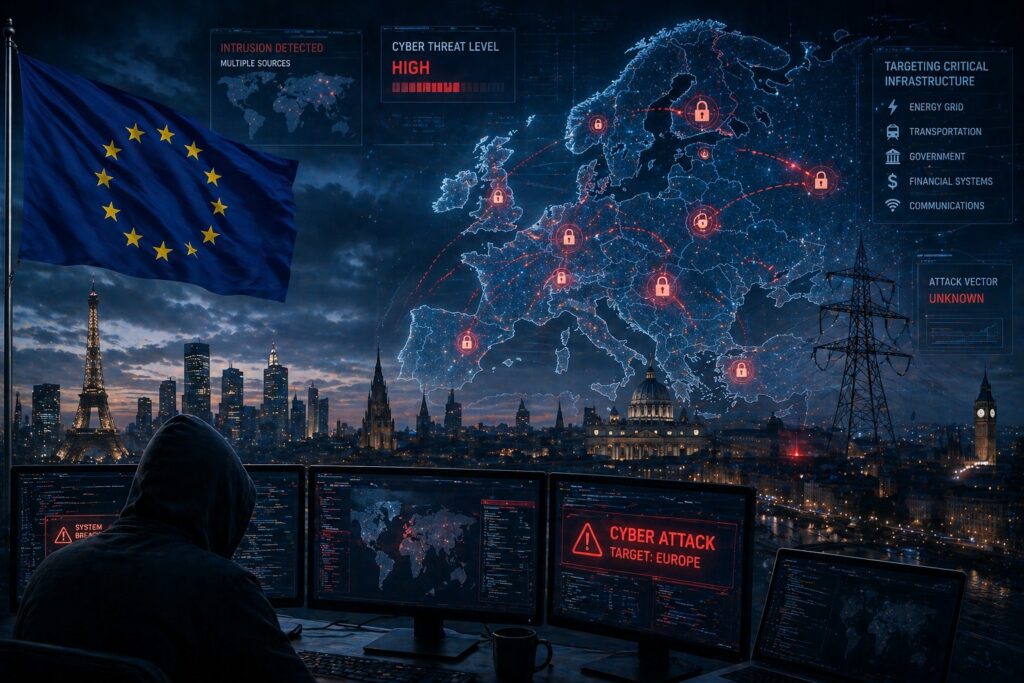
Cyber Incidents Surge Across European Nations
Government networks and essential services in multiple European countries are experiencing an unprecedented wave of coordinated digital attacks. The European Union Agency for Cybersecurity (ENISA) recorded a 38% increase in reported cyber incidents affecting member states in 2023, with particularly sharp rises in attacks targeting public sector infrastructure.
Estonia, which faced one of the earliest large-scale cyber campaigns in 2007, now serves as an early warning system for the continent. Estonian officials report that attempted intrusions into government systems have tripled since early 2022, with attack patterns showing clear coordination and timing that suggests state-level resources.
Attack Patterns Reveal Strategic Coordination
The timing and targets of recent incidents demonstrate careful planning rather than opportunistic strikes. When Sweden announced its NATO membership bid, Swedish government agencies faced a sustained campaign of distributed denial-of-service attacks. Similar patterns emerged around key diplomatic events in Poland, Lithuania, and other frontline states.
These aren’t random criminal enterprises seeking financial gain. The attacks coincide too precisely with geopolitical tensions to be coincidental.
Essential Infrastructure Emerges as the Primary Battleground
Energy networks, transportation systems, and communication infrastructure have become the new high ground in European security. The October 2022 attack on German rail systems demonstrated how digital intrusions can paralyze physical movement across borders, delaying thousands of passengers and freight shipments for hours.
Power grid vulnerabilities present even more serious risks. Ukraine’s experience since 2015 with attacks on its electrical infrastructure provided a testing ground for tactics now appearing elsewhere. Romanian energy officials quietly acknowledged in late 2023 that their systems had detected and blocked similar intrusion attempts.
The strategic logic is clear: disrupting infrastructure creates immediate civilian impact while avoiding the escalatory risks of kinetic warfare.
Digital Operations Merge with Broader Strategic Campaigns
Cyber warfare no longer operates in isolation from other forms of pressure and influence. What we are seeing is the normalization of hybrid warfare, where digital attacks, economic pressure, and strategic messaging combine to achieve geopolitical goals without triggering full-scale war.
The 2024 attacks on Polish government communications systems coincided with an intensive disinformation campaign targeting Polish support for Ukraine. Similar coordination appeared during Czech elections, where voting system probes occurred alongside social media operations designed to amplify political divisions.
This integration makes cyber operations more effective while providing additional cover for attribution challenges.
Determining Responsibility Remains Strategically Complex
Many sophisticated attacks remain difficult to trace definitively, creating a shield of plausible deniability for state actors. Even when technical evidence points toward specific countries or organizations, the legal and diplomatic standards for formal attribution require extensive investigation that often takes months or years.
Russia’s GRU and SVR intelligence services have demonstrated particular skill at routing attacks through multiple countries and using compromised civilian infrastructure to mask their origins. The 2023 intrusion into Norwegian government systems showed technical markers consistent with known Russian groups, but the attack traffic passed through servers in at least six countries before reaching its targets.
Legal Frameworks Struggle with Digital Evidence
International law governing cyber warfare remains underdeveloped compared to the sophistication of the attacks themselves. NATO’s Article 5 collective defense provision has never been invoked for a purely cyber incident, partly because determining the threshold for what constitutes an “armed attack” in digital space remains contentious among allies.
European Defense Capabilities Expand Rapidly
European nations are investing heavily in cybersecurity infrastructure and forming joint defense initiatives to counter the growing threat landscape. The EU’s new Cyber Solidarity Act, approved in 2024, establishes shared resources for incident response and creates mandatory reporting requirements for critical infrastructure operators.
Estonia, drawing on its experience as an early target, now hosts the NATO Cooperative Cyber Defence Centre of Excellence and provides real-time threat intelligence to allies. France has established a dedicated military cyber command with over 4,000 personnel, while Germany announced a €8.5 billion cybersecurity modernization program in late 2023.
These defensive measures are creating genuine obstacles for attackers, but the advantage still lies with those initiating attacks rather than those defending against them.
Daily Life Faces Growing Digital Disruption
Banking services, transportation networks, and utility systems that Europeans depend on daily are experiencing more frequent interruptions due to cyber incidents. The 2023 attack on Italy’s Lazio region computer systems forced hospitals to cancel non-emergency procedures and delayed pension payments for thousands of residents.
Similar disruptions are becoming routine rather than exceptional. Danish citizens faced online banking outages for several days in August 2024 following what officials described as a “sophisticated intrusion” into financial sector networks. Dutch rail passengers experienced widespread delays in September 2024 due to what investigators later confirmed was a deliberate attack on scheduling systems.
Traditional Conflict Boundaries Dissolve in Digital Space
Cyber conflict operates in a gray zone where escalation occurs without formal declarations of war or clear rules of engagement. This ambiguity is not accidental—it serves the interests of actors who want to inflict damage while avoiding the consequences that come with open warfare.
In my view, cyber warfare is the most underestimated threat in today’s geopolitical landscape. Because it lacks the visibility of traditional conflict, it often fails to trigger the same level of urgency. Yet its impact can be just as severe—crippling infrastructure, disrupting economies, and eroding public trust.
The challenge for European policymakers is developing responses that match the severity of the threat without escalating tensions beyond manageable levels. If this trend continues, future conflicts may not begin with tanks or missiles—but with invisible attacks that unfold quietly, long before the world realizes a war has already started.
What makes this particularly dangerous is the erosion of clear thresholds between peace and conflict. When attribution remains unclear and damage occurs gradually, traditional deterrence mechanisms weaken just when Europe needs them most.