
Climate Security — When Environmental Change Becomes a National Security Issue
For much of the twentieth century, climate change was framed primarily as an environmental concern — a problem for scientists, conservationists, and future generations. That framing has shifted considerably. Defense ministries, intelligence agencies, and strategic planning offices now treat environmental change as a direct input into security calculations. The question is no longer whether climate affects national security. The question is how seriously governments are preparing for it.
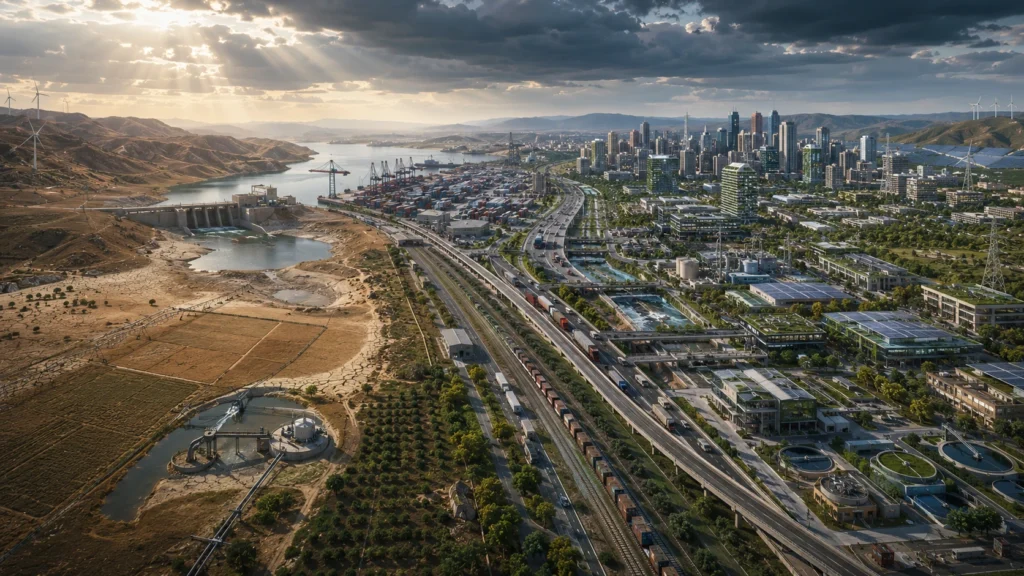
Climate Risks Reach Well Beyond Environmental Policy
Why governments now treat climate change as a strategic security challenge
The evolution here is worth tracking closely. The U.S. Department of Defense identified climate change as a national security threat in its 2014 Quadrennial Defense Review, and subsequent administrations have reinforced that position through successive strategy documents. NATO formally integrated climate security into its Strategic Concept in 2022. The European Union’s Foreign Policy Chief has described climate change as a “threat multiplier” — a term that has become standard language in security circles precisely because it captures the mechanism accurately.
A threat multiplier does not generate conflict on its own. It amplifies existing pressures. Drought intensifies competition over water between communities that already have political grievances. Flooding disrupts supply chains in regions where governance is already strained. Heat stress reduces agricultural output in areas where food insecurity is already a source of instability. The security risk is not the temperature change itself — it is the chain of institutional and social stresses that follows.
Critical Infrastructure Is More Exposed Than Most Plans Assume
Energy systems, transportation networks, and coastal facilities need deeper resilience planning
Infrastructure built decades ago was not designed around current climate projections. Coastal power plants, port facilities, rail corridors in flood-prone regions, and electricity transmission lines in areas prone to extreme heat are all operating with assumptions that may no longer hold. The 2021 heat dome that struck the Pacific Northwest caused road surfaces to buckle and strained power grids in ways that planners had not anticipated at that scale.
This is not a distant problem. The U.S. National Climate Assessment and equivalent studies in Europe and Asia have documented specific infrastructure categories at measurable risk over the next twenty to thirty years. The strategic implication is straightforward: countries that invest in hardening critical infrastructure now face lower disruption costs later. Those that delay face compounding exposure — both physical and economic.
Energy security is particularly sensitive. As countries shift toward renewable sources, the geographic logic of energy production changes. Regions with strong solar or wind resources gain strategic relevance. Regions dependent on hydropower face growing supply uncertainty as glacier retreat and rainfall pattern shifts alter river flows. These are not abstract scenarios; they are already affecting energy negotiations in Central Asia and Southern Africa.
Food and Water Security Are Becoming Strategic Assets
Environmental pressures are reshaping agricultural production and access to resources
Water stress affects roughly two billion people globally, according to UN estimates. That number is projected to grow. Agricultural zones in parts of sub-Saharan Africa, South Asia, and the Middle East face declining productivity from a combination of rising temperatures, shifting precipitation, and soil degradation. When food production falls in politically fragile regions, the downstream effects — migration, social unrest, increased pressure on neighboring states — are measurable and have been documented in peer-reviewed research as well as intelligence assessments.
The Syrian conflict, which emerged following a severe drought from 2006 to 2010, is frequently cited as a case where environmental stress contributed to the conditions that preceded political collapse. That single example has been perhaps over-cited, but it points to a pattern analysts have observed in multiple contexts: resource scarcity does not cause conflict automatically, but it compresses the political space available for peaceful resolution.
Countries with secure agricultural systems and reliable freshwater access hold a form of structural resilience that will appreciate in strategic value. This is partly why control over major river systems — the Nile, the Mekong, the Indus — has become an increasingly visible source of interstate tension.
Climate Migration Is Reshaping Regional Politics
Population displacement carries real consequences for economic stability and cooperation
The World Bank’s Groundswell report projected that climate change could force more than 216 million people to move within their own countries by 2050 under moderate scenarios. Cross-border displacement adds further complexity. Movements of this scale affect labor markets, housing systems, political coalitions, and bilateral relationships.
This is not purely a humanitarian issue, though it is that too. Receiving countries face fiscal pressure and social tension. Origin countries face demographic losses in working-age populations. Regional institutions built around different assumptions about population distribution may find their frameworks increasingly misaligned with conditions on the ground.
The political dynamics around climate migration are already shaping elections and foreign policy in Europe, South Asia, and parts of Latin America. States that develop adaptive capacity — managed migration systems, economic integration pathways, bilateral agreements with neighbors — are better positioned than those that treat migration as purely a border control problem.
Armed Forces Are Building Climate Into Long-Term Strategy
Militaries are incorporating environmental risk into operational and procurement planning
Military planners deal in time horizons of twenty to thirty years. At that range, climate projections are directly relevant to infrastructure investment, basing decisions, procurement priorities, and training requirements. The U.S. Army, the Royal Navy, and several other major militaries have published assessments of how climate change affects specific bases, operational theaters, and logistics chains.
Rising sea levels threaten low-lying naval installations. Permafrost degradation in the Arctic opens new navigable routes and creates new points of strategic competition. Extreme heat reduces the operational window for ground forces in regions like the Middle East and North Africa. None of this is speculative at this stage — it reflects documented physical changes that militaries are accounting for in planning cycles already underway.
International Coordination Is Not Optional
Cross-border environmental challenges require governments to work together more effectively
Climate security does not respect national boundaries. A drought in one country produces migration flows into another. A glacial collapse affects a river basin shared by multiple states. An infrastructure failure in a regional energy grid cascades across borders. The logic of collective response is not idealistic — it is structural. The problems genuinely cannot be contained within single jurisdictions.
Institutions like the UN Security Council have debated whether climate change should be a standing agenda item, with divisions largely tracking geopolitical lines. Regional bodies have moved faster in some cases: the African Union’s climate security framework and ASEAN’s disaster risk reduction initiatives represent concrete attempts to build coordinated capacity. Progress is uneven, but the direction is reasonably clear.
Environmental Resilience Is Becoming a Dimension of National Power
Climate security is shaping the geopolitical order in ways that will only intensify
Countries that treat climate security as a parallel track — separate from economic planning, infrastructure investment, and foreign policy — are likely to find that separation increasingly costly. The states that integrate environmental resilience into national strategy — through infrastructure hardening, agricultural adaptation, water management, and diplomatic engagement on shared resources — are positioning themselves for greater stability in a period when instability will be unevenly distributed.
This is ultimately the core argument for taking climate security seriously as a strategic category rather than an environmental subcategory. The competition for geopolitical influence in the decades ahead will be shaped partly by which states have built the domestic resilience to absorb environmental stress without destabilizing. That is not a guarantee of advantage, but the absence of resilience is increasingly a measurable liability. The countries that recognized this early and acted on it will have made a better set of bets.