
Copper and the Energy Transition — The Metal Powering the Electrified World
Copper rarely attracts the same headlines as lithium or rare earth elements, but in practical terms, it may be more indispensable than either. Every major pillar of the energy transition—power grids, solar installations, wind farms, electric vehicles—depends on reliable copper supplies at scale. As governments and industries accelerate their shift toward electrified systems, copper is quietly moving to the center of one of the most consequential resource stories of the coming decades.
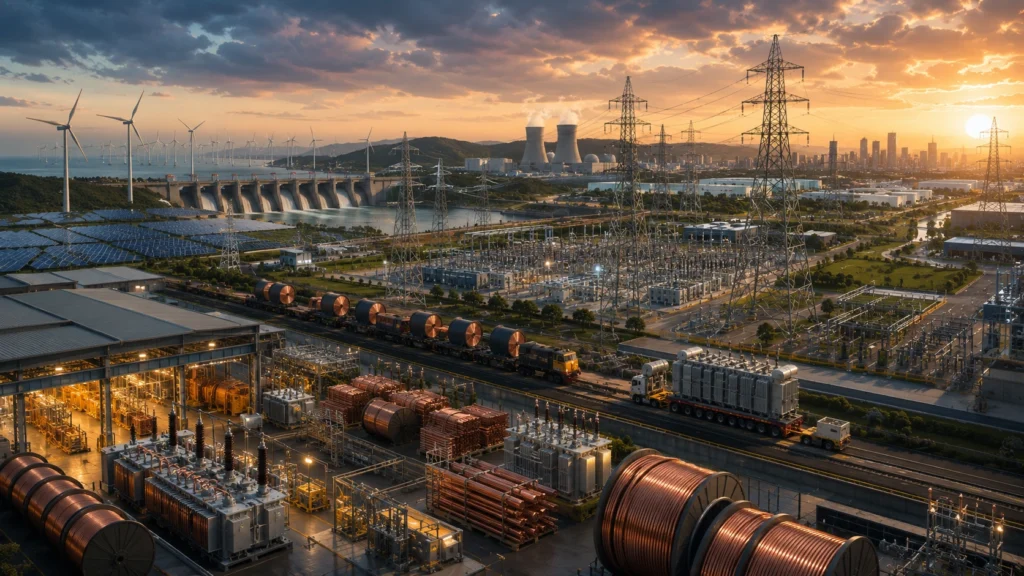
Why Electrification Places Copper at the Core of Modern Power Systems
Electricity does not move without copper. Transmission lines, distribution cables, transformers, and substations all rely on it as the primary conducting material. When countries expand or modernize their grids to accommodate greater electricity demand, copper consumption rises proportionally.
The Grid Upgrade Challenge
The International Energy Agency estimates that global electricity grids need to expand by some 25 million kilometers by 2030 to support clean energy targets. That is not an abstract number—it translates directly into enormous volumes of copper wire, connectors, and cabling. In many regions, existing grid infrastructure was built decades ago and was not designed for the distributed, bidirectional flows that renewable energy requires. Upgrading it is not optional. It is a prerequisite for the transition itself.
How Renewable Energy Is Driving a New Wave of Copper Demand
Solar and wind installations are considerably more copper-intensive than conventional fossil fuel power plants. A utility-scale solar farm uses roughly five to six tonnes of copper per megawatt of capacity. Offshore wind turbines require even more, given the lengthy subsea cables needed to bring power ashore. Battery storage systems, which are essential for managing intermittent generation, add another layer of demand.
This is not a future scenario—it is already happening. Global investment in renewable energy exceeded $1 trillion in 2023 for the first time, according to BloombergNEF, and a significant portion of that capital flows through supply chains where copper is non-negotiable. The metal sits beneath virtually every clean energy system being built today, largely invisible but structurally essential.
Electric Vehicles: A Multiplier Effect on Copper Consumption
A conventional internal combustion vehicle contains roughly 20 to 25 kilograms of copper. An electric vehicle uses between 60 and 80 kilograms, depending on battery size and powertrain configuration. Plug-in hybrids fall somewhere in between. As EV adoption scales globally, this gap compounds into substantial additional demand.
Charging Infrastructure Adds to the Total
The vehicles themselves are only part of the equation. Every public charging station, fast-charging hub, and grid connection point requires copper wiring and components. The buildout of EV charging networks across Europe, North America, and China is adding a demand layer that did not exist a decade ago. By 2040, the copper required for EVs and charging infrastructure alone could rival the total copper demand from entire sectors today.
Why Mining Investment Is Struggling to Match the Pace of Demand
Copper mines take time. From initial discovery through feasibility studies, permitting, financing, and construction, a new mine can take 15 to 20 years to reach production. That timeline does not align well with energy transition targets that are measured in years, not decades.
Several major projects have been delayed or scaled back due to community opposition, environmental permitting difficulties, or cost overruns. The Cobre Panama mine—one of the largest copper operations in the world—was shut down in late 2023 following public protests and a court ruling in Panama, removing a significant source of supply from global markets almost overnight. It illustrated how fragile supply assumptions can be when political and social conditions shift.
Capital investment in new copper exploration has also been inconsistent. Miners face pressure to return capital to shareholders while simultaneously investing in projects whose payoffs are a decade away. That tension has not been fully resolved, and analysts at S&P Global have warned of potential structural supply deficits emerging by the late 2020s.
Supply Security Is Becoming a Strategic Priority for Governments
Chile and Peru together account for roughly 40 percent of global copper mine production. The Democratic Republic of Congo and Zambia hold major reserves. China, meanwhile, controls a substantial share of copper smelting and refining capacity globally—giving it significant influence over where refined copper flows and at what price.
This concentration is not lost on policymakers. The United States, the European Union, and Japan have all taken steps to identify copper as a critical mineral and to develop strategies for securing more stable access. The U.S. Inflation Reduction Act, for instance, creates incentives for domestic processing of critical minerals, with copper included in that framework.
For resource-rich nations, this creates real leverage. Countries with the ability to expand both mining output and refining capacity will increasingly shape the economics of the energy transition—not just as commodity exporters, but as strategic partners.
Recycling Is Gaining Serious Ground as a Supply Strategy
Copper is one of the few industrial metals that can be recycled indefinitely without meaningful degradation in quality. Secondary copper—recovered from end-of-life cables, electronics, motors, and plumbing—already accounts for roughly 30 to 35 percent of global copper supply.
As primary supply faces constraints, the strategic value of recycled copper rises. The European Union has been developing policies to improve collection rates and reduce the export of copper-bearing scrap. In the United States, infrastructure investments are beginning to factor in domestic recycling capacity as part of supply resilience planning.
Recycling alone cannot close a supply gap of the scale some analysts project, but it meaningfully reduces pressure on primary production and shortens the supply chain for countries that lack domestic ore deposits.
Copper as a Foundation of the Energy Transition—and the Decades Ahead
Copper and the energy transition are inseparable. The metal is not a component that can be engineered away or easily substituted at scale—aluminum works in some applications, but not all, and often with trade-offs in efficiency or weight. For the foreseeable future, copper remains the conductor of choice for a world moving toward electrification.
The countries capable of expanding production, processing capacity, and recycling infrastructure will occupy an increasingly important position in the global economy. This is not a distant projection. Investment decisions being made now—in mining, grid infrastructure, and industrial policy—will determine supply availability through the 2030s and beyond. Copper may not dominate the news cycle, but it will shape the material reality of the energy transition more than most people currently appreciate.