
Global Migration Surges — A Growing Challenge for Governments Worldwide
Global migration is reaching unprecedented levels as millions of people cross borders seeking better economic opportunities, fleeing conflict, or escaping climate disasters. The scale of movement represents more than numbers—it reflects deeper economic and geopolitical imbalances that governments struggle to address effectively.
Current migration flows dwarf historical precedents, creating policy challenges that extend far beyond traditional humanitarian concerns. From Europe’s response to African migration routes to the U.S. handling of Central American displacement, governments face complex decisions that carry significant political and economic consequences. The strategic implications extend to international relations, domestic stability, and long-term demographic changes that will shape global power dynamics for decades.
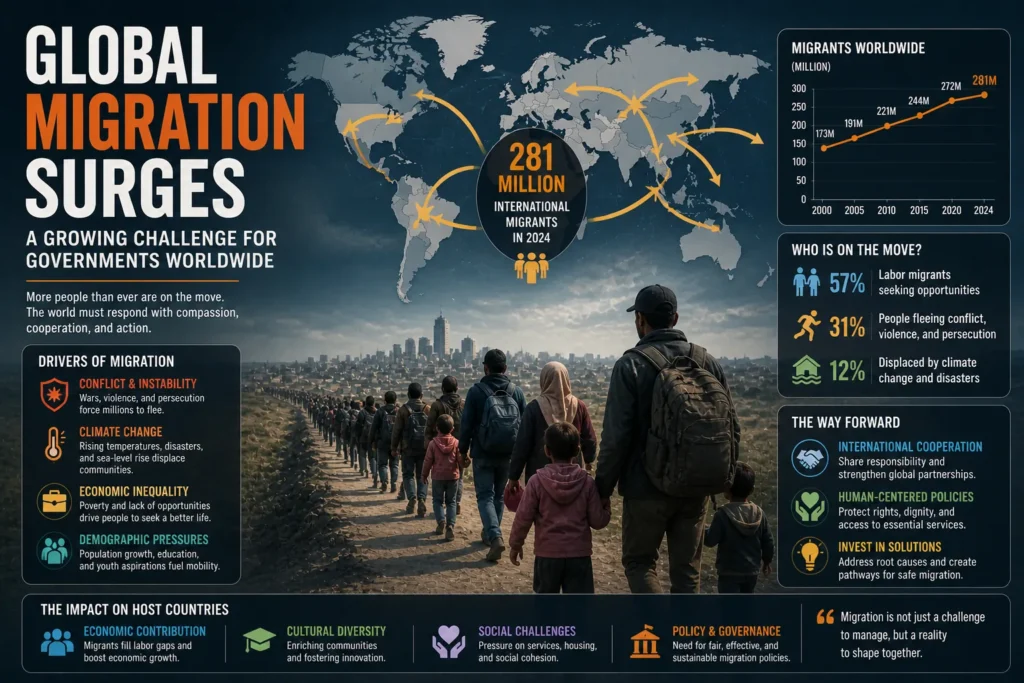
Migration Flows Reach Record Levels Globally
Economic pressures and political instability are driving population movement at an extraordinary scale. The International Organization for Migration reported over 281 million international migrants in 2020, representing a 128% increase since 1990. This surge reflects multiple converging factors rather than isolated regional crises.
Economic disparities between countries create powerful incentives for movement. Workers from sub-Saharan Africa risk dangerous Mediterranean crossings to reach European labor markets offering wages ten times higher than home countries. Similarly, Central Americans traverse Mexico seeking U.S. opportunities, while South Asians migrate to Gulf states for construction and service jobs.
Political persecution and conflict amplify these economic drivers. Syria’s civil war displaced over 13 million people, while Myanmar’s military crackdown forced nearly one million Rohingya into Bangladesh. Afghanistan’s Taliban takeover in 2021 triggered fresh displacement waves, adding pressure to already strained regional systems.
Climate Change Accelerates Displacement Patterns
Environmental factors increasingly shape migration decisions. Rising sea levels threaten Pacific island nations, while prolonged droughts push farmers from rural areas across Africa and Central America. The World Bank estimates climate change could displace over 200 million people by 2050, creating entirely new categories of migrants that existing legal frameworks struggle to accommodate.
Border Policies Become Increasingly Restrictive
Governments are implementing stricter immigration controls as domestic pressure mounts. The European Union’s migration policies exemplify this shift, moving from relatively open borders to fortress-like barriers along key transit routes.
Hungary constructed 325 miles of border fencing starting in 2015, reducing daily border crossings from thousands to dozens. Italy negotiated agreements with Libyan authorities to intercept migrants at sea, cutting arrivals by over 80% between 2017 and 2019. These measures redirect rather than eliminate migration flows, pushing people toward more dangerous routes.
The United States expanded border enforcement significantly, implementing Title 42 expulsions during the COVID-19 pandemic and maintaining restrictive asylum processing. Even traditionally welcoming countries like Canada tightened screening procedures and reduced refugee intake quotas.
Australia’s offshore detention system represents the most extreme approach, processing asylum seekers on remote Pacific islands for years while preventing mainland arrival. This policy achieved its stated goal of deterring boat arrivals but attracted international criticism for humanitarian conditions.
Political Tensions Intensify Around Immigration Issues
Migration has become central to domestic politics across developed nations. Political parties increasingly position themselves around immigration policies, recognizing the issue’s electoral significance.
European politics demonstrates this trend clearly. Italy’s Lega party gained power partly through anti-immigration messaging, while Germany’s Alternative for Germany party emerged as a major force following Angela Merkel’s decision to accept over one million asylum seekers in 2015. France’s Marine Le Pen built presidential campaigns around immigration restrictions, forcing mainstream parties to adopt tougher positions.
American politics show similar patterns. Immigration dominated the 2016 and 2020 presidential elections, influencing policy decisions on border wall construction, refugee admissions, and deportation priorities. State and local governments often clash with federal authorities over enforcement cooperation and sanctuary policies.
These political dynamics create policy instability as governments change. New administrations frequently reverse predecessor policies, creating uncertainty for migrants and destination communities alike.
Economic Impacts Create Winners and Losers
Some countries benefit significantly from labor inflows, while others face fiscal pressures. Germany’s economy gained an estimated 0.5% GDP growth from migration-driven labor force expansion between 2015 and 2018. Construction, healthcare, and service sectors filled critical worker shortages through migrant employment.
Gulf states built entire economic models around temporary labor migration. The UAE and Qatar rely on foreign workers for over 80% of their workforce, enabling rapid infrastructure development and economic diversification. These arrangements generate substantial economic benefits while maintaining strict controls over permanent settlement.
However, sudden large-scale arrivals strain public resources. Greek islands hosting Syrian refugees experienced infrastructure breakdowns and social tension as populations doubled overnight. Small German municipalities faced budget crises providing housing, education, and healthcare for unexpected refugee populations.
Labor market effects vary by skill level and regional context. High-skilled migration generally produces economic gains, while large influxes of low-skilled workers can depress wages in specific sectors. These distributional effects often determine political reactions more than aggregate economic impacts.
Fiscal Costs Concentrate in Border Regions
Geographic patterns intensify economic pressures. Border regions and major cities absorb disproportionate costs while benefits spread nationally. El Paso, Texas spends millions on emergency services for migrants, while employers across the country benefit from expanded labor pools. This mismatch creates political tensions between local and federal governments over resource allocation.
Humanitarian Crises Expose Global Inequalities
Refugee situations highlight stark disparities between rich and poor nations. Lebanon hosts over one million Syrian refugees despite having only four million citizens, while the entire European Union struggled with comparable numbers. Turkey shelters nearly four million refugees, spending billions annually with limited international support.
The contrast reveals how geographic proximity often determines responsibility regardless of capacity. Chad, one of the world’s poorest countries, hosts over 400,000 refugees from neighboring conflicts. Meanwhile, wealthy nations far from crisis zones contribute financially but accept relatively few refugees for resettlement.
International law requires countries to accept asylum seekers but provides limited enforcement mechanisms. This creates incentives for burden-shifting, where nations implement policies to prevent arrivals rather than share responsibility for protection.
Camp conditions in places like Cox’s Bazar, Bangladesh, and Dadaab, Kenya demonstrate the inadequacy of current approaches. Hundreds of thousands live in temporary shelters for years or decades, creating parallel societies with limited rights or opportunities.
International Cooperation Struggles to Keep Pace
Countries find coordination increasingly difficult as national interests diverge. The Global Compact for Migration, adopted by 164 countries in 2018, established principles for cooperation but lacks binding commitments or enforcement mechanisms.
European Union migration policies illustrate coordination challenges. Despite common borders, member states maintain different asylum procedures, benefit levels, and integration approaches. Hungary and Poland rejected mandatory refugee quotas, while Germany and Sweden accepted disproportionate numbers. This uneven burden-sharing undermines solidarity and enables free-riding.
Regional cooperation shows mixed results. The Comprehensive Refugee Response Framework attempts to share responsibility for large refugee populations, but implementation depends on voluntary contributions that often fall short of needs. Latin American countries initially coordinated responses to Venezuelan displacement but cooperation weakened as numbers grew.
United Nations agencies provide humanitarian assistance but cannot address root causes or ensure equitable burden-sharing. UNHCR operations face chronic underfunding, receiving less than 60% of required resources in recent years.
Migration Transforms Global Power Dynamics
Population movement increasingly influences international stability and diplomatic relations. Countries use migration policies as foreign policy tools, creating new forms of leverage and vulnerability.
Turkey’s relationship with the European Union exemplifies this dynamic. President Erdogan repeatedly threatened to “open the gates” for Syrian refugees to reach Europe, extracting billions in aid and political concessions. This migration diplomacy demonstrates how host countries can gain influence over distant powers.
Belarus weaponized migration in 2021, facilitating Middle Eastern migrants’ journey to Polish and Lithuanian borders to pressure the European Union over sanctions. Russia similarly uses migration threats as leverage over European energy policies.
Demographic changes reshape political landscapes in destination countries. Growing immigrant communities influence electoral outcomes, foreign policy priorities, and cultural debates. These shifts create long-term strategic implications that extend beyond immediate policy concerns.
Migration will continue reshaping global politics as economic disparities persist and climate change accelerates displacement. Governments that develop effective management approaches will gain competitive advantages, while those that fail to adapt risk increasing instability and lost opportunities for beneficial population exchanges.