
NATO Launches Major Baltic Sea Drills — The Baltic Becomes Europe’s New Frontline
When NATO assembled roughly 20 warships, 6,000 personnel, and assets from 15 allied nations for BALTOPS 2026 this month, the exercise carried a message that extended well beyond routine training. The Baltic Sea, long treated as a regional concern at the edges of NATO’s strategic attention, is now one of the alliance’s most operationally significant environments. What happens in these waters increasingly shapes the security of all of Northern Europe.
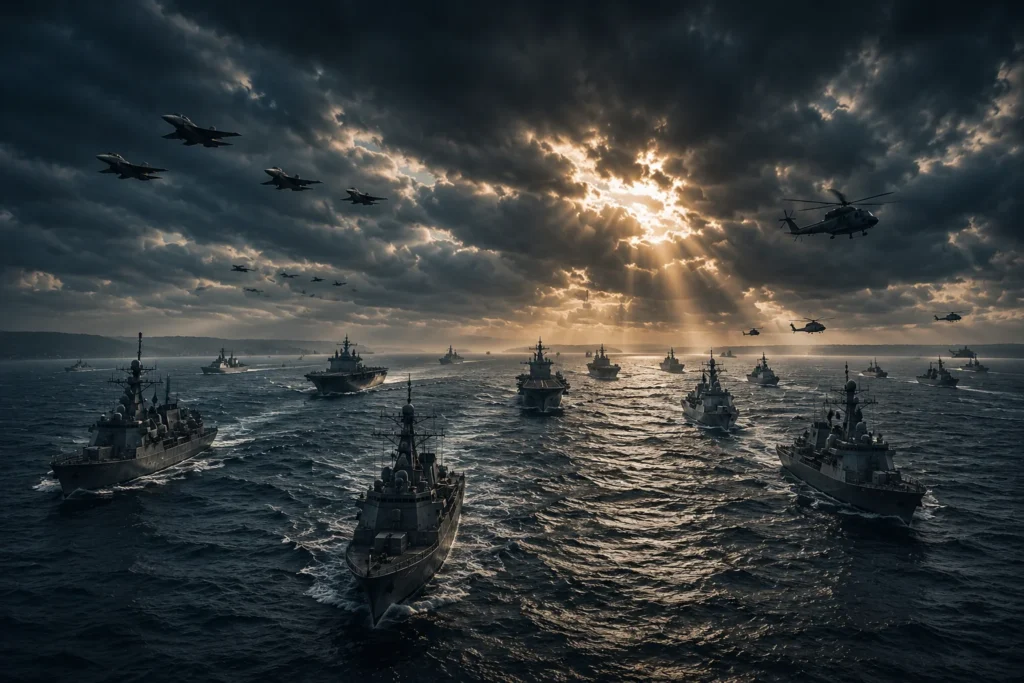
BALTOPS 2026: NATO Opens Its Most Significant Baltic Maritime Exercise This Year
Warships, aircraft, and thousands of allied personnel converge on the Baltic in a show of coordinated readiness
BALTOPS — the Baltic Operations exercise — is an annual event, but its 2026 edition carries particular weight. Fifteen NATO member nations are participating, bringing together surface vessels, naval aviation, and thousands of sailors and marines operating across some of Europe’s most contested maritime geography.
The scale this year is somewhat smaller than previous editions. NATO officials have acknowledged that several naval assets remain committed to other deployments, thinning the available pool. That constraint matters, but it does not undercut the exercise’s core purpose. Alliance officials have been clear: BALTOPS 2026 is a deliberate demonstration of unity and collective readiness, a signal sent in real ships and real people rather than diplomatic statements.
The exercise covers a range of naval competencies — anti-submarine warfare, amphibious landing drills, minecountermeasures, and joint coordination between surface and air assets. These are not abstract capabilities. They reflect specific operational scenarios that NATO planners consider plausible given the current security environment around the Baltic.
Why the Baltic Sea Is No Longer a Secondary Strategic Zone
Regional security pressures have forced a fundamental reassessment of what these waters mean to European defense
For most of the post-Cold War period, the Baltic Sea occupied a relatively quiet corner of NATO’s strategic thinking. The region mattered, but it rarely commanded the same level of institutional attention as the Atlantic approaches, the Mediterranean, or the Black Sea.
That calculus has shifted. Russia’s full-scale invasion of Ukraine in 2022 ended the working assumption that large-scale military conflict in Europe was a theoretical concern rather than a present one. The Baltic states — Estonia, Latvia, and Lithuania — share borders with Russia or its ally Belarus. Their security is directly tied to what NATO can project, reinforce, and sustain across these waters.
The most important story here is not the exercise itself, but what it reveals about where European security priorities are moving. The Baltic is no longer a regional footnote. It is becoming a central theater in how NATO thinks about deterrence on its northeastern flank.
Protecting the Sea Lanes: Maritime Supply Routes Take Center Stage
NATO rehearses the defense of critical corridors connecting Northern Europe and the Baltic states
One of BALTOPS 2026’s stated core objectives is the protection of maritime supply routes in the Baltic. This is a specific and consequential focus. The Baltic states rely heavily on sea-based logistics for military reinforcement and civilian supply. In a conflict scenario, the ability to keep those corridors open — or to deny an adversary the ability to close them — becomes operationally decisive.
The Swedish island of Gotland features prominently in this calculus. Positioned near the center of the Baltic Sea, Gotland offers whoever controls it significant leverage over maritime traffic in the surrounding waters. NATO planners are well aware of its value, and exercises like BALTOPS directly address the question of how alliance forces could operate in its vicinity under contested conditions.
Protecting sea lanes is not just about moving cargo. It is about preserving NATO’s ability to reinforce its eastern members quickly and sustainably. That logistical dimension — keeping the corridor open under pressure — is where maritime exercises do their most important work.
How Sweden and Finland Reshaped NATO’s Position in the North
Sweden’s accession to NATO in March 2024, following Finland’s membership in April 2023, fundamentally altered the alliance’s strategic geometry in the Baltic region. Before these expansions, NATO’s presence around the Baltic Sea had notable gaps. Russia’s Baltic Fleet, based at Kaliningrad, operated in waters where alliance coverage was uneven.
With both Nordic nations now inside the alliance, the Baltic Sea is increasingly enclosed by NATO territory on most of its coastline. Sweden’s military geography — particularly Gotland, its air bases, and its naval infrastructure — directly strengthens the alliance’s ability to monitor and respond to threats in the region. Finland’s long border with Russia adds another layer of strategic depth.
BALTOPS 2026 incorporates both new members as full participants. That integration is itself part of the exercise’s value. Interoperability — the ability of different national forces to operate together under a common command structure — is not automatic. It is built through exactly the kind of repeated joint training that BALTOPS provides.
Russia Remains the Defining Security Variable
No official NATO statement names Russia as a direct adversary in BALTOPS, and none is expected to. But the exercise’s design, its focus areas, and its geographic positioning are all shaped by a clear-eyed understanding of where the threat lies.
Russia’s Baltic Fleet, headquartered in Kaliningrad, maintains surface and submarine capabilities that factor directly into NATO’s planning. Russian maritime activity in the Baltic — including surveillance, occasional provocative maneuvers, and submarine operations — has remained a persistent feature of the security environment. The damage to the Nord Stream pipelines in 2022 and subsequent incidents involving suspected sabotage of undersea infrastructure have made NATO members significantly more attentive to the vulnerability of critical maritime assets.
BALTOPS 2026 takes place against this backdrop. The exercise is not a provocation. It is a long-standing, internationally notified NATO activity. But its timing and content reflect the reality that the Baltic has become an active zone of strategic competition, not a stable peripheral sea.
Naval Power and Maritime Infrastructure Gain Strategic Priority
Land warfare has dominated much of the public discussion about European defense since 2022 — tank deliveries, artillery stockpiles, infantry positions. The maritime dimension has received comparatively less attention, but that is beginning to change.
NATO’s naval posture in the Baltic encompasses more than warship deployments. It includes the protection of undersea cables and pipelines, the readiness of port infrastructure to receive reinforcements, and the capacity to conduct anti-submarine operations in relatively shallow Baltic waters — an environment that presents distinct tactical challenges compared to the open ocean.
The alliance’s Baltic members have invested in expanding port facilities and logistics chains capable of handling NATO reinforcement flows. These physical investments complement the operational training that BALTOPS delivers. Sea control and naval logistics are receiving strategic attention that was, until recently, largely reserved for land-based reinforcement planning.
The Baltic Takes Shape as One of Europe’s Most Contested Strategic Arenas
What was once treated as a secondary security zone has become one of the most operationally active regions in Europe’s defense landscape. BALTOPS 2026 is one visible indicator of that shift, but the underlying drivers — the expansion of NATO’s northern flank, Russia’s continued military posture, the vulnerability of undersea infrastructure, and the logistical centrality of Baltic sea lanes — are structural, not episodic.
NATO Launches Major Baltic Sea Drills — The Baltic Becomes Europe’s New Frontline is a headline that would have seemed overstated a decade ago. Today it reads as a straightforward description of where strategic attention is concentrated. The exercise will end. The competition for position, access, and influence in these waters will not.