
Renewable Supply Chains — The New Competition Behind the Green Economy
The global shift toward clean energy is often framed as a story about electricity—solar panels replacing coal plants, wind farms cutting carbon emissions, batteries storing power where grids once failed. But beneath that narrative runs a harder, more consequential competition. Renewable supply chains have become the real arena where energy leadership is being decided, and the countries that understand this earliest are moving fastest to secure it.
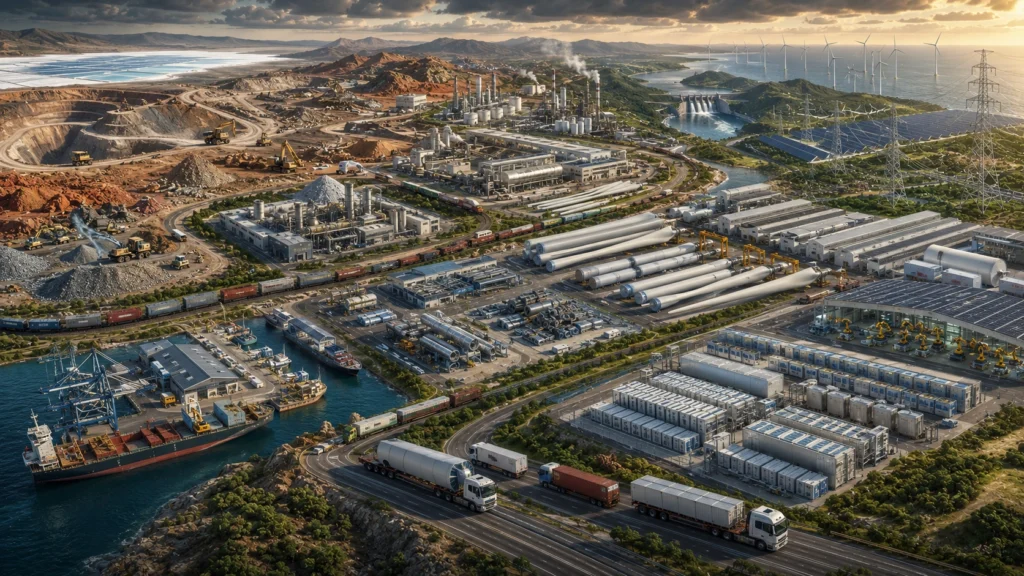
Renewable Energy Runs on Global Supply Chains
Why Clean Technology Depends on Complex International Networks
Every solar panel, wind turbine, and grid-scale battery that gets installed somewhere in the world is the product of a supply chain stretching across multiple continents. Polysilicon refined in China, rare earth magnets processed in Inner Mongolia, lithium extracted in Chile, copper drawn from Zambian mines—these materials flow through a web of factories, ports, and logistics networks before becoming the clean infrastructure that governments proudly announce at ribbon cuttings.
This is not a minor operational detail. It means that a country’s ability to deploy renewable energy at scale is structurally tied to its access to manufacturing capacity and raw materials it often does not control. Energy independence through renewables, in other words, does not automatically follow from installing more panels. It depends on where those panels come from and who controls the industrial process behind them.
Manufacturing Capacity Is Now a Strategic Asset
How Countries Are Racing to Build Domestic Clean-Energy Industries
What changed in the past several years is that governments stopped treating renewable manufacturing as a private sector problem. It became a policy priority—explicitly, publicly, and with significant capital attached.
The United States Inflation Reduction Act, passed in August 2022, directed roughly $370 billion toward clean energy investment, a substantial portion of which targets domestic manufacturing through tax credits for producers of solar modules, batteries, and wind components. The European Union’s Net-Zero Industry Act, finalized in 2024, set a target for Europe to manufacture at least 40 percent of its clean technology needs domestically by 2030. China, meanwhile, had spent the previous decade building dominant positions in nearly every segment of renewable manufacturing—positions it is actively defending and expanding.
The logic behind these moves is straightforward. Countries that control manufacturing capacity control costs, supply reliability, and the ability to deploy at politically acceptable timelines. Outsourcing that capacity to a single dominant supplier creates a dependency that energy security strategies can no longer absorb.
Critical Components Are Becoming Strategically Contested
Solar, Wind, Batteries, and Power Electronics Enter the Industrial Competition
Not all components carry equal weight. Solar photovoltaic modules, lithium-ion battery cells, wind turbine nacelles, and power electronics like inverters have emerged as the segments attracting the most intense competition—partly because of their scale, and partly because concentrated production in a small number of facilities creates obvious leverage points.
China currently manufactures roughly 80 percent of global solar modules and holds dominant positions in battery cell production, largely through CATL and BYD. For wind, the picture is more distributed, with Vestas and Siemens Gamesa still competitive in Europe, but Chinese manufacturers like Goldwind and Mingyang rapidly scaling export capacity.
This concentration is not simply a market efficiency outcome. It reflects deliberate industrial policy choices made over two decades, including subsidized financing, coordinated land and energy access, and sustained public investment in manufacturing scale. Recognizing that is important because it clarifies what competing countries are actually trying to replicate.
Diversifying Supply Chains Has Become a Policy Objective
Why Governments Are Working to Reduce Single-Country Manufacturing Dependence
The political appetite for supply chain diversification grew sharply after COVID-era disruptions exposed how brittle concentrated global production networks could be. For renewable energy specifically, that awareness sharpened further as geopolitical friction with China raised questions about the reliability of supply relationships that had previously been taken for granted.
The response has been a combination of friend-shoring—redirecting procurement toward allied nations—and reshoring, building domestic capacity from scratch. India has emerged as a priority alternative manufacturing base for solar components, with the government’s Production Linked Incentive scheme pushing domestic module capacity toward 100 GW. Vietnam and Malaysia have expanded their roles in solar manufacturing, though both remain heavily integrated with Chinese upstream supply.
Diversification at this scale takes years and carries real costs. Building a competitive battery cell factory requires not just capital but also a trained workforce, reliable material inputs, and domestic demand large enough to justify the investment. These are not obstacles that policy announcements dissolve quickly.
Industrial Policy Is Determining Who Leads the Market
How Public Investment and Incentives Are Shaping Renewable Manufacturing
The era of assuming that market forces alone would build adequate clean energy manufacturing capacity is effectively over. What is replacing it is a more deliberate form of industrial strategy, where government incentives, procurement rules, and public financing are explicitly used to shape where factories get built and which companies grow.
The IRA’s domestic content requirements, for example, create financial incentives for manufacturers to locate production inside the United States, not just sell into the American market. The EU’s carbon border adjustment mechanism adds a cost dimension to imports from regions with weaker climate standards. South Korea and Japan are deploying similar combinations of subsidies and procurement preferences to anchor battery and component manufacturing domestically.
The underlying bet is that early investment in manufacturing capacity creates durable advantages—in cost curves, in workforce expertise, in supplier ecosystems—that later entrants will find difficult to overcome. The winners of the energy transition will not simply be those generating the most renewable electricity, but those controlling the industrial infrastructure that makes the technologies possible.
Resource Security Underpins the Entire Transition
Why Access to Critical Minerals Remains a Foundational Challenge
Manufacturing capacity alone is not sufficient if the materials feeding that capacity are insecure. Lithium, cobalt, nickel, manganese, and rare earth elements sit at the base of virtually every renewable technology supply chain, and their extraction is geographically concentrated in ways that create their own strategic vulnerabilities.
The Democratic Republic of Congo supplies roughly 70 percent of global cobalt. Lithium production is dominated by Australia, Chile, and Argentina—the so-called Lithium Triangle. Rare earth processing remains almost entirely concentrated in China, which handles around 85 percent of global refining capacity despite deposits existing elsewhere.
Efforts to diversify mineral supply are underway. The Minerals Security Partnership, launched in 2022 among the United States, European Union, Japan, Australia, and others, aims to coordinate investment in new mining and processing projects across allied nations. Australia is scaling lithium refining. Canada is developing a critical minerals strategy with explicit geopolitical framing. But building mining and processing capacity takes a decade or more, and demand for these materials is accelerating faster than new supply is coming online.
The Race for Renewable Supply Chains Is Reshaping Global Industrial Strategy
Clean Energy Becomes the New Terrain of Geopolitical Competition
The renewable energy transition is not only changing how electricity is generated—it is transforming global manufacturing and the distribution of industrial power that comes with it. Supply chain resilience has become as important as technological innovation, and in some respects more immediately consequential, because technology without the capacity to produce it at scale remains theoretical.
What is taking shape is a competition that looks less like a climate cooperation story and more like a strategic industrial rivalry, with allies coordinating on one side, China consolidating on another, and a range of emerging economies trying to position themselves as indispensable nodes in whatever supply chain architecture ultimately stabilizes.
The countries that will shape energy markets in the 2030s and beyond are not necessarily those with the most sunlight or wind. They are the ones investing now in the manufacturing depth, material security, and policy alignment needed to build and sustain the industries behind renewable supply chains. That is where the real competition is being fought—and it is already well underway.