
Resource Nationalism — Why Countries Are Tightening Control Over Critical Resources
For decades, the standard arrangement was straightforward: resource-rich countries dug up raw materials, exported them, and let wealthier industrialized nations do the refining, manufacturing, and value-adding. That arrangement is coming apart. Resource nationalism — the drive by governments to assert greater control over how their natural resources are extracted, processed, and traded — is accelerating across multiple continents, and the strategic consequences are starting to reshape global supply chains in ways that investors and policymakers are only beginning to absorb.
This is not simply a reaction to commodity price swings. It reflects a structural shift in how governments think about natural resources — not as export revenue, but as long-term strategic assets tied to industrial development, energy security, and national economic sovereignty.
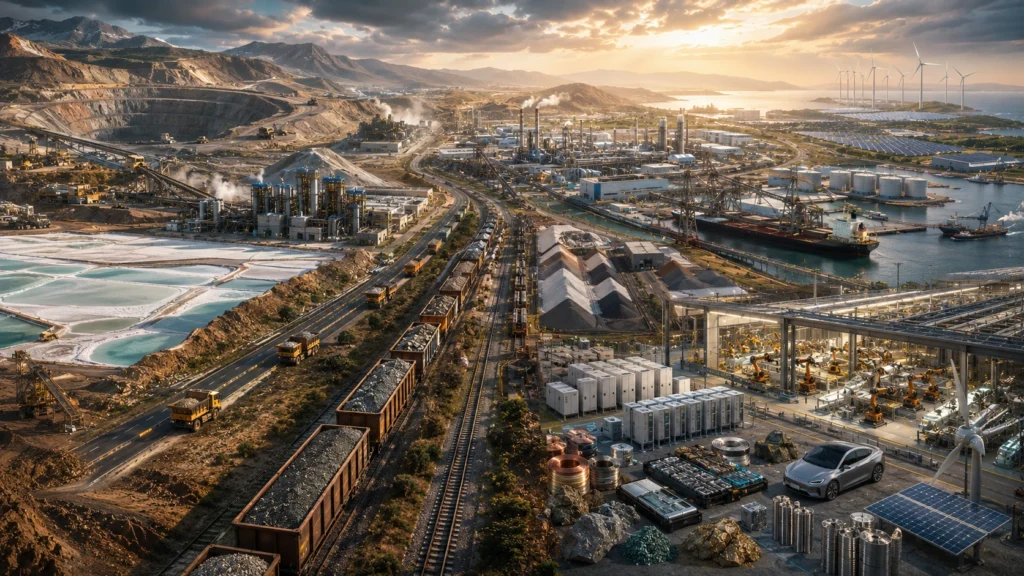
How Governments Are Asserting Greater Control Over Strategic Industries
New policies are rewriting the rules for resource extraction and ownership
The legislative push has been broad and fast-moving. Indonesia banned nickel ore exports in 2020, forcing global supply chains to adjust and compelling foreign companies to invest in domestic smelting capacity. Chile under President Gabriel Boric moved to nationalize its lithium industry in 2023, framing state control as a prerequisite for long-term industrial development. Mexico strengthened state authority over lithium deposits through constitutional amendments in 2022. Zimbabwe banned raw lithium exports in 2022 as well, explicitly to capture more value before materials leave the country.
These are not isolated cases driven by ideology. Governments across Africa, Latin America, and Southeast Asia are reading from the same strategic logic: the countries that processed and manufactured critical materials in the twentieth century accumulated industrial capacity, employment, and geopolitical leverage. Resource producers want a larger share of that going forward.
The policy tools vary — export bans, windfall taxes, mandatory state equity stakes, domestic processing requirements — but the direction is consistent.
Critical Minerals Move to the Center of National Strategy
Lithium, copper, nickel, and rare earths are now treated as strategic assets, not just commodities
The energy transition has fundamentally changed which resources matter most. Lithium, cobalt, nickel, copper, and rare earth elements are essential inputs for electric vehicle batteries, renewable energy infrastructure, semiconductors, and defense systems. That demand profile has given resource-holding governments new leverage — and a compelling reason to use it.
The Democratic Republic of Congo controls roughly 70 percent of global cobalt production. Chile and Australia together hold the majority of the world’s lithium reserves. China dominates rare earth processing, covering an estimated 85 to 90 percent of global refining capacity. These concentrations were tolerable when the materials were niche commodities. They look very different when those same materials are required for energy systems, military hardware, and digital infrastructure.
Governments holding these deposits now recognize they are sitting on something the rest of the world urgently needs. The policy response has been predictable: more control, higher domestic requirements, and a harder line in negotiations with foreign companies.
Export Restrictions Are Starting to Reshape International Trade
Resource policy decisions in one country now carry global market consequences
When Indonesia imposed its nickel ore export ban, global nickel prices climbed and major stainless steel and battery supply chains were forced to reorganize. When China restricted exports of gallium and germanium in mid-2023 — two materials used in semiconductors and defense systems — it sent a clear signal that resource access can be a geopolitical instrument, not just an economic one.
The broader consequence is that export restrictions are no longer treated as emergency measures. They have become standard tools of industrial policy. Countries with the right deposits are using them to pressure trading partners, attract foreign investment on better terms, and build domestic industries that would not otherwise be competitive.
For companies that built supply chains on the assumption of open access to raw materials, the recalculation is significant.
Building Value at Home Rather Than Exporting Raw Materials
More governments are demanding that processing and refining happen within their borders
The clearest expression of resource nationalism is the push to move up the value chain domestically. Exporting unprocessed ore generates revenue. Exporting refined metal, battery-grade chemicals, or manufactured components generates more — and builds industrial capacity in the process.
Indonesia’s trajectory illustrates the ambition. After banning nickel ore exports, the government began attracting investment in nickel smelting, battery precursor chemicals, and EV battery manufacturing. The goal is not just to sell nickel; it is to position Indonesia inside the battery supply chain. Whether that strategy fully delivers is still an open question, but the logic is sound: raw material exporters have historically captured the smallest share of final product value.
Resource nationalism is gaining momentum precisely because governments have seen this pattern long enough to want to change it. The push for domestic processing, refining, and manufacturing is now central to how many countries approach foreign investment negotiations — not an afterthought.
Foreign Investment Now Comes With Stricter Conditions
Companies entering resource sectors face new ownership requirements and partnership structures
The era of straightforward concession agreements — where a foreign company secures rights, extracts resources, and repatriates profits — is narrowing. Governments are attaching conditions that reflect a different set of priorities.
Mandatory joint ventures with state-owned entities are increasingly common. So are requirements to hire locally, source equipment domestically, and meet downstream processing benchmarks before export licenses are renewed. Tanzania, Zambia, and Ghana have each revised their mining codes in recent years to increase state participation and tighten the terms for foreign operators.
This does not mean foreign capital is unwelcome — most resource-rich governments need external investment, technology, and expertise that domestic institutions cannot yet provide. The shift is in the leverage each side brings to the table. Governments are negotiating harder, and companies that assumed historical terms would hold are finding the ground has moved.
Natural Resources as Long-Term National Development Anchors
Governments are repositioning resource wealth as a foundation for broader economic strategy
The underlying shift in thinking is perhaps the most significant change. For much of the twentieth century, resource revenues were treated as budget income — useful for funding public services, often subject to volatile price cycles, and frequently managed through straightforward royalty arrangements. The strategic framing is different now.
Governments increasingly treat their mineral endowments the way Norway treats its oil wealth: as an intergenerational asset that should fund sovereign wealth, industrial diversification, and long-term development rather than simply flowing through annual budgets. Saudi Arabia’s Vision 2030, which uses oil revenue to fund economic diversification, represents one version of this logic applied at scale.
In my view, this repositioning is durable. Access to natural resources is no longer the primary variable — governments increasingly want control over how those resources are processed, traded, and integrated into national economic strategy. That ambition does not disappear when commodity prices fall; if anything, it intensifies when governments feel they have been undervalued.
Resource Nationalism Is Forcing Multinational Companies to Rethink Supply Chain Strategy
Multinational companies are adjusting how they think about long-term resource access, and the adjustments are not marginal. Supply chains built on geographic concentration and open export markets are being stress-tested. The response from major economies has been to pursue supply diversification — the United States through the Inflation Reduction Act’s domestic content requirements, the European Union through its Critical Raw Materials Act, Japan through long-term bilateral agreements with resource-producing nations.
None of these responses fully resolve the underlying tension. The countries that hold the most important deposits are also the ones with the strongest incentive to attach conditions to access. Companies that engage early, offer genuine technology transfer, and accept minority positions in joint ventures are often better positioned than those that push for legacy-style concession terms.
Resource nationalism will likely define one of the central investment and geopolitical themes of the coming decade. It is not anti-market sentiment dressed up in policy language — in most cases, it is a calculated effort by governments to capture more of the economic value their geology generates. Understanding that calculation, and the specific policy tools being used to pursue it, is now a prerequisite for anyone operating in the global resource sector.