
Strategic Ports — Why Maritime Gateways Are Becoming Geopolitical Assets
A port is easy to underestimate. It looks like infrastructure — cranes, containers, berths, and logistics yards. But in the current period of intensifying great-power competition, ports have taken on a different kind of significance. Strategic ports are no longer viewed solely as commercial facilities. They have become pressure points in a global contest over trade routes, energy flows, defense access, and economic leverage. Understanding why maritime gateways are becoming geopolitical assets means understanding how physical geography and economic policy are converging in ways that matter far beyond the dockside.
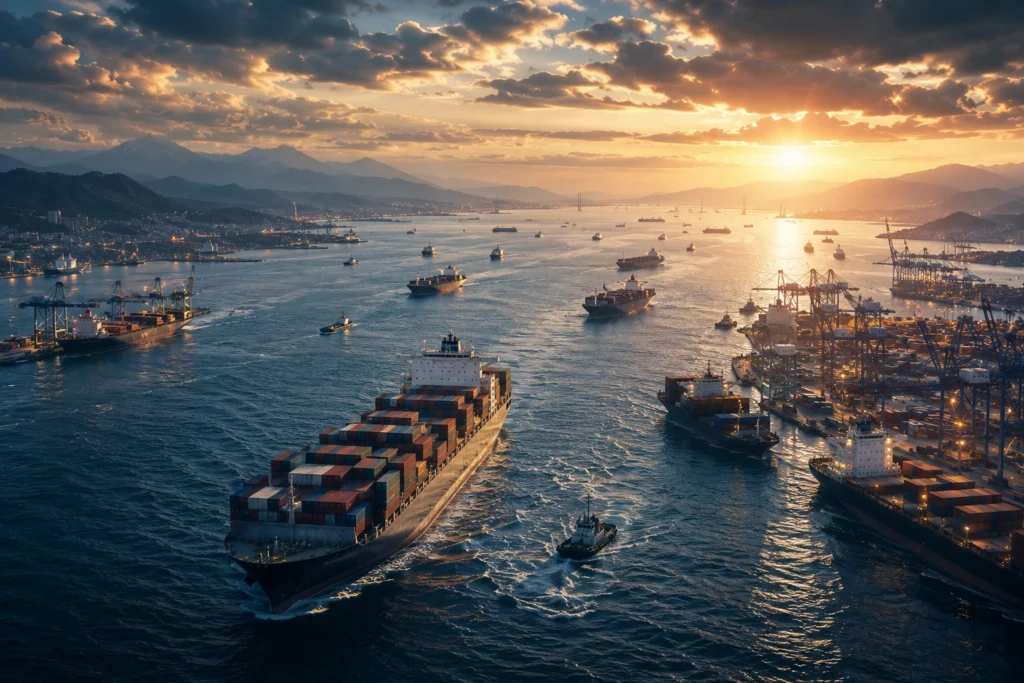
The Backbone of Global Trade Runs Through the Sea
Why maritime transportation still dominates international commerce
Around 80 percent of global trade by volume moves by sea. That single figure explains a great deal about why ports sit at the center of so many strategic calculations. Unlike air freight, which handles high-value, time-sensitive goods, maritime shipping moves the bulk materials that economies depend on — oil, liquefied natural gas, grain, minerals, and manufactured goods in container form.
The efficiency of this system is not automatic. It depends on port capacity, handling speed, deep-water berths that accommodate modern ultra-large container vessels, and reliable connections to inland transport networks. Countries with well-developed port infrastructure move goods faster, attract more trade, and give their exporters a competitive edge that tariff negotiations alone cannot replicate.
What tends to get overlooked is that port infrastructure also defines vulnerability. A country heavily reliant on a single gateway for imports faces real exposure if that gateway is disrupted — whether by conflict, natural disaster, or political disagreement with the controlling authority.
Port Ownership as a Tool of Geopolitical Competition
How overseas port investment has reshaped strategic rivalries
China’s Belt and Road Initiative made port investment a widely discussed topic, and for good reason. Through state-backed financing and construction, Chinese entities gained operational stakes or significant influence in ports from Hambantota in Sri Lanka to Piraeus in Greece and Gwadar in Pakistan. The pattern raised questions that went beyond trade efficiency — specifically, what access or leverage does port presence provide to a major power with both commercial and military ambitions?
The United States and its allies have responded with growing scrutiny of foreign port investment. Australia moved to cancel the 99-year lease of Darwin Port from a Chinese company in 2021, citing national security concerns. The European Union has been developing frameworks to screen foreign investment in critical infrastructure, with ports explicitly included.
This is not a story about one actor. Gulf sovereign wealth funds, Japanese trading houses, and Singaporean port operators all have significant overseas port footprints. The difference is that investments from non-aligned or rival powers now trigger a security review that commercial investments rarely did a decade ago. Port ownership has become part of the geopolitical ledger.
How Modern Port Capacity Shapes National Competitiveness
Ports improve trade efficiency in ways that compound over time. A country that invests in automated terminals, efficient customs processing, and rail or road connectivity to port facilities reduces logistics costs across its entire export sector. This matters enormously for manufacturers competing on thin margins in global markets.
Singapore is the clearest example of a small country using port infrastructure as a national strategy. Its position as one of the world’s busiest transshipment hubs is not accidental — it is the product of decades of investment, regulatory design, and deliberate positioning as a reliable neutral node in global supply chains. The result is an economy whose strategic influence exceeds what its size alone would suggest.
The broader point is that port capacity is not just about handling more boxes. It shapes where multinational companies site their regional distribution centers, where shipping lines call first, and ultimately where economic activity concentrates.
Why Location Near Chokepoints Multiplies Strategic Value
Some ports matter not just because of their facilities but because of where they sit. The Strait of Hormuz, the Strait of Malacca, the Bab el-Mandeb, and the Turkish Straits are all narrow passages through which enormous volumes of global trade flow daily. Ports positioned near these chokepoints carry a strategic premium that no amount of inland infrastructure can substitute.
Djibouti is a useful case. The country of fewer than one million people hosts military bases from the United States, France, China, and Japan, largely because its port at Doraleh controls access to one of the most contested maritime corridors in the world — the route connecting the Red Sea to the Indian Ocean. Djibouti has extracted considerable external investment and political attention as a direct result.
The same logic applies in the South China Sea, where China’s construction of artificial islands with port facilities is explicitly about projecting presence along shipping lanes that carry roughly one-third of global maritime trade annually. Control of chokepoints, or proximity to them, confers options that translate into diplomatic weight.
Smart Technology Is Redefining What Ports Can Do
Digitalization is changing port operations in concrete ways. Automated cranes and yard vehicles reduce labor costs and increase throughput. Port community systems allow customs authorities, shipping lines, terminal operators, and freight forwarders to share data in real time, cutting clearance delays that once added days to cargo transit times.
Cybersecurity has become a related concern. The 2017 NotPetya cyberattack disrupted operations at Maersk, one of the world’s largest shipping companies, and highlighted how deeply interconnected digital systems underpin physical logistics. A sophisticated attack on a major port’s operating system is now a recognized threat vector that security planners take seriously.
Digitally advanced ports also generate better intelligence about cargo flows, vessel movements, and supply chain patterns — information that has both commercial and security value. The countries and companies that control this data infrastructure gain visibility that matters beyond the port gate.
Governments Are Reclassifying Ports as Critical Infrastructure
Supply chain resilience is pushing port policy toward the center of national strategy
The disruptions of 2020 and 2021 — pandemic-driven port congestion, the Ever Given blocking the Suez Canal for six days in March 2021, and semiconductor shortages cascading from logistics failures — forced a policy rethink in many capitals. Ports moved from the background of economic policy into active strategic planning.
The United States passed the Ocean Shipping Reform Act in 2022 partly in response to concerns about foreign carrier pricing and port access during the pandemic. The European Union designated ports as critical infrastructure under its revised directive, increasing obligations on member states to assess and reduce vulnerabilities. In Asia, Japan and South Korea accelerated investments in domestic port capacity and nearshoring of key supply chains.
The underlying logic is consistent: reliance on distant, foreign-controlled infrastructure is a liability when global conditions shift. Building or securing domestic and allied port capacity is increasingly understood as a form of economic defense.
Maritime Infrastructure and the Architecture of Global Power
Why strategic ports will shape economic and diplomatic relationships for decades
The countries that invest wisely in maritime infrastructure will strengthen both their economic competitiveness and their ability to project strategic influence. This is not a prediction that requires much speculation — the evidence is already accumulating. Port access shapes where navies can operate, where supply chains are anchored, and which trade agreements carry real enforcement options.
What makes this moment distinct is the degree to which port investment has become an explicit instrument of statecraft rather than simply a commercial decision. Governments are making choices about port financing, ownership screening, and alliance-based logistics networks that reflect deliberate strategic priorities, not just market signals.
The competition is not primarily about seizing territory. It is about positioning within the physical systems that move goods, energy, and military assets around the world. In that competition, a well-placed, well-run port is a durable form of influence — one that generates returns measured in decades, not quarters. Nations that treat maritime gateways as strategic assets, rather than passive infrastructure, are the ones most likely to shape the terms of global exchange in the years ahead.