
The Chagos Islands Return to the Spotlight — A Tiny Archipelago Sparks a Major Geopolitical Debate
Most people have never heard of the Chagos Islands, yet this remote archipelago in the Indian Ocean has quietly become the center of a major geopolitical debate. Recent reports suggest the United States is exploring new options to maintain long-term access to Diego Garcia, the military base that anchors American operations across the Middle East and Indo-Pacific. The discussion has intensified as uncertainty grows around Britain’s plans to transfer sovereignty of the islands to Mauritius.
This is exactly the type of geopolitical story that often gets overlooked until it becomes a major issue. While headlines focus on Ukraine, Taiwan, or the Middle East, small territories positioned along critical maritime routes can quietly reshape global military strategy.
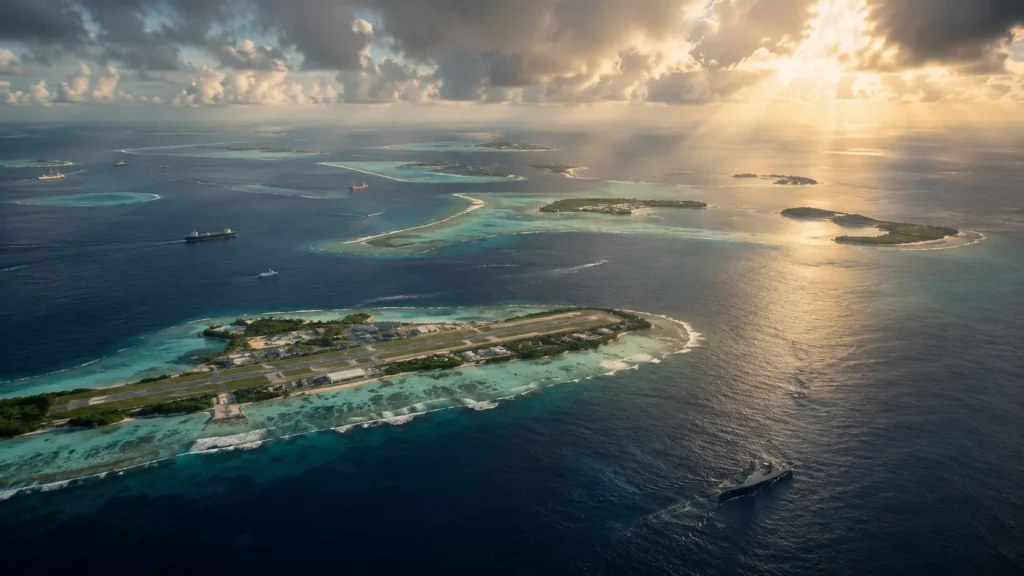
The Chagos Archipelago Emerges from Obscurity
A fresh wave of international attention has focused on this cluster of 55 small islands, most uninhabited, scattered across 210,000 square miles of Indian Ocean waters. The renewed debate combines questions of sovereignty, decolonization, and military access that extend far beyond the archipelago’s modest geographic footprint.
The current controversy stems from ongoing negotiations between the United Kingdom and Mauritius over transferring control of the islands. Britain has administered the territory since 1965, when it separated the Chagos Islands from Mauritius before granting the latter nation independence. This decision displaced roughly 2,000 Chagossian residents to make way for the military installation that would become Diego Garcia.
Diplomatic Pressure Builds on Multiple Fronts
International legal pressure has mounted against British control over recent years. The International Court of Justice issued an advisory opinion in 2019 stating that Britain’s continued administration of the islands violates international law. The United Nations General Assembly has also passed resolutions calling for the territory’s return to Mauritius.
These legal challenges have created the political uncertainty that now drives American concerns about future base access.
Diego Garcia Anchors Critical Military Operations
The military installation on Diego Garcia represents one of America’s most strategically positioned overseas bases. Located roughly 1,000 miles south of India, the facility provides launching points for operations spanning from East Africa to Southeast Asia.
The base has supported major military campaigns over the past three decades. During the 1991 Gulf War, B-52 bombers flew missions from Diego Garcia to Iraq. The facility played similar roles during operations in Afghanistan and subsequent Middle East interventions. More recently, the base has gained importance as Washington shifts military focus toward great power competition in the Indo-Pacific.
The installation houses approximately 4,000 military personnel and contractors. Its strategic value lies not just in geography, but in its isolation from population centers and political pressures that can complicate base operations elsewhere.
Washington Evaluates Long-Term Access Arrangements
American officials are reportedly examining various mechanisms to preserve base rights regardless of sovereignty changes. These discussions reflect broader concerns about maintaining military positioning as geopolitical competition intensifies across the Indian Ocean region.
The United States currently operates Diego Garcia under a lease agreement with Britain that runs through 2036. However, if sovereignty transfers to Mauritius, Washington would need new arrangements with Port Louis to continue base operations.
Mauritius has indicated willingness to accommodate continued American military presence, but the terms and duration of such access remain unclear. U.S. planners apparently prefer more certainty about long-term base rights than current diplomatic discussions provide.
Strategic Planning Meets Political Reality
The American approach must balance several considerations. Military planners want maximum operational flexibility and extended lease terms. Diplomatic officials must work within the constraints of decolonization pressures and Mauritian sovereignty claims. Defense budgeting requires clear arrangements that justify continued investment in base infrastructure.
These competing pressures explain why Washington may be exploring alternative frameworks that could provide stronger guarantees of continued access.
Indian Ocean Competition Reshapes Strategic Calculations
The Chagos debate unfolds against broader competition for influence across Indian Ocean shipping lanes and strategic positions. China has expanded its presence in the region through port investments, naval facility construction, and diplomatic partnerships with island nations.
Beijing established its first overseas military base in Djibouti in 2017 and has invested in port facilities across Sri Lanka, Pakistan, and East Africa. These developments have heightened American attention to maintaining countervailing positions throughout the region.
India has also strengthened its Indian Ocean presence through partnerships with island nations including the Seychelles and Maldives. New Delhi views the region as central to its security perimeter and economic interests.
The geographic position of the Chagos Islands places them at the intersection of these competing strategic visions.
Sovereignty Claims Challenge Military Requirements
The tension between decolonization efforts and security interests reflects a broader pattern in contemporary geopolitics. Small territories with strategic value often become focal points where historical grievances meet present-day military requirements.
The displaced Chagossian population adds another dimension to the sovereignty dispute. These former residents and their descendants have legal claims for return and compensation that complicate any settlement. Their interests don’t necessarily align with either British retention or Mauritian control, creating additional complexity for negotiators.
Mauritius faces its own balancing act between asserting sovereignty rights and maintaining relationships with major powers. The country needs foreign investment and security partnerships, but also confronts domestic pressure to reclaim territory viewed as illegally separated during the colonial period.
Regional Powers Monitor Developments Closely
India watches the Chagos situation with particular interest given its proximity and strategic concerns. New Delhi has historically supported Mauritian sovereignty claims while maintaining defense cooperation with the United States. Indian officials likely prefer arrangements that don’t strengthen Chinese influence in nearby waters.
China has backed Mauritius in international forums on the sovereignty question. Beijing’s support fits within broader efforts to challenge Western control over strategic territories and align with developing nations on decolonization issues.
Australia and other U.S. allies in the region also have stakes in the outcome. These countries benefit from American military presence that helps balance Chinese power projection, making continued base access a shared security interest.
Geographic Position Drives Strategic Importance
The Chagos Islands demonstrate that geography still matters in military planning. Despite their small size and remote location, these islands control access to shipping routes that carry significant portions of global trade between Asia, Europe, and East Africa.
The future of this tiny archipelago may influence military planning and strategic balances far beyond the Indian Ocean. How Washington, London, and Port Louis resolve competing claims over sovereignty and base access could establish precedents for similar disputes elsewhere.
The outcome will likely reflect which priorities ultimately prove decisive: legal claims about decolonization, strategic requirements for military positioning, or practical arrangements that attempt to balance both concerns. In an era of renewed great power competition, even the smallest territories can carry outsized strategic weight.