
Uranium Revival — Why Nuclear Fuel Is Regaining Strategic Importance
For years, uranium barely registered in conversations about strategic resources. Oil prices moved markets. Natural gas routes shaped foreign policy. Uranium sat quietly in the background, associated more with Cold War-era stockpiles than with 21st-century energy planning. That is changing. As governments across Europe, Asia, and North America recommit to nuclear energy — driven by energy security concerns and emissions targets — uranium is returning to the center of a resource conversation it once dominated.
The revival is not sudden. It reflects a gradual but deepening shift in how governments think about long-term energy resilience, and why a fuel once considered secondary is now drawing strategic attention at the highest levels.
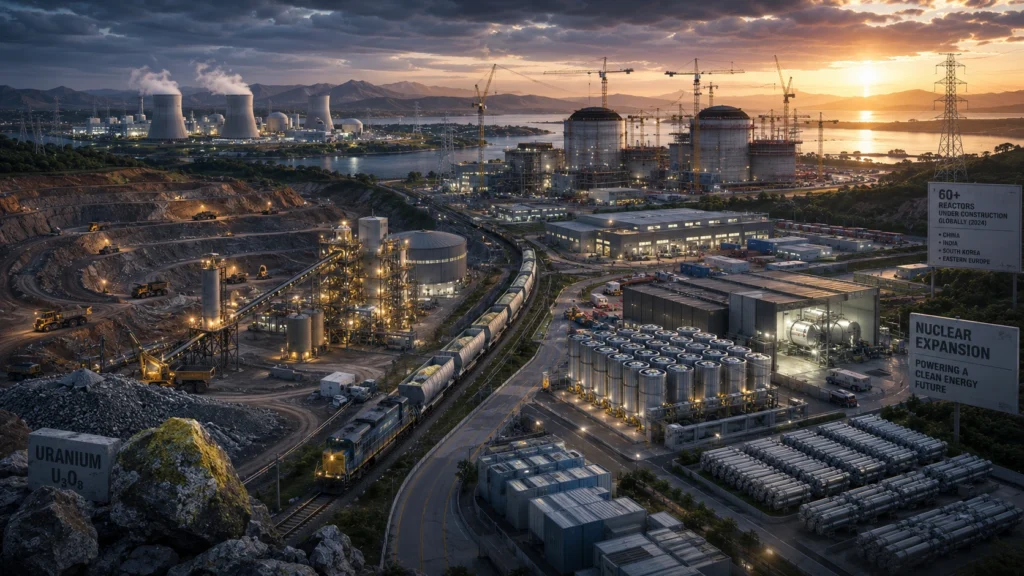
Nuclear Expansion Is Driving a Structural Increase in Uranium Demand
Growing interest in nuclear energy is strengthening long-term demand for uranium.
The numbers behind the trend are concrete. As of 2024, more than 60 nuclear reactors are under construction globally, with the largest concentrations in China, India, South Korea, and several Eastern European countries. China alone aims to triple its nuclear capacity by 2035. The United States has moved to extend the operational lives of existing plants and, after years of hesitation, is investing in advanced reactor designs including small modular reactors.
This is not a short-cycle story. Nuclear plants operate for 40 to 60 years. Each one requires a consistent, long-term supply of uranium. When a government commissions a reactor today, it is effectively committing to decades of fuel procurement — which means uranium demand is being locked in now, well before many of these plants go online.
The policy momentum matters as much as the construction activity. Countries that once planned reactor phase-outs, including Japan and Belgium, have reversed or softened those decisions. France has announced a new wave of reactor construction after years of reducing its nuclear share. Each policy reversal adds to the structural demand picture.
Energy Security Is Reshaping How Countries Think About Fuel Supply
Countries are investing in reliable domestic fuel sources to reduce external exposure.
The disruption to European energy markets following Russia’s invasion of Ukraine clarified something that energy planners had known but not fully acted on: dependence on a single external supplier is a strategic liability. For nuclear energy, Russia’s state-owned Rosatom historically supplied enrichment services and fuel assemblies to several European reactors. That relationship became politically uncomfortable — and in some cases untenable — almost overnight.
The response has been a push for supply diversification. The United States passed the Prohibiting Russian Uranium Imports Act in 2024, cutting off most Russian uranium imports with limited exceptions. European utilities accelerated their search for alternative enrichment partners. The urgency was not theoretical; operators needed replacement supply within planning cycles that left little room for delay.
This experience reinforced the argument that nuclear fuel supply is a national security question, not just a procurement one. Countries are now approaching uranium with the same strategic seriousness once reserved for oil reserves or pipeline routes.
Uranium Producers Are Gaining Strategic Leverage They Rarely Held Before
Nations with substantial uranium reserves are attracting renewed geopolitical attention.
Kazakhstan is the world’s largest uranium producer, accounting for roughly 45 percent of global mine supply through its state company Kazatomprom. Canada, Namibia, Uzbekistan, and Australia hold significant reserves as well. Niger, until political disruptions in 2023, was a major supplier to French utilities — its military coup and subsequent expulsion of French interests illustrated how quickly supply assumptions can collapse.
What was once a fairly quiet commodity relationship is becoming part of broader diplomatic engagement. Countries with uranium reserves are finding that their resource base carries more weight in bilateral negotiations. Australia, for instance, has uranium supply agreements with energy-importing partners in Asia, where the agreements function as much as strategic anchors as commercial contracts.
The concentration of production in a small number of countries — several of them in geopolitically uncertain regions — means that uranium supply carries a risk profile more comparable to critical minerals than to conventional bulk commodities.
Fuel Supply Chains Are Under Scrutiny From Mine to Reactor
Enrichment, processing, and transport capacity are all part of the strategic picture.
Uranium goes through several stages before it powers a reactor: mining, conversion, enrichment, and fabrication into fuel assemblies. Each stage involves a limited number of facilities globally, and the geography of that infrastructure matters. Russia’s TENEX and state-enrichment capacity accounted for roughly 28 percent of global uranium enrichment services before 2022. Replacing that capacity is not a quick exercise.
The United States, France, and the United Kingdom are investing in enrichment capacity expansion. Orano, the French nuclear fuel company, is scaling up operations. Centrus Energy in the US received government backing to restart domestic enrichment at its Piketon, Ohio facility — the first US enrichment production in years. These are slow-moving industrial investments, which means the supply chain gap will persist for several years even as demand builds.
Transportation and processing infrastructure add further complexity. The logistical chain from a mine in Kazakhstan or Namibia to a reactor in France or South Korea involves multiple national jurisdictions, export licenses, and transit agreements. That chain is manageable in stable conditions — and fragile under pressure.
Investment Is Returning to Uranium Mining After a Long Dry Period
Mining projects that were shelved after Fukushima are being revived as market conditions improve.
The 2011 Fukushima disaster triggered a decade-long contraction in nuclear energy investment and, with it, uranium mining. Prices fell sharply. Cameco, the Canadian mining giant, suspended production at its McArthur River mine — one of the world’s richest uranium deposits — for years. Smaller projects were abandoned entirely.
The price recovery that began in earnest around 2023 changed the calculus. Uranium spot prices rose above $100 per pound in early 2024 for the first time since 2007. Cameco restarted and expanded McArthur River. Junior miners began advancing projects that had been sitting dormant, attracting both institutional investors and sovereign wealth interest.
The investment cycle in uranium mining is long. From exploration to production, a new mine typically requires a decade or more. The projects advancing now will not produce meaningfully until the early 2030s. That lag is itself a strategic detail — supply is constrained precisely during the period when demand is accelerating.
Utilities Are Moving Away from Spot Markets Toward Long-Term Fuel Agreements
Stable supply contracts are replacing the opportunistic purchasing that defined the post-Fukushima era.
During the years of low uranium prices, many utilities reduced their contract coverage and relied more heavily on spot market purchases. It was financially efficient and strategically short-sighted. As prices rose and supply risks became more visible, that approach became harder to defend internally or to regulators.
By 2023 and 2024, a clear shift toward long-term contracting was underway. Utilities in the US, France, South Korea, and Japan were signing multi-year supply agreements with producers, often at fixed or floor-priced terms that reduced exposure to price volatility. Cameco reported its contract book growing substantially, with agreements extending into the early 2030s.
This shift matters structurally. Long-term contracts lock in supply for buyers and provide revenue certainty for producers, which in turn supports investment decisions in new mining capacity. The market is, in effect, rebuilding the planning discipline that eroded after Fukushima.
Uranium Re-Emerges as a Factor in Long-Term Geopolitical Planning
Nuclear fuel is once again part of how governments think about energy power and strategic depth.
The uranium revival illustrates something that tends to recur in resource geopolitics: strategic value is not fixed. It shifts as priorities shift. For roughly a decade after Fukushima, uranium was treated as a problem commodity — associated with stranded assets and a contracting industry. Today it sits at the intersection of energy security policy, climate planning, and industrial strategy.
That repositioning carries real consequences. Countries with uranium reserves have more leverage than they did five years ago. Countries without domestic supply face harder procurement choices. And the handful of companies that control enrichment and fuel fabrication capacity have become infrastructure assets of a kind that governments now watch carefully.
The deeper point is that uranium’s return to strategic prominence was not caused by a single event. It was the cumulative result of energy security anxieties, decarbonization commitments, supply concentration risks, and a gradual recognition that nuclear energy is not a transitional technology but a long-term pillar of low-carbon power. Governments that treated uranium as a secondary resource are now treating it as something closer to a strategic reserve — and adjusting their policies accordingly.