
Cambodia and Thailand Resume Border Talks After Months of Military Tension
After months of heightened military posturing along one of Southeast Asia’s more volatile land borders, Cambodia and Thailand have returned to the negotiating table. The resumption of direct dialogue may not resolve the underlying territorial disputes overnight, but it signals something meaningful: both governments have decided that managed tension is preferable to open confrontation. In a region where great-power competition tends to absorb most of the analytical attention, this kind of bilateral de-escalation deserves a closer look.
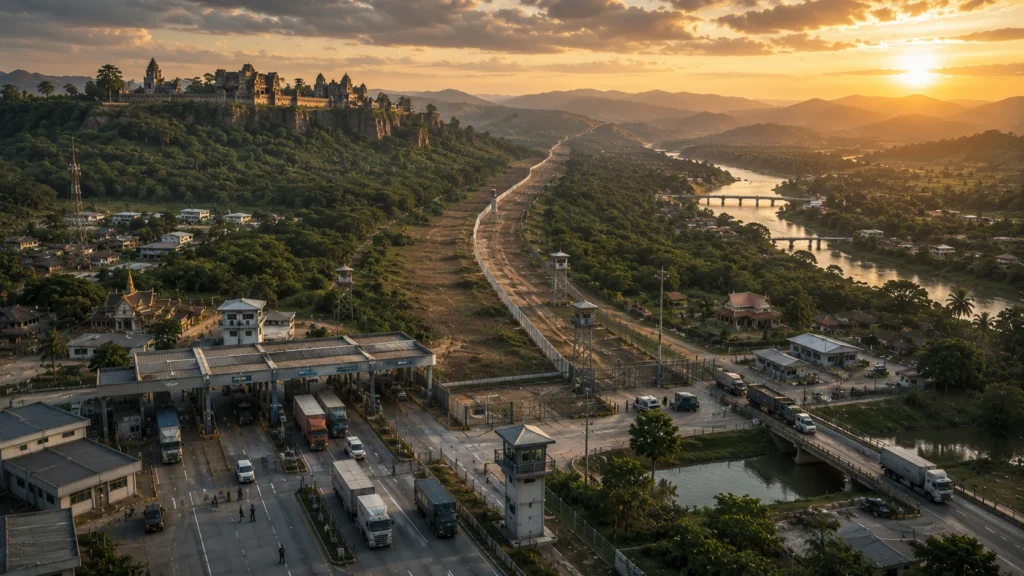
Border Negotiations Restart as Both Sides Return to the Table
Officials from Cambodia and Thailand have restarted formal discussions aimed at reducing tensions along their disputed border.
Representatives from both countries have reopened official channels to address longstanding disagreements over border demarcation, troop positioning, and access to disputed areas. While the specific agenda of the current talks has not been fully disclosed publicly, the fact that structured dialogue has resumed after a prolonged standoff is itself a significant shift in posture.
The border between Cambodia and Thailand stretches for roughly 800 kilometers and includes several sensitive zones where historical claims overlap and physical markers remain contested. Past incidents along this border, including the armed clashes near the Preah Vihear temple complex in 2011, demonstrate how quickly localized friction can escalate into something more serious. The current decision to prioritize negotiation over military pressure suggests both capitals are aware of those precedents.
Diplomatic Engagement Replaces Military Pressure
Both governments are now emphasizing dialogue after months of elevated security concerns along the shared frontier.
The shift toward diplomacy did not emerge in a vacuum. Both sides had been reinforcing military positions along disputed zones, raising alarm among analysts and neighboring governments watching the standoff develop. The de-escalation appears to reflect a calculation by both Bangkok and Phnom Penh that sustained military posturing carries costs—economic, diplomatic, and political—that outweigh any short-term leverage it might provide.
Thailand, navigating its own domestic political transitions, has limited appetite for an open border dispute that could complicate its standing within ASEAN and its broader diplomatic relationships. Cambodia, for its part, has consistently framed its position in terms of sovereignty and international law, and returning to negotiations allows Phnom Penh to maintain that framing without the risks of military escalation.
The renewed dialogue reflects a broader regional preference for managing disputes through diplomacy rather than prolonged confrontation. That preference is not simply idealistic—it is driven by the practical recognition that unresolved border tensions carry real economic and security costs for both sides.
Why ASEAN’s Stake in This Outcome Is Larger Than It Looks
A peaceful resolution would reinforce confidence in Southeast Asia’s regional conflict management mechanisms.
ASEAN has long operated on the principle that member states manage disputes through consultation rather than coercion. That principle is easier to state than to enforce, and critics have frequently pointed to the bloc’s structural reluctance to apply pressure on members in bilateral disputes. But when two ASEAN members genuinely choose negotiation over escalation, it validates the regional architecture even without formal ASEAN intervention.
A sustained diplomatic process between Cambodia and Thailand would demonstrate that the bloc’s norms have internalized to the point where governments default to dialogue as the first response—not the last resort. That matters particularly now, as Southeast Asia continues to manage competing pressures from China, the United States, and other external actors who all have interests in how regional disputes are handled.
What Stability Along the Border Means for Local Communities
Improved security conditions could support cross-border trade, tourism, and economic activity in border regions on both sides.
The people most immediately affected by border tensions are rarely the ones setting policy. Communities along the Cambodia-Thailand border depend on cross-border commerce, movement, and in some areas shared infrastructure. When military positioning intensifies, informal trade routes close, movement becomes restricted, and economic activity contracts quickly.
A return to stable conditions creates room for these flows to resume. Border markets, tourism connected to temple sites and natural areas, and agricultural trade all benefit from predictability. For rural communities that have limited alternatives, that predictability is not an abstraction—it is the difference between a functioning local economy and one operating under constant disruption.
Territorial Disputes That Predate the Current Talks Remain Unresolved
Decades of overlapping historical claims continue to shape how both governments approach the border, even as diplomacy resumes.
Restarting talks should not be confused with resolving the underlying issues. The territorial disputes between Cambodia and Thailand are rooted in colonial-era boundary agreements, divergent interpretations of historical maps, and in some cases competing claims over specific landmarks and access routes. These disagreements have persisted through multiple rounds of negotiations over decades.
The Preah Vihear dispute, which reached the International Court of Justice in 1962 and returned there in 2013, illustrates how durable these tensions can be. Even with legal rulings in place, implementation and interpretation continue to generate friction. The current talks are taking place against that backdrop, which means expectations about rapid resolution should remain grounded.
Confidence-Building Steps That Could Reduce the Risk of Future Incidents
Both governments are exploring practical measures to manage the border more predictably and prevent accidental escalation.
Beyond the formal negotiation process, both sides are reportedly considering practical confidence-building steps—mechanisms such as communication hotlines between military commanders, agreed protocols for troop movements near sensitive zones, and joint patrols in select areas. These are unglamorous but effective tools for reducing the risk that a minor incident becomes something harder to contain.
This kind of institutional friction-reduction is where diplomacy often does its most durable work. High-level statements matter for signaling intent, but it is the operational-level agreements—who calls whom when troops come within range of each other—that prevent miscalculation.
Southeast Asia Is Watching, and the Precedent Matters
The Cambodia-Thailand negotiations are being observed carefully across the region. Several ASEAN members are managing their own unresolved bilateral tensions, and how this particular process unfolds will inform how other governments assess the viability of diplomatic engagement over confrontation.
This story receives less international coverage than it deserves. While competition among major powers dominates the headlines, the capacity of neighboring states to pull back from the edge of a territorial dispute and negotiate in good faith is equally important for regional order. If these talks hold and produce even incremental progress, they offer something concrete: evidence that Cambodia and Thailand resume border talks after months of military tension not because they were forced to, but because diplomacy remained a credible option. That, in itself, is worth tracking.