Rare Earth Competition Intensifies — The Hidden Battle Behind Modern Technology

Every smartphone, wind turbine, and military radar system depends on a handful of obscure minerals most people have never heard of. Yet these rare earth elements have quietly become the foundation of technological civilization—and the center of an escalating global power struggle that could reshape the world economy.

The global economy underestimated how dependent advanced technology is on a fragile resource network. That realization is now driving a new wave of geopolitical competition as nations scramble to secure access to materials that determine whether they can compete in the 21st century.

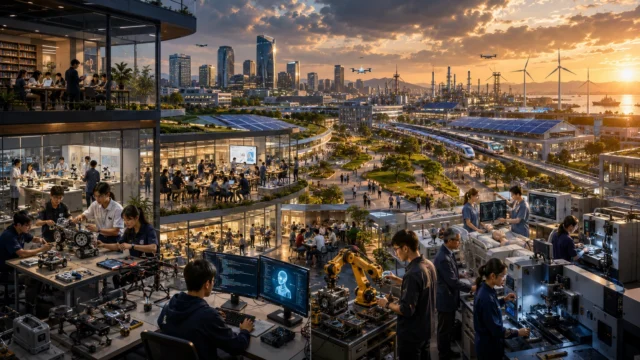
Rare earth minerals and advanced technologies including electric vehicles, robotics, and electronics, illustrating growing competition over critical resources.


Why Rare Earth Minerals Have Become Critical to Global Power

Seventeen chemical elements buried deep in the periodic table now determine which nations can build the technologies that define modern life. Neodymium powers the permanent magnets in electric vehicle motors. Europium creates the red phosphors in LED displays. Terbium enables the precision guidance systems in advanced weaponry.

These materials aren’t actually rare in geological terms, but they’re dispersed in low concentrations and require complex extraction processes. More importantly, they’ve become indispensable to virtually every advanced technology sector. Defense contractors need them for missile guidance systems and stealth aircraft. Renewable energy companies can’t build efficient wind turbines or solar panels without them. Consumer electronics manufacturers rely on them for everything from smartphone screens to laptop batteries.

The Technology Dependence Goes Deeper Than Most Realize

The scope of rare earth dependence extends far beyond consumer gadgets. Modern military systems are particularly vulnerable—a single F-35 fighter jet contains over 920 pounds of rare earth materials. Electric vehicle batteries require lithium, cobalt, and rare earth elements in precise combinations. Even seemingly simple technologies like energy-efficient light bulbs depend on rare earth phosphors to function properly.

China’s Dominance Creates Uncomfortable Dependencies

One country controls roughly 60% of global rare earth mining and an even larger share of processing capabilities. China’s dominance didn’t happen by accident—it represents decades of strategic investment while other nations treated these materials as niche commodities.

Beijing’s position becomes more concerning when considering the processing bottleneck. Even rare earths mined elsewhere often get shipped to China for refining because other countries dismantled their processing infrastructure or never developed it at scale. This creates a dependency that goes beyond simple mining statistics.

The strategic implications became clear in 2010 when China temporarily restricted rare earth exports during a territorial dispute with Japan. Prices spiked, supply chains froze, and governments suddenly realized they had outsourced control over critical materials to a single supplier.

Export Controls Signal Growing Resource Nationalism

Recent export restrictions on gallium and germanium—materials essential for semiconductor manufacturing—demonstrate how resource control translates into geopolitical leverage. China has shown increasing willingness to use its material advantages as diplomatic tools, particularly as tensions with Western nations escalate over technology transfer and trade practices.

Alternative Supply Sources Face Major Development Challenges

Governments across North America, Europe, and Australia are rushing to develop alternative rare earth sources, but the path forward presents substantial obstacles. The Mountain Pass mine in California, once the world’s largest rare earth producer, is attempting a comeback after environmental problems forced its closure. Australia’s Lynas Corporation has expanded operations, but scaling up takes years and billions in investment.

Processing capabilities represent an even bigger challenge than mining. Building the specialized facilities needed to refine rare earth ores requires enormous capital investment, environmental permits, and technical expertise that few companies possess outside China.

The timeline problem is acute. New mining projects typically require 10-15 years from discovery to production, while processing facilities can take nearly as long to build and optimize. This means any supply diversification efforts starting today won’t meaningfully impact global supply chains until the 2030s.

Technology Companies Scramble to Secure Future Access

Major technology manufacturers are taking unprecedented steps to secure rare earth supplies. Apple has invested in recycling programs to recover rare earths from old devices. Tesla has struck direct deals with mining companies to guarantee lithium and rare earth access for its battery production. Defense contractors are lobbying for government stockpiles and domestic processing capabilities.

Some companies are pursuing substitution strategies, attempting to redesign products around more abundant materials. However, the performance characteristics of rare earths often prove irreplaceable—particularly in applications requiring strong permanent magnets or specific optical properties.

Supply Chain Redesign Proves Complex and Costly

The interconnected nature of global supply chains makes rare earth security particularly challenging. A single smartphone might contain rare earths from multiple countries, processed in China, assembled in Southeast Asia, and sold worldwide. Untangling these dependencies requires coordinated effort across entire industries, not just individual companies.

Environmental Constraints Limit Expansion Options

Rare earth mining and processing generate significant environmental challenges that complicate efforts to diversify supply sources. The extraction process often involves radioactive materials and toxic chemicals. Processing requires enormous amounts of water and energy while producing substantial waste streams.

China’s willingness to accept environmental costs partly explains its market dominance—other countries with rare earth deposits have proven more hesitant to develop them due to regulatory hurdles and public opposition. This creates a paradox where environmental concerns in democratic countries reinforce dependence on potentially less environmentally responsible production elsewhere.

Modern environmental standards make new rare earth operations expensive and time-consuming to develop, even when deposits are known to exist. This regulatory reality constrains how quickly alternative supply sources can come online, regardless of financial investment or political will.

Resource Control Becomes a Tool of Statecraft

Nations are increasingly treating rare earth access as a national security issue rather than a simple trade matter. The United States has designated rare earths as critical materials and created government programs to support domestic production. European Union leaders have launched the Critical Raw Materials Act to reduce import dependencies. Japan has diversified its supply sources and invested in recycling technologies.

Resource nationalism is spreading beyond rare earths to other critical materials. Countries with significant mineral deposits are tightening export controls and demanding more domestic value-added processing before materials can leave their borders.

Strategic Alliances Form Around Material Access

New partnerships are emerging based on resource security rather than traditional trade patterns. The United States has strengthened ties with Australia partly due to its mineral resources. European countries are investing in African mining projects to reduce Chinese dependencies. These resource-focused alliances may prove more durable than conventional diplomatic relationships.

Material Control Will Define Technological Leadership

The rare earth competition highlights how resource security and technological leadership are now deeply interconnected. Nations that control critical material supplies gain significant leverage over global technology development and manufacturing capabilities.

This dynamic extends beyond rare earths to lithium for batteries, cobalt for energy storage, and semiconductor-grade silicon. Countries are discovering that advanced manufacturing capabilities mean little without reliable access to the specialized materials that enable modern technology.

The hidden battle for rare earth control will likely intensify as renewable energy adoption accelerates and military technologies become more sophisticated. Nations that secure diverse, reliable access to these materials will maintain technological advantages, while those that remain dependent on single suppliers face increasing strategic vulnerability in an era where technology determines economic and military power.