The AI War Has Begun — A Global Race for Technological Dominance Is Escalating

Artificial intelligence has quietly moved from Silicon Valley boardrooms to the highest levels of government strategy rooms worldwide. What began as competition between tech companies has evolved into something far more consequential: a defining contest between nations that will reshape global power for decades to come. The AI war has begun — a global race for technological dominance is escalating, and the stakes extend far beyond corporate market share to encompass economic leadership, military superiority, and geopolitical influence.

This represents the most consequential technological competition of our era. Unlike previous industrial races, AI’s capacity to amplify capabilities across multiple domains simultaneously makes it uniquely powerful and uniquely dangerous to fall behind in.

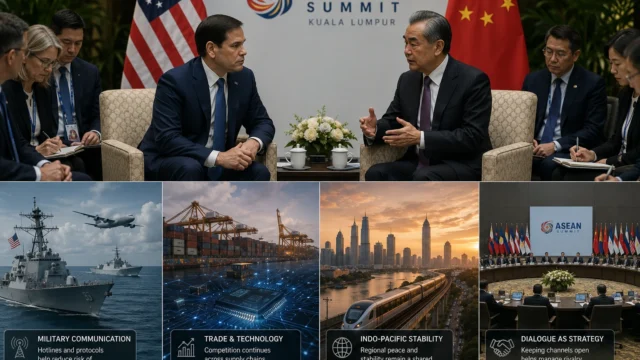
Global competition in artificial intelligence with advanced digital networks and major tech powers racing for technological dominance.
The global race for artificial intelligence supremacy is intensifying, as major powers compete to define the future of technology and influence.

Artificial Intelligence Becomes Central to National Power

Governments across major powers now treat AI development with the same urgency once reserved for nuclear programs or space exploration. The technology’s ability to enhance everything from economic productivity to military capabilities has fundamentally altered how nations calculate their strategic position.

China’s 2017 AI strategy explicitly aimed for global leadership by 2030, backed by state funding exceeding $150 billion. The United States responded with the National AI Initiative and establishment of the National AI Research Resource Task Force. The European Union launched its Digital Decade plan with €20 billion in AI investments through 2027.

This shift reflects a recognition that AI superiority translates directly into multiple forms of power. Nations leading in AI development gain advantages in manufacturing efficiency, financial services innovation, and military technology simultaneously. The multiplier effect makes AI dominance potentially decisive across the entire spectrum of national capabilities.

Strategic Assets Mirror Military Infrastructure

Countries now protect AI capabilities like critical military infrastructure. Export controls on advanced semiconductors, restrictions on AI talent mobility, and classified research programs signal that AI development has moved into the realm of national security policy.

Unprecedented Investment Levels Drive Competition Forward

The scale of current AI spending dwarfs previous technology races. Government and private sector investments combined now exceed $200 billion annually worldwide, with spending accelerating each year as competition intensifies.

China leads in total government AI spending, while the United States maintains advantages in private sector investment and venture capital funding. The European Union has committed to matching these levels through coordinated member state programs and EU-wide initiatives.

Beyond raw spending, nations are restructuring entire research and development ecosystems around AI advancement. New government agencies, university partnerships, and public-private collaborations are emerging specifically to accelerate AI capabilities and maintain competitive edges.

Talent Acquisition Becomes a Priority Spending Category

Countries are offering unprecedented compensation packages and immigration incentives to attract top AI researchers. The competition for human capital has become as intense as the race for technological breakthroughs themselves.

Technology Supply Chains Face Strategic Restructuring

Access to essential AI infrastructure has become heavily politicized, with nations seeking to control key chokepoints in the supply chain. Advanced semiconductor manufacturing, cloud computing resources, and specialized AI chips now receive the same strategic attention once focused on oil supplies or rare earth minerals.

The United States has implemented sweeping export controls on AI-related semiconductors to China, while China has accelerated domestic chip manufacturing through massive state investment. Taiwan’s position as the world’s dominant semiconductor producer has elevated the island’s strategic importance beyond its traditional geopolitical significance.

Data access represents another critical bottleneck. Nations with large domestic markets and fewer privacy restrictions can generate the training data necessary for AI advancement more easily than countries with smaller populations or stricter data protection laws.

Military and Security Applications Accelerate Development Timelines

AI’s military potential has compressed development timelines and elevated the urgency surrounding technological breakthroughs. Autonomous weapons systems, cyber warfare capabilities, and intelligence analysis tools powered by AI offer decisive advantages that can shift military balances rapidly.

The Pentagon’s Joint AI Center and similar organizations in other major powers reflect the integration of AI development into core defense planning. Military contracts now drive significant portions of AI research funding, with defense applications often receiving priority over civilian uses.

Cybersecurity has become another critical domain where AI superiority matters immediately. Nations with more advanced AI-powered defensive and offensive cyber capabilities gain significant advantages in the digital aspects of international competition.

Intelligence Agencies Reshape Operations Around AI

Intelligence services are restructuring their operations to incorporate AI-powered analysis, surveillance, and information warfare capabilities. These applications often push the boundaries of AI development in ways that civilian applications do not.

Global Competition for AI Talent Reaches Fever Pitch

The race to attract and retain top AI researchers has become a central element of national AI strategies. Immigration policies, university funding, and research environment quality now factor directly into geopolitical competitiveness calculations.

Major powers are offering expedited visa processes, substantial research grants, and world-class facilities to AI talent. The concentration of expertise in relatively few individuals makes talent acquisition particularly crucial in this field compared to broader industrial competition.

Brain drain and brain gain patterns in AI research are already reshaping global innovation centers. Countries losing top talent face compounding disadvantages, while nations successfully attracting researchers see accelerating progress across multiple AI domains.

Regulatory Frameworks Become Tools of Strategic Competition

AI governance and regulatory approaches are diverging along geopolitical lines, with nations using different standards and rules to advantage their domestic industries and limit foreign influence.

The European Union’s comprehensive AI regulation focuses on safety and transparency requirements that may disadvantage rapid development models. China’s approach emphasizes state control and social stability applications. The United States has favored lighter regulatory frameworks that prioritize innovation speed and private sector leadership.

These regulatory differences are creating incompatible AI ecosystems that may fragment global technology markets. Standards battles in AI development are becoming proxy competitions for broader technological influence.

Technological Fragmentation Points Toward Divided Systems

The intense competition and security concerns surrounding AI development are pushing the world toward separate, incompatible AI ecosystems rather than integrated global systems. This fragmentation represents a fundamental shift from the interconnected technology development that characterized previous decades.

As nations prioritize control and security over collaboration, the pace of innovation may slow while global tensions increase. The world may not just compete over AI capabilities—it may divide because of them, creating parallel technological systems that limit cross-border cooperation and slow overall human progress in artificial intelligence development.

The AI war’s outcome will determine not just technological leadership, but the fundamental structure of power in the coming decades. Nations that fall behind risk finding themselves permanently disadvantaged across economic, military, and political dimensions simultaneously.